
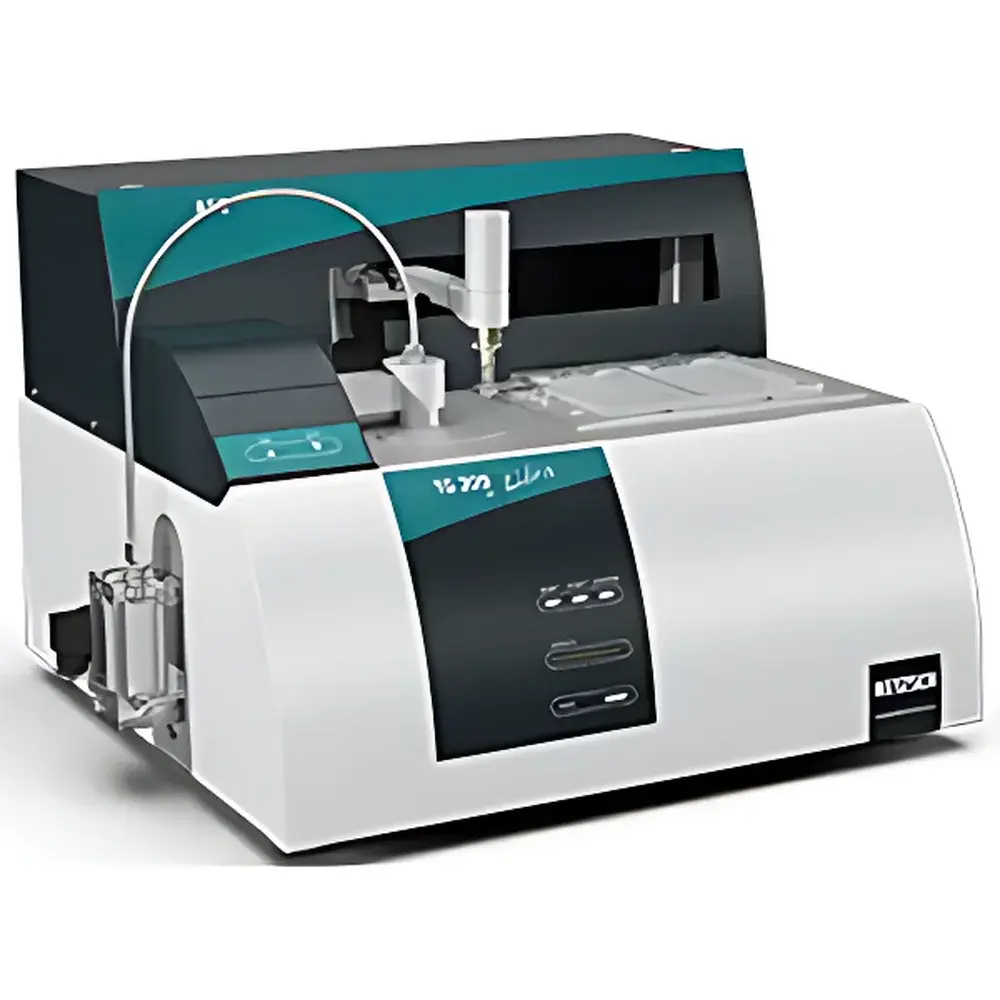
Netzsch TG209F1 Libra Thermogravimetric Analyzer
| Brand | Netzsch |
|---|---|
| Origin | Germany |
| Model | TG209F1 Libra |
| Temperature Range | 10 °C to 1100 °C |
| Temperature Accuracy | ±0.2 K |
| Balance Sensitivity | 0.1 µg |
| Heating/Cooling Rate | 0–200 K/min |
| Cooling Time | <15 min (1100 °C → RT) |
| Vacuum Level | 10⁻² mbar |
| Maximum Sample Mass | 2 g |
| Furnace Material | Corrosion-Resistant Ceramic |
| Baseline Correction | BeFlat® Intelligent Baseline Compensation |
| Differential Thermal Signal | c-DTA® Function |
| Optional Automation | ASC Auto-Sampler (192 positions) |
| Optional Module | Temperature-Modulated TGA (TM-TG) |
Overview
The Netzsch TG209F1 Libra Thermogravimetric Analyzer is a high-precision, top-loading TGA system engineered for rigorous thermal stability and compositional analysis under controlled atmospheric and vacuum conditions. Operating on the fundamental principle of mass change measurement as a function of temperature or time, the instrument employs a microbalance with sub-microgram resolution integrated into a thermally optimized ceramic furnace. Its design conforms to ISO 11358-1 (Plastics — Thermogravimetry — Part 1: General principles) and supports method development aligned with ASTM E1131 and USP <467> for residual solvent and moisture quantification. The TG209F1 Libra delivers reproducible mass loss data across dynamic heating profiles up to 200 K/min and rapid cooling cycles—enabling kinetic modeling of decomposition reactions, oxidation onset detection, and quantitative volatiles assessment in compliance with GLP and GMP laboratory requirements.
Key Features
- Top-loading sample configuration ensures ergonomic operation, minimizes thermal disturbance during loading, and enables rapid access to the crucible without furnace disassembly.
- Corrosion-resistant ceramic furnace provides exceptional thermal homogeneity, long-term dimensional stability, and compatibility with aggressive atmospheres—including halogen-containing gases and acidic vapors—without degradation.
- Vacuum-tight furnace design (10⁻² mbar base pressure) allows precise control of reactive or inert environments, supporting redox studies, pyrolysis under reduced pressure, and moisture-free thermal characterization.
- Integrated constant-temperature water bath stabilizes the microbalance suspension system, suppressing thermal drift and ensuring baseline fidelity over extended runs (>24 h).
- Modular sample holder system accommodates standard Pt, Al₂O₃, and quartz crucibles, as well as specialized holders for fiber, powder, or film samples—facilitating method transfer across material classes.
- BeFlat® intelligent baseline compensation algorithm automatically corrects for buoyancy effects and thermal expansion artifacts using reference measurements, eliminating manual baseline subtraction.
- c-DTA® functionality generates a differential thermal signal synchronized with mass loss, enabling simultaneous detection of endo-/exothermic events (e.g., melting, crystallization) alongside decomposition steps—without requiring a separate DSC instrument.
Sample Compatibility & Compliance
The TG209F1 Libra accepts solid, powdered, granular, and thin-film specimens up to 2 g. It supports quantitative determination of moisture, solvents, plasticizers, fillers, and inorganic residues in polymers, pharmaceuticals, catalysts, battery materials, and composites. All hardware and software comply with ISO/IEC 17025 calibration traceability requirements. Data acquisition and reporting modules meet FDA 21 CFR Part 11 criteria when configured with audit trail, electronic signatures, and user-access controls—making it suitable for regulated QC/QA laboratories in pharma, medical device, and aerospace sectors.
Software & Data Management
Proteus® Software v9.x provides full instrument control, real-time visualization, and post-run analysis including derivative thermogravimetry (DTG), multi-step kinetic modeling (e.g., Friedman, Ozawa-Flynn-Wall), and composition deconvolution. The proprietary TGA Spectral Search Engine allows pattern-based matching against an embedded database of >1,200 reference curves for rapid material identification. Raw data are stored in vendor-neutral ASCII and HDF5 formats; export options include CSV, PDF reports with metadata embedding, and direct integration into LIMS via OPC UA or RESTful API interfaces.
Applications
- Thermal stability assessment of polymer blends and flame-retardant formulations per IEC 60695-1-10.
- Quantitative moisture and residual solvent analysis in active pharmaceutical ingredients (APIs) and excipients per USP <467> and Ph. Eur. 2.2.44.
- Decomposition kinetics of metal-organic frameworks (MOFs) and battery cathode materials under N₂ or air.
- Oxidation onset temperature (OOT) determination for lubricants and transformer oils per ASTM D943 and D2440.
- Char yield and ash content measurement in coal, biomass, and carbon composites per ASTM D3174 and ISO 1171.
- In-process monitoring of catalyst deactivation and coke formation via sequential TGA-MS coupling.
FAQ
What atmosphere options are supported?
The system operates under inert (N₂, Ar), oxidative (air, O₂), reducing (H₂/N₂), or vacuum conditions—configurable via mass flow controllers and vacuum pump interface.
Is c-DTA® equivalent to conventional DSC?
No. c-DTA® is a calculated signal derived from furnace temperature gradients and sample heat capacity changes—not a true heat-flow measurement. It serves as a qualitative complement to mass loss, not a replacement for calibrated DSC.
Can the TG209F1 Libra be coupled to GC-MS or FTIR?
Yes. It features standardized gas outlet ports and temperature-controlled transfer lines compatible with commercial hyphenated systems (e.g., Netzsch STA-GC-MS, Bruker HYPERION FTIR).
What validation documentation is provided?
Each unit ships with factory calibration certificates for temperature (ITS-90 traceable), mass (NIST-traceable weights), and furnace homogeneity—plus IQ/OQ protocols compliant with ISO 17025 and GAMP5 guidelines.
Is remote operation supported?
Proteus® includes secure remote desktop access and browser-based status monitoring via optional Netzsch Cloud Connect module—subject to local IT security policy approval.



