
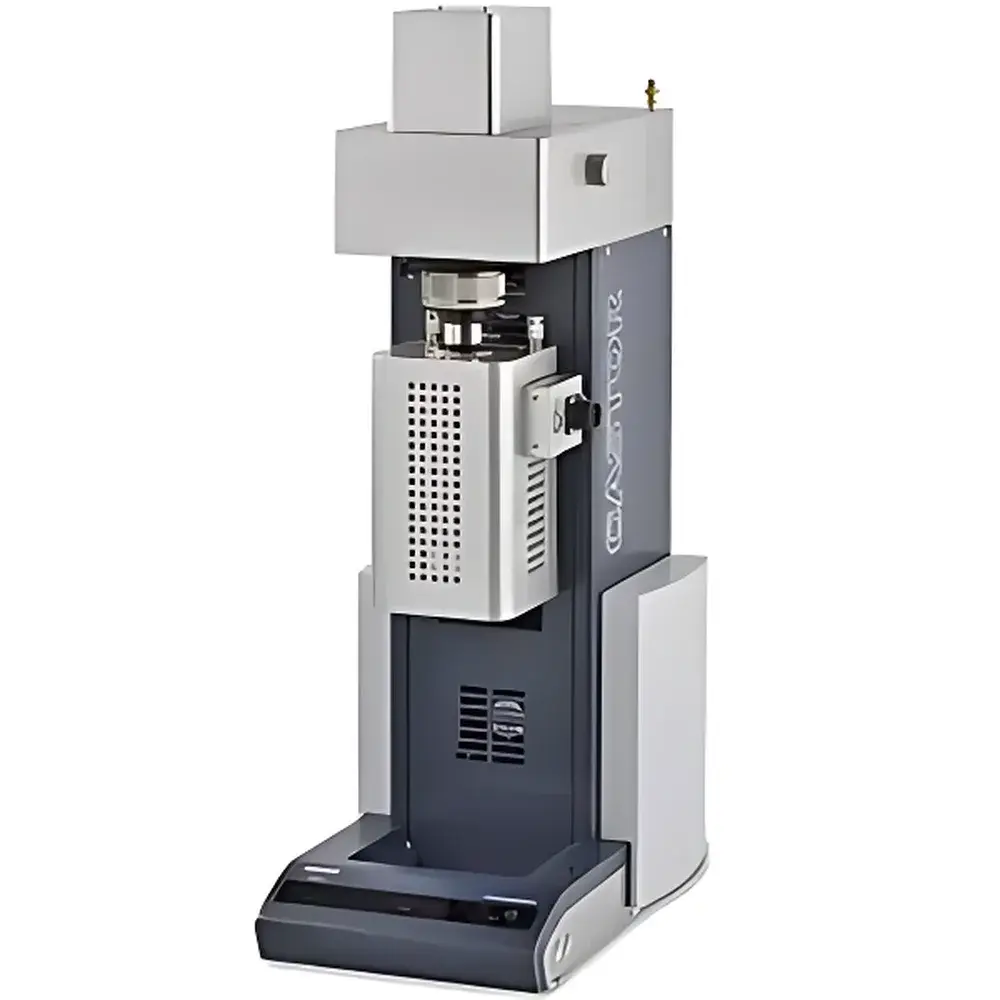
NETZSCH TMA 4000 SE Thermomechanical Analyzer
| Brand | NETZSCH |
|---|---|
| Origin | Germany |
| Model | TMA 4000 SE |
| Temperature Range | –150 to 1700 °C |
| Temperature Accuracy | ±0.1 °C |
| Force Range | 0–4.9 N |
| Displacement Range | ±2.5 mm |
| Dynamic Frequency Range | 0.01–0.5 Hz |
| Measurement Modes | Expansion, Compression, Tension, Penetration, Bending, Dynamic Oscillation, Curing |
| Load Profiles | Constant Force, Sinusoidal (0.01–0.5 Hz), Triangular (0.01–0.2 Hz), Rectangular (0.01–0.1 Hz), Ramp Force (0–0.49 N/min) |
| Deformation Modes | Constant Strain, Strain Ramp (0–50 mm/min), Combined Modes |
Overview
The NETZSCH TMA 4000 SE is a high-precision thermomechanical analyzer engineered for quantitative measurement of dimensional changes in solid and semi-crystalline materials under controlled thermal and mechanical stimuli. Operating on the principle of contact-based linear displacement detection with active force control, the instrument applies calibrated mechanical loads while subjecting samples to precisely programmed temperature ramps, isotherms, or dynamic thermal cycles. Its extended temperature range—from cryogenic conditions at –150 °C up to ultra-high temperatures of 1700 °C—enables characterization across polymer glass transitions, ceramic sintering stages, metal phase transformations, and composite interfacial relaxation phenomena. Designed for traceable metrology in regulated environments, the system integrates platinum resistance thermometry (PRT) with dual-sensor thermal calibration and closed-loop furnace control to maintain ±0.1 °C temperature accuracy across its full operational span.
Key Features
- Modular sensor head architecture supporting interchangeable probe geometries: expansion rods, compression plates, tensile clamps, penetration needles, and bending fixtures.
- Electromagnetic force actuator with real-time digital feedback, enabling precise force application from 0.1 mN to 4.9 N with sub-mN resolution.
- Dual-range capacitive displacement transducer offering ±2.5 mm full-scale range with nanometer-level resolution and linearity better than 0.1% FS.
- Dynamic mechanical profiling capability: sinusoidal, triangular, and rectangular waveforms between 0.01 and 0.5 Hz—fully programmable via time-temperature-force matrices.
- High-stability vertical furnace with three-zone heating control, optimized gas purge compatibility (N₂, Ar, air, forming gas), and integrated quartz or alumina sample holders.
- Auto-calibration routines for thermal expansion coefficient (CTE), zero-point drift compensation, and mechanical compliance correction using certified reference materials (e.g., fused silica, Invar, Al₂O₃).
Sample Compatibility & Compliance
The TMA 4000 SE accommodates diverse material forms—including powders, fibers, films (≥5 µm thick), bulk ceramics, metallic alloys, thermosets, elastomers, and multilayer laminates—without requiring metallization or conductive coating. Sample mounting follows ISO 11359-2 and ASTM E831 guidelines for thermomechanical analysis. All firmware and data acquisition modules comply with GLP/GMP documentation requirements, supporting 21 CFR Part 11–compliant electronic signatures, audit trails, and user-access hierarchy management. Calibration certificates are traceable to PTB (Physikalisch-Technische Bundesanstalt) standards, and system validation packages include IQ/OQ documentation templates aligned with pharmaceutical and aerospace quality systems.
Software & Data Management
Control and analysis are executed through NETZSCH Proteus® Software v9.x, a platform validated for laboratory information management system (LIMS) integration. The software provides synchronized multi-channel acquisition (temperature, force, displacement, time), automated baseline subtraction, derivative CTE calculation, kinetic modeling (e.g., isoconversional analysis), and modulus extraction from dynamic oscillation data. Raw data files (.ASC) are stored in ASCII format with embedded metadata (instrument ID, operator, method version, calibration timestamp). Export options include CSV, PDF reports with embedded uncertainty budgets, and direct linkage to MATLAB®, Python (via .NET API), and statistical process control (SPC) platforms. Data integrity safeguards include write-once-read-many (WORM) archive mode and SHA-256 hash logging.
Applications
- Quantification of linear thermal expansion coefficients (CTE) in packaging films and encapsulation resins for microelectronics reliability assessment.
- Analysis of softening behavior and filler-matrix debonding onset in fiber-reinforced composites during post-cure cycling.
- Characterization of sintering shrinkage kinetics and densification onset temperatures in advanced ceramics and MIM (metal injection molding) feedstocks.
- Evaluation of viscoelastic recovery and stress relaxation in shape-memory polymers under constrained thermal cycling.
- Determination of glass transition (Tg), cold crystallization (Tcc), and melting (Tm) endpoints in semi-crystalline thermoplastics via simultaneous DSC-TMA hybrid methods.
- Measurement of interfacial adhesion degradation in coated steel substrates exposed to thermal-humidity aging per ASTM D3359 and ISO 4624 protocols.
FAQ
What temperature calibration standards are supported for traceability?
Certified reference materials including NIST SRM 736 (sapphire), SRM 735 (Invar), and PTB-certified fused silica rods are preloaded in Proteus® calibration libraries.
Can the TMA 4000 SE operate under vacuum or reactive atmospheres?
Yes—the furnace chamber supports vacuum down to 10⁻² mbar and gas flow rates from 20–200 mL/min with optional mass flow controllers and gas-switching modules.
Is dynamic mechanical data exportable for rheological modeling?
Displacement and force time-series data are fully exportable in SI units; storage modulus (E′), loss modulus (E″), and tan δ can be derived using built-in Fourier transform routines or third-party viscoelastic modeling tools.
How is mechanical compliance corrected during high-temperature measurements?
Proteus® applies automatic probe-and-furnace thermal expansion compensation using pre-measured system-specific compliance curves, updated with each firmware revision.
Does the system support automated sample changers?
The TMA 4000 SE is compatible with the NETZSCH ASC 16 robotic autosampler for unattended sequential analysis of up to 16 samples under identical thermal protocols.



