
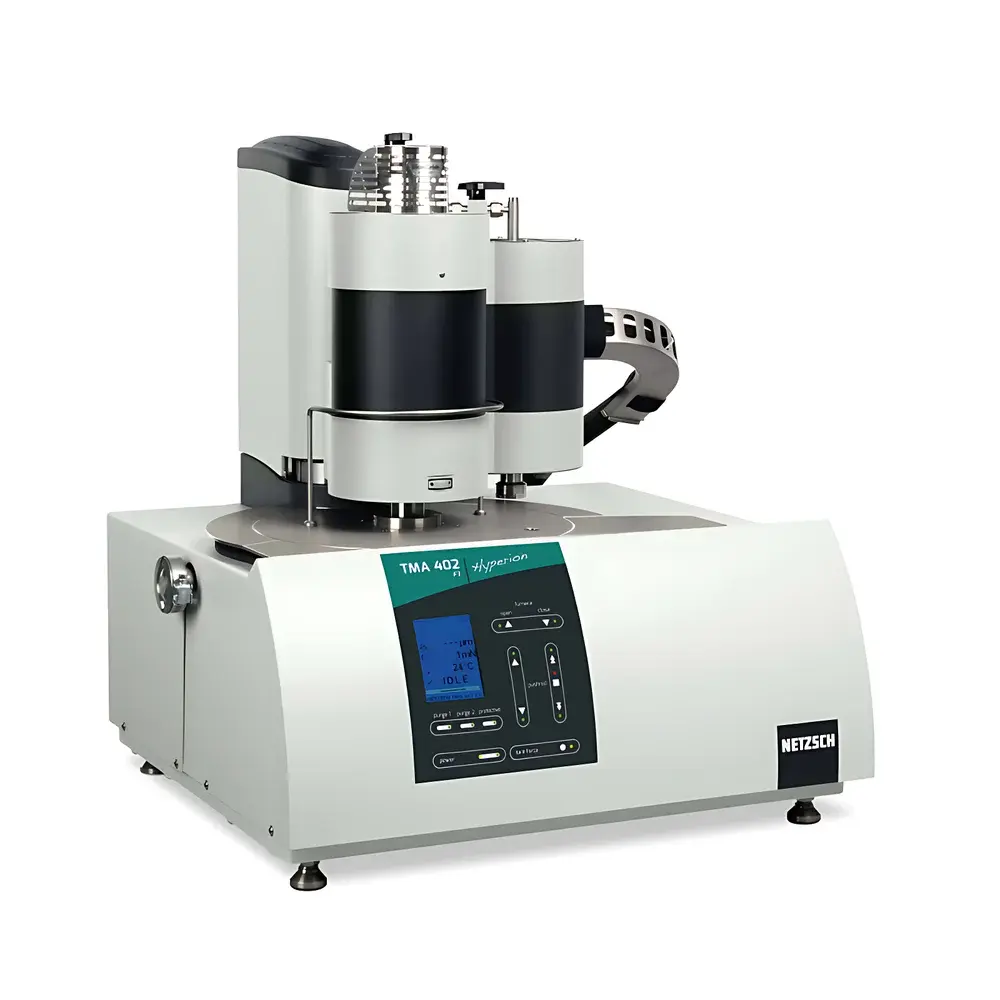
Netzsch TMA 402 F1 Hyperion Thermomechanical Analyzer
| Brand | Netzsch |
|---|---|
| Origin | Germany |
| Model | TMA 402 F1 Hyperion |
| Temperature Range | −150 °C to 1550 °C (with interchangeable furnaces) |
| Temperature Accuracy | ±0.1 °C |
| Force Range | ±3 N |
| Displacement Range | ±2.5 mm |
| Displacement Resolution | 1.25 nm |
| Force Resolution | 0.01 mN |
| Heating Rate | 0–50 °C/min |
| Vacuum Level | 10⁻⁴ mbar |
| Measurement Atmospheres | Oxidizing, Reducing, Inert, Vacuum |
| Dual-Furnace Capability | Yes |
| Compatible with DSC/STA Furnaces | Yes |
| Dynamic Force Mode | Optional |
| Rate-Controlled Sintering (RCS) | Optional |
Overview
The Netzsch TMA 402 F1 Hyperion is a high-precision thermomechanical analyzer engineered for quantitative dimensional change measurements under controlled thermal and mechanical conditions. It operates on the principle of contact-based dilatometry, applying calibrated static or dynamic forces to solid or semi-solid samples while precisely monitoring dimensional response (expansion, contraction, creep, or stress relaxation) across an exceptionally broad temperature range—from cryogenic −150 °C to ultra-high temperatures up to 1550 °C. Its modular furnace architecture enables seamless adaptation to diverse material classes, including polymers, ceramics, metals, composites, and glasses. The system’s core architecture integrates a high-stiffness mechanical frame, vacuum-tight furnace enclosure, and low-noise electromagnetic force actuation—ensuring minimal thermal drift and exceptional signal-to-noise ratio in displacement detection. Designed for laboratories requiring traceable, reproducible thermo-mechanical data, the TMA 402 F1 supports both routine quality control and advanced research into viscoelastic transitions, sintering kinetics, and high-temperature modulus evolution.
Key Features
- Interchangeable furnace modules—including low-temperature cryo-furnace, standard quartz furnace, and high-temperature SiC or Pt/Rh furnace—enabling application-specific thermal coverage without hardware replacement.
- Dual-furnace mounting capability: The main instrument frame accommodates two furnaces simultaneously, allowing rapid switching between temperature regimes without realignment or recalibration.
- Ultra-high-resolution capacitive displacement sensor with 1.25 nm resolution and ±2.5 mm full-scale range, delivering sub-nanometer stability over extended measurement durations.
- Vacuum-sealed furnace chamber (≤10⁻⁴ mbar), compatible with evolved gas analysis (EGA) coupling via heated transfer lines to FTIR or MS systems for simultaneous structural and compositional characterization.
- Electronically regulated force application system supporting static load, linear ramp, step-load, and optional dynamic force modulation (up to 1 Hz), enabling viscoelastic property extraction (e.g., compliance, modulus, time–temperature superposition).
- Multi-mode mechanical testing: Compression, penetration, bending, and tensile configurations—each with dedicated probe geometries and sample holders optimized for film, fiber, powder, or bulk specimens.
Sample Compatibility & Compliance
The TMA 402 F1 accommodates a wide morphological spectrum: rigid rods, thin films (<5 µm), ceramic green bodies, metallic wires, polymer fibers, and composite laminates. Sample mounting is standardized per ISO 11359-2 and ASTM E831 guidelines for coefficient of linear expansion (CTE) determination. The system supports GLP-compliant operation through configurable audit trails, electronic signatures, and user-access controls aligned with FDA 21 CFR Part 11 requirements when used with Proteus® software. All furnace atmospheres—including synthetic air, N₂, Ar, H₂/N₂ mixtures, and high-vacuum—are programmable with mass-flow controller integration, ensuring repeatability across oxidation, reduction, and inert environments per ISO 80004 and IEC 60068-2-1/2/14 standards.
Software & Data Management
Controlled exclusively via Netzsch Proteus® software, the TMA 402 F1 provides fully integrated instrument management, method scripting, real-time data visualization, and automated report generation. Proteus® implements hierarchical user permissions, method validation templates, and raw-data encryption compliant with ISO/IEC 27001 principles. Measurement data are stored in vendor-neutral .tdms format, supporting third-party post-processing in MATLAB®, Python (via PyTMA), or commercial CAE platforms. Built-in routines include CTE calculation (dL/dT), Tg/Ts onset/inflection detection per ASTM E1356, modulus derivation from force–displacement loops, and RCS-derived densification rate modeling. All calibration records, maintenance logs, and environmental metadata are embedded within each dataset for full traceability.
Applications
- Determination of glass transition (Tg), softening (Ts), and melting onset temperatures in thermoplastics, elastomers, and amorphous inorganic materials.
- Linear and volumetric coefficient of thermal expansion (CTE/α) quantification for packaging substrates, aerospace alloys, and MEMS packaging materials.
- Creep and stress-relaxation behavior assessment in high-performance polymers under sustained load at elevated temperatures.
- Ceramic and powder metallurgy process development—monitoring shrinkage kinetics, pore closure, and densification rates during sintering via Rate-Controlled Sintering (RCS) mode.
- Thermo-mechanical stability evaluation of battery electrode coatings, fuel cell membranes, and thermal interface materials (TIMs) under thermal cycling.
- High-temperature Young’s modulus tracking in refractory composites and superalloys using dynamic force protocols and isostrain analysis.
FAQ
What temperature accuracy is guaranteed across the full operating range?
Temperature accuracy is maintained at ±0.1 °C throughout the −150 °C to 1550 °C span, verified via NIST-traceable platinum resistance thermometer (PRT) calibration and multi-point furnace mapping.
Can the TMA 402 F1 be used for dynamic mechanical testing?
Yes—when equipped with the optional Dynamic Force Module, it performs oscillatory measurements up to 1 Hz, enabling time-resolved compliance and modulus spectra under controlled strain or stress amplitude.
Is furnace interchangeability limited to TMA-specific units?
No—the furnace design follows Netzsch’s universal mounting interface, allowing direct compatibility with DSC 214 Polyma and STA 449 F5 Jupiter furnaces, reducing lab-wide consumables inventory.
How is data integrity ensured during long-duration high-temperature experiments?
Proteus® software enforces automatic data backup every 30 seconds, monitors thermal stability thresholds in real time, and triggers emergency cooldown if deviation exceeds ±0.5 °C from setpoint for >60 s.
Does the system support automated sample loading?
While not equipped with robotic autosamplers, the dual-furnace configuration and quick-release probe mechanisms enable manual high-throughput screening with <90-second average turnaround between samples.



