
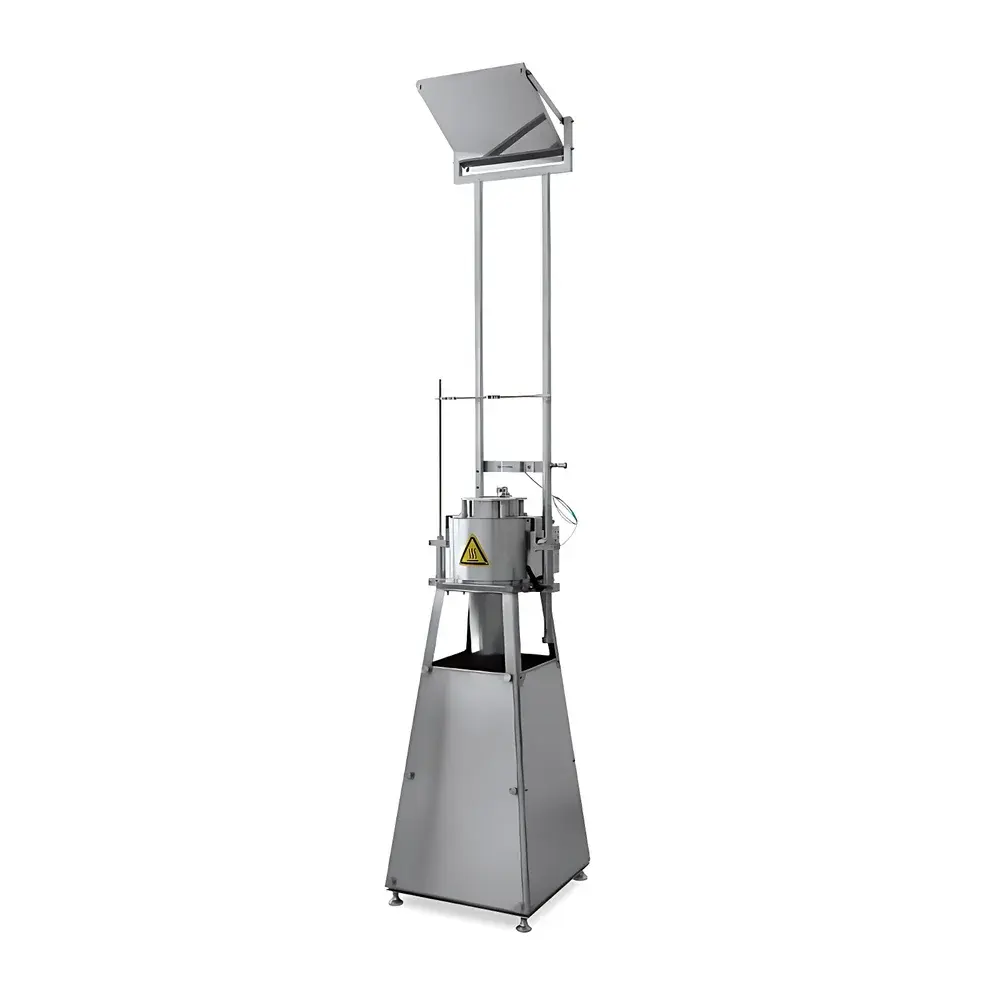
Netzsch TNB Non-Combustibility Furnace
| Brand | Netzsch |
|---|---|
| Origin | Germany |
| Model | TNB Non-Combustibility Furnace |
| Compliance | ISO 1182, EN 13501-1, GB 8624 |
| Chamber Material | Stainless Steel |
| Viewing Mirror | 300 × 320 mm, 30° tilt |
| Thermocouple Type | Armored N- or K-type |
| Temperature Range | Up to 1300 °C |
| Resolution | 0.1 K with Cold-Junction Compensation |
| Integrated Control Unit | Single-board computer with 32 GB SSD |
| Data Interface | USB and Ethernet |
| Heating Control | Digital linear ramping with real-time monitoring |
Overview
The Netzsch TNB Non-Combustibility Furnace is a precision-engineered thermal test system designed for the standardized determination of non-combustibility in construction materials according to internationally recognized fire safety protocols. Based on the principle of controlled, linear furnace heating under defined ambient and specimen conditions, the TNB furnace subjects test specimens—such as gypsum boards, mineral wool insulation, fiber-cement panels, and other building products—to sustained high-temperature exposure (up to 1300 °C) while continuously monitoring temperature evolution, mass loss, and flame occurrence. Its operation aligns strictly with the gravimetric and thermometric requirements of ISO 1182 “Reaction to fire tests — Non-combustibility test”, serving as a foundational assessment within the Euroclass classification system (EN 13501-1) and China’s national standard GB 8624 for fire performance grading of building materials.
Key Features
- Stainless steel furnace housing with corrosion-resistant finish ensures long-term structural integrity and thermal stability under repeated high-temperature cycles.
- Digital linear temperature ramp control maintains precise heating profiles per ISO 1182 Annex A, minimizing thermal overshoot and extending heating element service life.
- Integrated armored N- or K-type thermocouples provide traceable, cold-junction-compensated measurements with 0.1 K resolution across the full 0–1300 °C range.
- Front-mounted, tilting (30°) metal mirror enables safe, real-time visual observation of specimen behavior—including glowing, charring, or flaming—without compromising chamber integrity or operator safety.
- Onboard single-board computer with 32 GB solid-state storage logs time-synchronized temperature, mass change, and event flags at user-configurable intervals, supporting audit-ready data retention.
- Native USB 2.0 and Ethernet interfaces enable direct connection to laboratory networks, facilitating automated data export in CSV, XML, and PDF report formats compliant with internal QA workflows.
Sample Compatibility & Compliance
The TNB furnace accommodates standard cylindrical specimens (45 mm diameter × 50 mm height) prepared from rigid or semi-rigid construction materials including calcium silicate boards, rockwool slabs, perlite-based plasters, and cement-bonded particleboards. Specimen mounting fixtures conform to ISO 1182 mechanical requirements, ensuring reproducible positioning relative to thermocouple probes and airflow boundaries. All system-level calibration, verification, and operational procedures are documented to support GLP-compliant testing environments. The instrument meets essential requirements of the EU Construction Products Regulation (CPR) and provides traceable evidence for CE marking documentation packages. It is routinely validated in third-party accredited laboratories for participation in interlaboratory comparison studies coordinated by CEN/TC 127 and national fire research institutes.
Software & Data Management
Furnace operation and data acquisition are managed via Netzsch’s proprietary TNB Control Suite—a Windows-based application supporting both local touchscreen interaction and remote desktop access. The software implements role-based user permissions, electronic signatures, and full 21 CFR Part 11–compliant audit trails—including timestamped records of method changes, calibration events, and raw data exports. All measurement sequences are stored with embedded metadata (operator ID, environmental conditions, calibration certificate IDs), enabling seamless integration into LIMS platforms via standard OPC UA or RESTful API endpoints. Raw datasets include synchronized thermocouple readings, furnace power consumption, and optional mass loss signals when interfaced with external microbalances.
Applications
- Classification of building products into Euroclass A1 (non-combustible) or A2 categories per EN 13501-1.
- Pre-certification screening of novel insulation composites prior to full-scale reaction-to-fire testing (e.g., SBI or room corner tests).
- Quality assurance of mineral-based substrates in manufacturing facilities producing fire-rated ceiling tiles or façade cladding systems.
- Research into thermal decomposition kinetics of inorganic binders and refractory additives under oxidative atmospheres.
- Technical due diligence for green building certification schemes (e.g., LEED, BREEAM) requiring verified non-combustibility declarations.
FAQ
Which standards does the TNB furnace directly support?
ISO 1182, EN 13501-1 Annex A, and GB 8624–2012 Clause 5.1 for non-combustibility classification.
Can the TNB furnace be integrated into an existing laboratory network?
Yes—via built-in Ethernet (TCP/IP) and USB 2.0 ports, supporting both local data transfer and centralized LIMS synchronization.
Is routine calibration required, and how is it performed?
Annual verification using NIST-traceable reference thermocouples and certified fixed-point cells (e.g., Al₂O₃, Co-C) is recommended; procedures are detailed in the included Calibration Manual.
What safety certifications apply to the TNB furnace?
It complies with IEC 61010-1 for electrical safety and EN 60519-12 for industrial electroheating equipment, with CE marking valid for the EU market.
Does the system support automated reporting for regulatory submissions?
Yes—predefined report templates generate PDF outputs containing test parameters, raw curves, pass/fail determinations, and digital signatures aligned with ISO/IEC 17025 documentation requirements.



