
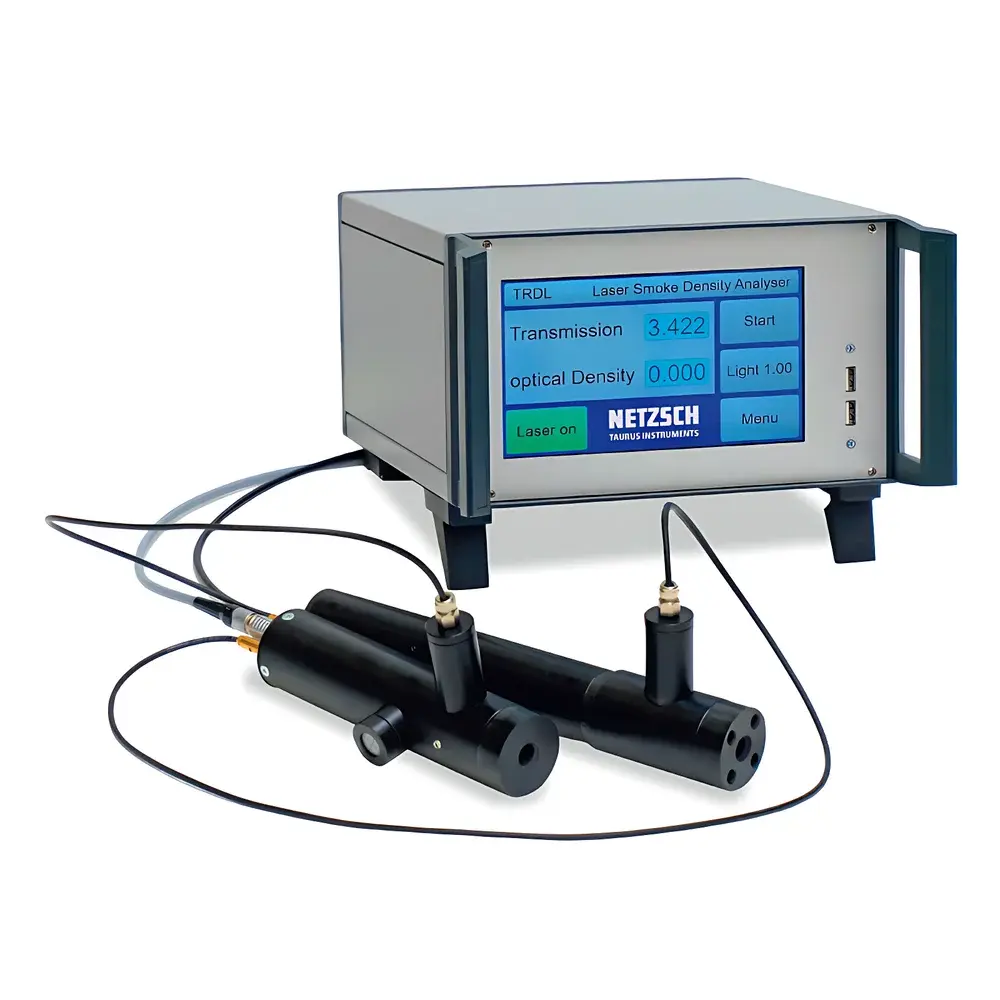
Netzsch TRDL Helium-Neon Laser Smoke Density Tester
| Brand | Netzsch |
|---|---|
| Origin | Germany |
| Model | TRDL Helium-Neon Laser Smoke Density Tester |
| Light Source | He–Ne laser (632.8 nm) |
| Optical Path Length | 10 m (unobstructed) |
| Calibration Filters | Neutral density filters with OD 0.3 and 0.8 |
| Compliance | ISO 5660-2, ASTM E662, NFPA 265, UL 94, IEC 60695-2-2 |
| Interface | USB + RS232 |
| Control System | Integrated single-board computer with Windows OS, high-resolution color touchscreen, TRDL proprietary software |
Overview
The Netzsch TRDL Helium-Neon Laser Smoke Density Tester is a precision optical instrument engineered for quantitative measurement of smoke obscuration during material combustion under controlled fire conditions. It operates on the fundamental principle of laser light attenuation—specifically, the Beer–Lambert law—using a stabilized 632.8 nm helium–neon (He–Ne) laser as its monochromatic light source. As smoke particles generated in standardized fire tests pass through the 10-meter unobstructed optical path, the reduction in transmitted laser intensity is converted into optical density (OD), enabling calculation of specific optical density (Ds) over time. This metric is critical for evaluating smoke generation propensity—a key parameter in fire safety engineering for building materials, transportation interiors (e.g., automotive and rail composites), and insulated cables. The TRDL system is not a standalone chamber but a core optical subsystem designed to integrate seamlessly with standard fire test apparatuses—including cone calorimeters (per ISO 5660-2), radiant panel testers (ASTM E662), and large-scale room-corner or cable tray configurations (NFPA 265, IEC 60332-3). Its German-engineered optical architecture ensures long-term beam stability, minimal thermal drift, and high reproducibility across repeated thermal cycles.
Key Features
- Stabilized He–Ne laser source (632.8 nm) with <±0.01 nm wavelength tolerance and <0.5% power fluctuation over 8-hour operation
- Integrated single-board computer running embedded Windows OS, eliminating dependency on external PCs for real-time acquisition and display
- High-brightness, capacitive multi-touch color display (≥1024 × 768 resolution) with intuitive GUI optimized for lab technicians and fire testing personnel
- Dual communication interfaces: USB 2.0 for local data export and RS232 for legacy system integration with calorimeters or environmental chambers
- Factory-calibrated neutral density reference filters (OD 0.3 and OD 0.8) traceable to PTB (Physikalisch-Technische Bundesanstalt) standards
- Rugged aluminum housing with IP54-rated enclosure, suitable for laboratory and accredited fire testing facilities adhering to ISO/IEC 17025 requirements
Sample Compatibility & Compliance
The TRDL system supports specimens conforming to major international fire-test standards. It is routinely deployed in conjunction with ISO 5660-2 cone calorimeter setups for small-scale material evaluation, ASTM E662 radiant panel smoke tests for vertical specimens, and NFPA 265 full-scale room-corner fire simulations for wall/ceiling assemblies. For cable applications, it interfaces with IEC 60332-3-compliant burner arrays to quantify smoke release from bundled polymer-insulated conductors. All measurements comply with the optical density calculation methodology defined in ISO 5660-2 Annex E and ASTM E662 Section 8. The system’s laser alignment mechanism meets ISO 5659-2 mechanical tolerances, ensuring consistent beam collimation across varying ambient temperatures (15–35 °C operational range). Documentation packages include calibration certificates, traceability statements, and installation qualification (IQ) templates for GLP/GMP-regulated environments.
Software & Data Management
TRDL proprietary software—licensed exclusively by Netzsch—is pre-installed and validated for regulatory use. It provides real-time plotting of Ds(t) curves, automatic calculation of peak smoke density (Dsmax), average density over 4-minute intervals (Ds4min), and time-to-peak metrics. Raw photodetector voltage signals are logged at ≥10 Hz sampling rate with 16-bit ADC resolution. Data export formats include CSV (for Excel/Python analysis), XML (for LIMS integration), and PDF reports compliant with ISO/IEC 17025 clause 7.8. Audit trail functionality records user actions, parameter changes, and calibration events—meeting FDA 21 CFR Part 11 requirements when configured with electronic signatures. Software updates are delivered via secure Netzsch Customer Portal; no third-party drivers or runtime dependencies are required.
Applications
- Fire performance qualification of flame-retardant polymers used in architectural façades and interior finishes
- Regulatory compliance testing for automotive interior components (seats, dashboards, wiring harnesses) per UNECE R118 and FMVSS 302
- Development and validation of low-smoke zero-halogen (LSZH) cable compounds for data centers and mass transit systems
- Comparative smoke toxicity screening in conjunction with Fourier-transform infrared (FTIR) gas analyzers
- Research on nanoparticle-laden smoke behavior in advanced composite combustion studies
FAQ
Does the TRDL require periodic recalibration by an external metrology lab?
No—field recalibration is performed using the supplied NIST-traceable neutral density filters. Annual verification by an ISO/IEC 17025-accredited lab is recommended but not mandatory unless specified by internal QA protocols.
Can the TRDL be retrofitted into an existing cone calorimeter?
Yes—mechanical mounting brackets and optical alignment jigs are available as optional accessories; integration typically requires ≤2 days of on-site commissioning by Netzsch Field Service Engineers.
Is the He–Ne laser classified as a safety hazard under IEC 60825-1?
The laser is Class 2M (≤1 mW output), requiring no interlocks but mandating appropriate warning labels and operator training per local occupational health regulations.
What is the minimum detectable optical density increment?
System noise floor corresponds to ΔOD ≈ 0.005 (rms) over 1-second integration, enabling reliable detection of early-stage smoke development in low-yield materials.
Does TRDL software support automated report generation for certification bodies like UL or BRE?
Yes—predefined report templates align with UL 94, EN 13501-1, and BS 476 Part 22 formats; digital signatures and timestamped metadata satisfy submission requirements for notified body review.



