
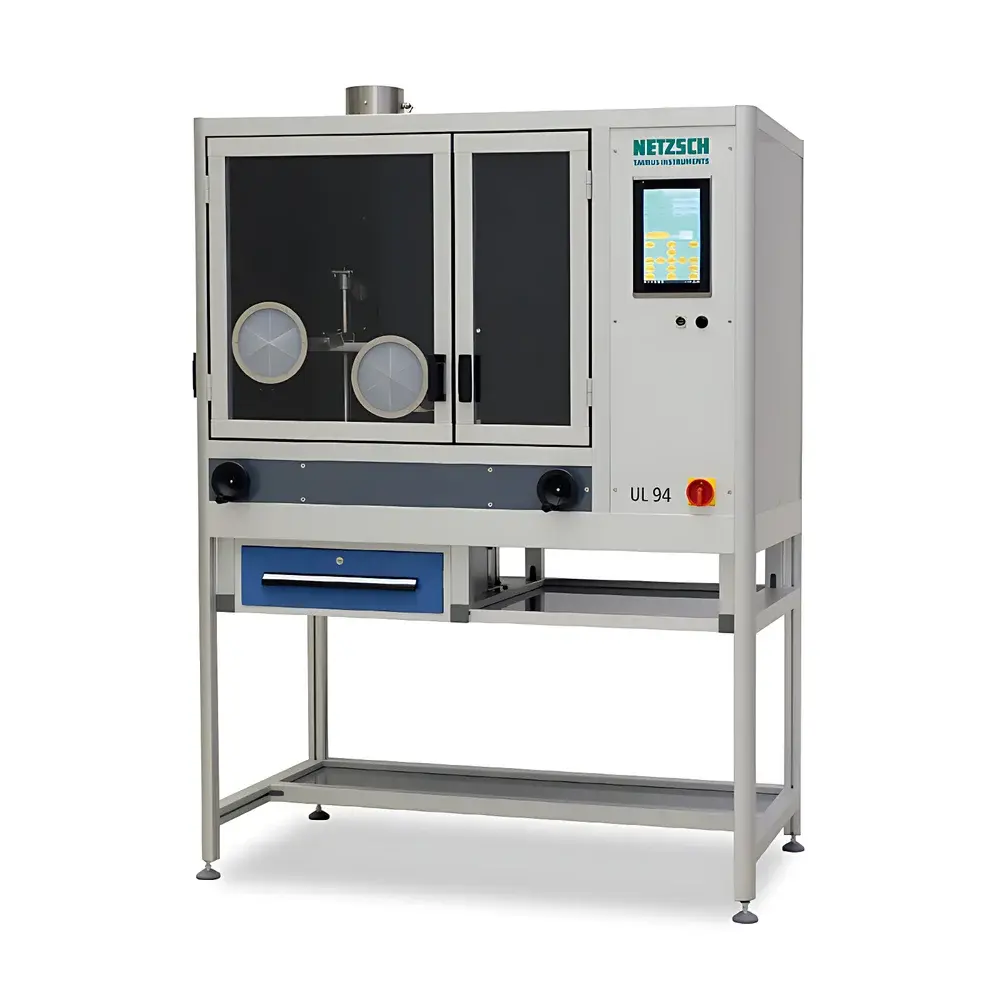
Netzsch UL94 Vertical/Horizontal Flame Chamber
| Brand | Netzsch |
|---|---|
| Origin | Germany |
| Model | UL94 Vertical/Horizontal Flame Chamber |
| Standards Compliance | UL 94 (5th Ed.), IEC/EN 60695-11-10, -11-20, -11-3, -11-4, ISO 9773 |
| Sample Dimensions (Strip) | 125.0 ± 5.0 mm × 13.0 ± 0.5 mm |
| Sample Dimensions (Sheet) | ≥150.0 ± 5.0 mm × ≥150.0 ± 5.0 mm |
| Burner Power | 50 W / 500 W |
| Burner Tilt Angles | 0°, 20°, 45° |
| Touchscreen Interface | 10" High-Resolution Capacitive Display |
| Enclosure Material | Sandblasted Stainless Steel (AISI 304) |
| Integrated Control Unit | Embedded Industrial PC with 32 GB SSD Storage |
Overview
The Netzsch UL94 Vertical/Horizontal Flame Chamber is a precision-engineered test apparatus designed for evaluating the flammability classification of polymeric materials used in electrical and electronic equipment housings, consumer appliances, and industrial enclosures. It operates in strict accordance with the internationally recognized UL 94 standard (5th edition) and its harmonized European counterparts—including IEC/EN 60695-11-10 (vertical flame test), -11-20 (horizontal flame test), -11-3 (500-W flame test), and -11-4 (needle flame test)—as well as ISO 9773 for embrittled strip specimens. The system employs a calibrated laboratory-grade burner delivering precisely regulated thermal flux at either 50 W (for low-energy ignition assessment) or 500 W (for high-flux vertical burn evaluation), enabling reproducible ignition source application under controlled ambient conditions. Its dual-axis sample holder accommodates both vertical and horizontal orientation tests without mechanical reconfiguration, minimizing operator intervention and inter-test variability.
Key Features
- Modular dual-mode sample holder supporting UL 94 HB, V-0, V-1, V-2, 5V, and HF-1/HF-2 classifications per standard-defined specimen geometry and mounting requirements.
- Motorized, programmable burner positioning system with fine-resolution angular adjustment (0°, 20°, 45°) to meet exact alignment tolerances specified in EN 60695-11-3 and ISO 9773.
- 10-inch industrial-grade capacitive touchscreen HMI with intuitive workflow navigation, real-time timer synchronization, and on-screen pass/fail logic validation based on observed afterflame time, afterglow duration, and drip ignition criteria.
- Robust enclosure fabricated from sandblasted AISI 304 stainless steel—resistant to thermal discoloration, corrosion, and repeated cleaning with ethanol or isopropanol—ensuring long-term dimensional stability and optical clarity of observation windows.
- Integrated embedded control unit featuring an industrial-grade processor, 32 GB solid-state storage, and deterministic real-time OS for synchronized ignition timing, flame exposure duration control, and automatic data logging with timestamped event markers.
Sample Compatibility & Compliance
The chamber accepts standardized strip specimens (125.0 ± 5.0 mm × 13.0 ± 0.5 mm, thickness ≤ 13 mm) and sheet specimens (≥150.0 ± 5.0 mm × ≥150.0 ± 5.0 mm) conforming to UL 94 Annex A and IEC/EN 60695-11-10 dimensional tolerances. Specimen clamping mechanisms maintain consistent grip pressure and edge alignment across repeated cycles, critical for eliminating positional bias in flame propagation measurements. All operational parameters—including burner tip-to-specimen distance (20 mm ± 1 mm), flame impingement angle, gas flow rate (air/propane or air/natural gas), and ambient temperature/humidity monitoring—are traceable to NIST-traceable calibration protocols. The system supports full audit trails required under GLP-compliant laboratories and is compatible with FDA 21 CFR Part 11–enabled software extensions for electronic signature and change control.
Software & Data Management
Data acquisition and reporting are managed via Netzsch’s proprietary FlameTest Suite v3.x, a Windows-based application compliant with ISO/IEC 17025 documentation requirements. Each test session generates a structured XML dataset containing raw sensor timestamps, flame-on/off events, visual observation annotations (e.g., “drip ignited cotton,” “self-extinguished at 8.2 s”), and digital image capture metadata. Reports export in PDF/A-1b format with embedded digital signatures, revision history, and instrument calibration certificate references. Optional integration with LIMS platforms (e.g., LabWare, Thermo Fisher SampleManager) enables automated result ingestion and QC flagging based on configurable acceptance thresholds.
Applications
This system is routinely deployed in R&D labs and quality assurance departments of polymer compounders, electronics OEMs, and automotive Tier-1 suppliers to validate flame-retardant additive efficacy, assess batch-to-batch consistency of halogen-free formulations, and support regulatory submissions for UL recognition, CE marking (under RoHS and RED directives), and IECQ QC080000 compliance. It also serves accredited third-party testing laboratories performing certification testing to UL, VDE, TÜV, and CSA standards. Common material categories tested include ABS, PC/ABS blends, PBT, PA66, PPS, and silicone-modified polyolefins—particularly those formulated with phosphinate, melamine cyanurate, or aluminum hydroxide flame retardants.
FAQ
Does the system support automated reporting compliant with ISO/IEC 17025?
Yes—FlameTest Suite v3.x generates fully traceable, digitally signed reports with calibration status, environmental monitoring logs, and operator identification fields.
Can the burner be calibrated in-house using certified reference gases?
Yes—the integrated mass flow controller supports user-initiated zero/span verification using certified propane/air mixtures; full calibration requires annual service by Netzsch-certified field engineers.
Is the chamber suitable for testing thin films or foams below 0.8 mm thickness?
No—UL 94 explicitly excludes specimens thinner than 0.8 mm unless tested under modified conditions per UL 94 Section 5.5; such evaluations require documented deviation justification and are not supported by default firmware.
What safety interlocks are implemented?
Dual redundant thermal cutoffs (120 °C and 180 °C), door-open flame shutoff solenoid, real-time gas leak detection (0–100% LEL), and emergency stop circuit meeting EN ISO 13850 Category 3 requirements.
Is remote diagnostics available?
Yes—via optional Ethernet-connected maintenance port with TLS-encrypted access; remote support sessions require prior written authorization and adhere to GDPR-compliant data handling policies.
Related Products



