
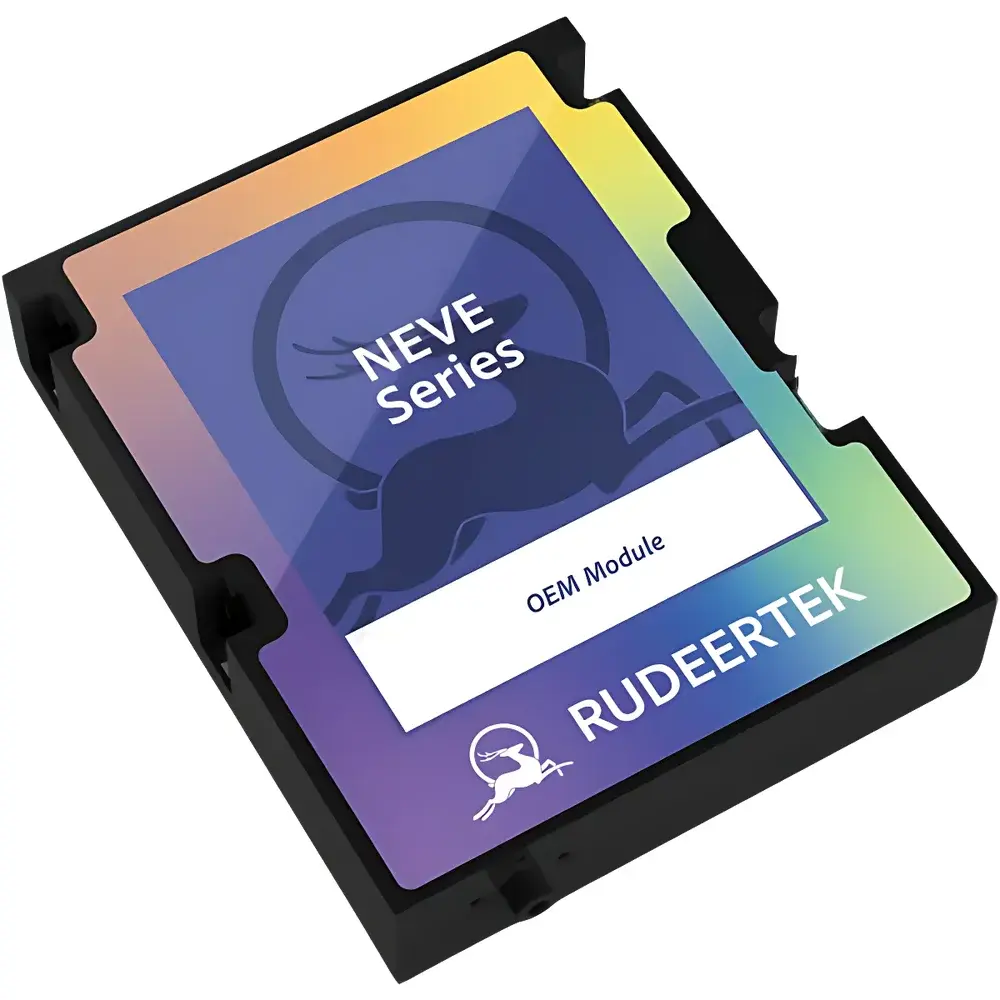
NEVE Symmetric OEM Optical Platform
| Brand | LQ Tech |
|---|---|
| Origin | Anhui, China |
| Manufacturer Type | Original Equipment Manufacturer (OEM) |
| Model | NEVE |
| Pricing | Available Upon Request |
| Spectral Range | 200–1100 nm |
| Optical Architecture | Symmetric Czerny-Turner |
| F-number | f/7.5 |
| Slit Width Options | 10, 25, 50, 75, or 100 µm |
| Grating Options | 300, 600, 900, 1200, or 1800 lines/mm |
| Stray Light | <1% |
| Weight | 400 g |
| Interface | USB 2.0 Type-B, Digital I/O |
| Fiber Optic Connector | Standard SMA 905 (customizable) |
Overview
The NEVE Symmetric OEM Optical Platform is a compact, modular spectrometer core engineered for integration into custom analytical instrumentation. Based on the symmetric Czerny-Turner optical layout, it delivers high optical fidelity and mechanical stability while enabling flexible spectral configuration across UV-Vis-NIR domains (200–1100 nm). Unlike asymmetric or crossed-beam designs, the symmetric geometry minimizes aberration asymmetry and ensures consistent beam path alignment under thermal or mechanical perturbation—critical for long-term repeatability in OEM systems deployed in industrial or field environments. Its f/7.5 focal ratio balances light throughput with resolution scalability, supporting both high-sensitivity detection and fine spectral discrimination depending on grating and slit selection. Designed explicitly for embedded deployment, the platform features external slit access, standardized mechanical mounting interfaces, and low-mass aluminum housing (400 g), facilitating integration into portable analyzers, process monitors, or multi-channel sensor arrays.
Key Features
- Symmetric Czerny-Turner optical architecture for minimized astigmatism and optimized collimation consistency
- Modular slit assembly with externally replaceable blades (10, 25, 50, 75, or 100 µm widths) enabling rapid reconfiguration without optical realignment
- Interchangeable diffraction gratings (300–1800 lines/mm) to tailor resolution, dispersion, and free spectral range per application requirement
- Low-stray-light performance (<1% typical) achieved through optimized baffling, black-anodized internal surfaces, and precision-aligned optical mounts
- Standard SMA 905 fiber input with mechanical registration; optional FC/PC, ST, or custom fiber interface available upon request
- Onboard digital I/O lines (TTL-compatible) for hardware-triggered acquisition, shutter control, or external device synchronization
- USB 2.0 Type-B host interface with vendor-provided SDK supporting Windows, Linux, and macOS for deterministic data streaming and register-level control
Sample Compatibility & Compliance
The NEVE platform does not directly interact with samples but serves as the optical engine within end-user instruments designed for liquid, solid, gas, or surface analysis. It complies with CE marking requirements for electromagnetic compatibility (EN 61326-1) and safety (EN 61010-1). Its mechanical design adheres to ISO 10110-7 surface quality standards for mounted optics and supports RoHS-compliant assembly. When integrated into regulated systems—such as environmental monitoring analyzers or semiconductor wafer inspection tools—the platform’s deterministic optical behavior and stable mechanical reference frame facilitate compliance with ISO/IEC 17025 calibration traceability pathways and support GLP/GMP documentation workflows. No moving parts or consumables are present; lifetime expectancy exceeds 10,000 operating hours under nominal ambient conditions (15–35°C, non-condensing).
Software & Data Management
LQ Tech provides a cross-platform Software Development Kit (SDK) with C/C++, Python, and LabVIEW APIs, enabling full control over exposure time, integration cycles, dark offset correction, and region-of-interest readout. Raw pixel data is delivered in 16-bit linear format with timestamped metadata (UTC-sync capable via host system). The SDK includes built-in routines for wavelength calibration using Hg/Ar lamp spectra or user-defined polynomial coefficients, intensity linearity correction, and stray-light compensation algorithms compliant with ASTM E275-22 Annex A3 methodologies. All firmware updates are signed and verified; audit logs of configuration changes are exportable in CSV or JSON format to satisfy FDA 21 CFR Part 11 requirements when deployed in regulated QA/QC systems.
Applications
- Real-time environmental monitoring: integration into portable or fixed-site spectrometers for water quality (COD, nitrate, turbidity), air pollutant quantification (NO₂, SO₂), and particulate matter characterization
- In-line process analytics: deployment in semiconductor fabrication lines for plasma emission monitoring, thin-film thickness verification, and etch endpoint detection
- Fluorescence and Raman spectroscopy modules: pairing with laser excitation sources and notch/dichroic filters for handheld or benchtop molecular identification systems
- Sorting and classification systems: incorporation into hyperspectral imaging engines for agricultural product grading, pharmaceutical tablet verification, or recycling stream analysis
- Research-grade OEM subsystems: serving as the dispersive core in custom-built ultrafast transient absorption setups, cavity-enhanced sensors, or dual-comb interferometric configurations
FAQ
Can the NEVE platform be calibrated traceably to NIST standards?
Yes—LQ Tech provides optional factory calibration reports with uncertainty budgets traceable to NIST SRM 2035 (Holmium Oxide) and SRM 1920a (Didymium), including wavelength accuracy (±0.2 nm) and photometric linearity (±1.5%) specifications.
Is thermal drift compensated in firmware or hardware?
Thermal stabilization is passive (aluminum heat-sink chassis); active compensation is implemented in software via onboard temperature sensor feedback and user-configurable baseline correction models.
What level of customization is supported beyond fiber interface and grating options?
Custom mechanical housings, modified PCB layouts, embedded FPGA logic for real-time spectral processing, and OEM-branded firmware branding are available under NDA and minimum order quantity agreements.
Does the platform support synchronized multi-unit operation?
Yes—via TTL trigger input/output pins and USB enumeration control, up to 8 NEVE units can be daisy-chained or independently addressed for parallel spectral acquisition in multi-angle or multi-excitation configurations.




