
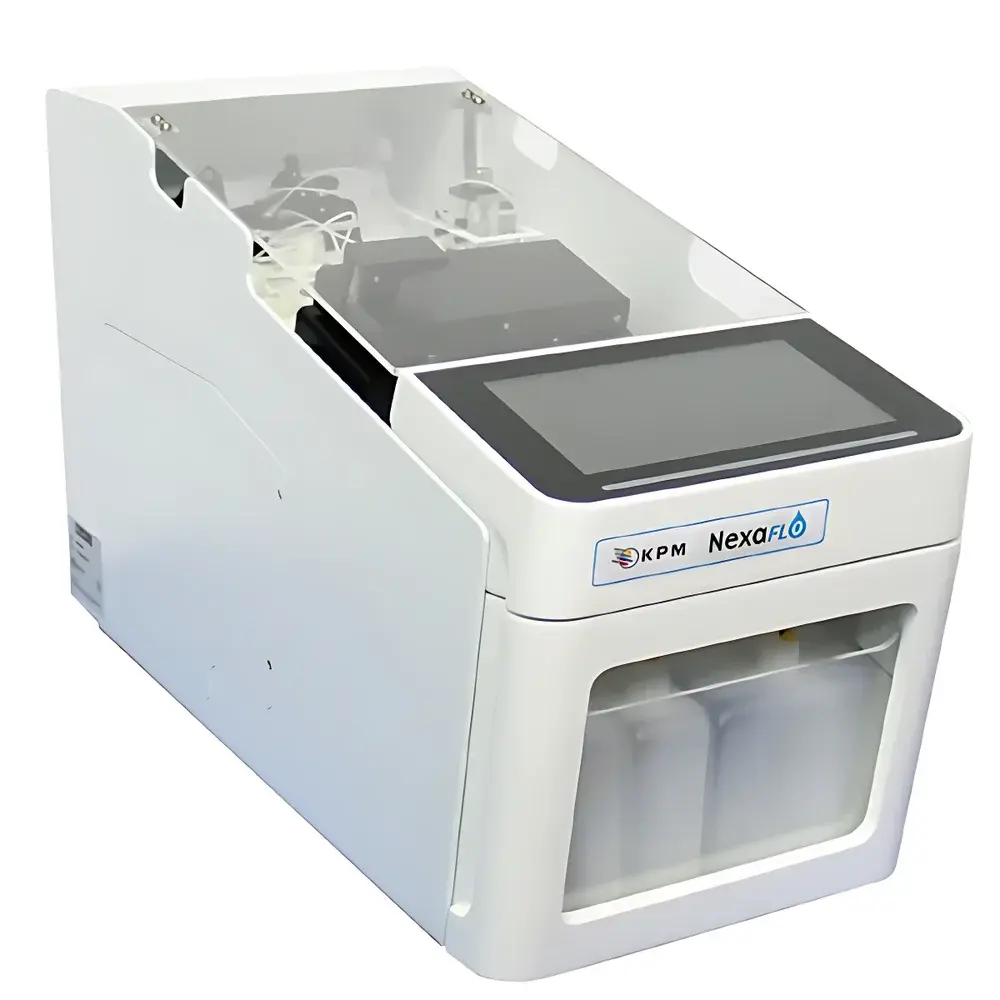
NexaFlo™ Series Intelligent Flow Analysis Platform
| Brand | AMS |
|---|---|
| Origin | Beijing, China |
| Model | NexaFlo™ |
| Configuration | Up to 14 independent analytical channels |
| Detection Principles | Continuous Flow Analysis (CFA) with segmented flow, online pre-treatment (dialysis, UV digestion, distillation, heating, dilution, mixing, extraction) |
| Detector Options | UV-Vis spectrophotometer, flame photometer (for K⁺/Na⁺), fluorimeter |
| Display | 7-inch color touchscreen (NexaFlo™ 450 variant) |
| Automation | Fully programmable CFA software with auto-startup/shutdown, QC control, auto-dilution, LIMS export, and audit-trail-capable operation |
| Compliance | Designed to support ASTM D129, ISO 11905-1, USP <621>, EPA Methods 353.2, 354.1, 365.2, and GLP/GMP-aligned data integrity practices |
| Sample Handling | Dual-probe autosampler optional |
| Fluidics | High-precision three-speed peristaltic pumps |
| Reagent Management | Integrated sealed reagent reservoirs with vapor/leak mitigation |
Overview
The NexaFlo™ Series Intelligent Flow Analysis Platform is a next-generation Continuous Flow Analysis (CFA) system engineered for high-reproducibility, trace-level elemental and speciation analysis in environmental, food, agricultural, and industrial laboratories. Built upon decades of AMS expertise in wet-chemistry automation, NexaFlo™ replaces the legacy FUTURA platform with a robust, modular architecture that integrates real-time diagnostics, multi-detector compatibility, and full method traceability. Unlike discrete batch analyzers, NexaFlo™ employs segmented flow CFA—where samples and reagents are separated by air bubbles within chemically inert tubing—to minimize cross-contamination, ensure precise reaction timing, and deliver exceptional precision (RSD <1.5% typical for routine parameters). The platform supports fully automated online sample pretreatment including UV photo-oxidation (for total nitrogen/phosphorus), steam distillation (for ammonia, cyanide, phenols), dialysis (for turbid or particulate-laden matrices), thermal digestion, and controlled dilution—all executed without manual intervention. Its core design prioritizes operational safety, long-term stability, and regulatory readiness, making it suitable for ISO/IEC 17025-accredited labs and facilities operating under FDA 21 CFR Part 11 or EU Annex 11 requirements.
Key Features
- Modular 14-channel configuration: Independent fluidic paths, detectors, and temperature-controlled reaction zones enable concurrent analysis of diverse analytes—including NH₄⁺, NO₃⁻/NO₂⁻, TN, TP, SO₂, SiO₂, Cr(VI), formaldehyde, volatile acids, and nicotine—without cross-method interference.
- Integrated health monitoring: Real-time LED status indicators, embedded bubble sensors, leak-detection modules, and continuous voltage/temperature signal logging provide immediate visibility into system integrity.
- Advanced fluid handling: Three-speed programmable peristaltic pumps deliver stable flow rates across macro-flow (1–5 mL/min) and micro-flow (0.1–1.0 mL/min) regimes; optional dual-probe autosampler doubles throughput via parallel sampling.
- Sealed reagent management: Vapor-tight, low-headspace reservoirs with pressure-balanced caps eliminate evaporation losses and accidental leakage—critical for unstable reagents like sulfanilamide or NEDD.
- Intuitive human-machine interface: 7-inch color touchscreen (NexaFlo™ 450) enables on-device method editing, calibration curve generation, diagnostic mode access, and live signal visualization without external PC dependency.
- Comprehensive pretreatment suite: Field-replaceable UV digestion cells (254 nm), stainless-steel distillation modules, thermostatted reaction coils (30–100 °C), and inline dialyzers expand applicability to complex, high-matrix samples (e.g., wastewater sludge, wine must, soil extracts).
Sample Compatibility & Compliance
NexaFlo™ accommodates liquid samples across a broad viscosity and particulate range—from clarified drinking water to undiluted seawater, digested soil leachates, tobacco extracts, and fermented beverage matrices. Optional filtration and centrifugation interfaces maintain line integrity when processing suspended solids. All hardware and software components adhere to IEC 61000-6-2/6-3 EMC standards and RoHS directives. Method validation aligns with internationally recognized protocols: ammonia (ISO 11905-1), nitrate/nitrite (EPA 353.2), total phosphorus (ISO 6878), sulfate (ASTM D129), and chromium(VI) (EPA 7196A). Audit trails, electronic signatures, and user-access controls comply with GLP and GMP documentation requirements; raw data files include timestamped metadata (flow rate, detector gain, lamp intensity, temperature) required for regulatory review.
Software & Data Management
The NexaFlo™ CFA Software is a Windows-based application supporting method development, sequence scheduling, QC charting (Levey-Jennings, Shewhart), automatic outlier flagging, and LIMS integration via ASTM E1394 or HL7-compliant export. Each analysis generates a structured .csv/.xlsx report containing raw absorbance/fluorescence values, calculated concentrations, calibration statistics (r², LOD/LOQ), and instrument status logs. The software enforces role-based permissions (operator, supervisor, administrator), maintains immutable audit trails for all critical actions (e.g., method edits, calibration updates, result overrides), and supports 21 CFR Part 11 compliance through digital signature capture and electronic record retention. A simplified runtime version operates directly on the NexaFlo™ 450’s embedded OS, enabling offline diagnostics, pump priming, valve sequencing tests, and firmware updates without host PC connectivity.
Applications
NexaFlo™ delivers validated performance across regulated and research-driven workflows. In environmental labs, it quantifies nutrients (TN, TP, NH₄⁺, NO₃⁻) in surface water per EU WFD criteria and measures Cr(VI) in industrial effluents at sub-µg/L levels. Food and beverage applications include SO₂ in wine (AOAC 990.22), reducing sugars in dairy (AOAC 982.14), and free amino nitrogen in brewing wort. Agricultural testing covers K⁺/Na⁺ in fertilizers (flame photometry), nitrate in leaf tissue extracts, and phosphate in manure digestates. Tobacco labs use it for nicotine and nitrosamines (TSNA) screening; clinical/environmental toxicology labs apply it to cyanide (pyridine-barbituric acid) and phenol (4-aminoantipyrine) assays. Its modularity allows method-specific configurations—e.g., a dedicated distillation channel for volatile phenols paired with a UV-digestion channel for total nitrogen—maximizing lab asset utilization.
FAQ
What sample volumes are required per analysis?
Typical injection volumes range from 50 µL to 500 µL, depending on method sensitivity and dilution factor. Minimum sample requirement is 1.5 mL per vial for autosampler compatibility.
Can NexaFlo™ perform simultaneous multi-analyte detection on a single sample stream?
No—each channel operates independently with dedicated chemistry and detection. However, up to 14 channels can process different analytes from the same sample rack concurrently, achieving true parallel throughput.
Is method transfer from legacy FUTURA systems supported?
Yes. NexaFlo™ software includes a FUTURA method import wizard that maps legacy pump speeds, valve timings, and detector settings to the new platform’s parameter schema, minimizing re-validation effort.
How is calibration verification handled during extended unattended runs?
The software schedules periodic bracketing standards and blank checks at user-defined intervals (e.g., every 10th sample); deviation thresholds trigger automatic recalibration or pause-and-alert protocols.
What maintenance intervals are recommended for peristaltic pump tubing?
Tubing life averages 1,200–1,800 hours under standard flow conditions; the system logs cumulative pump runtime and alerts users 48 hours prior to scheduled replacement.





