
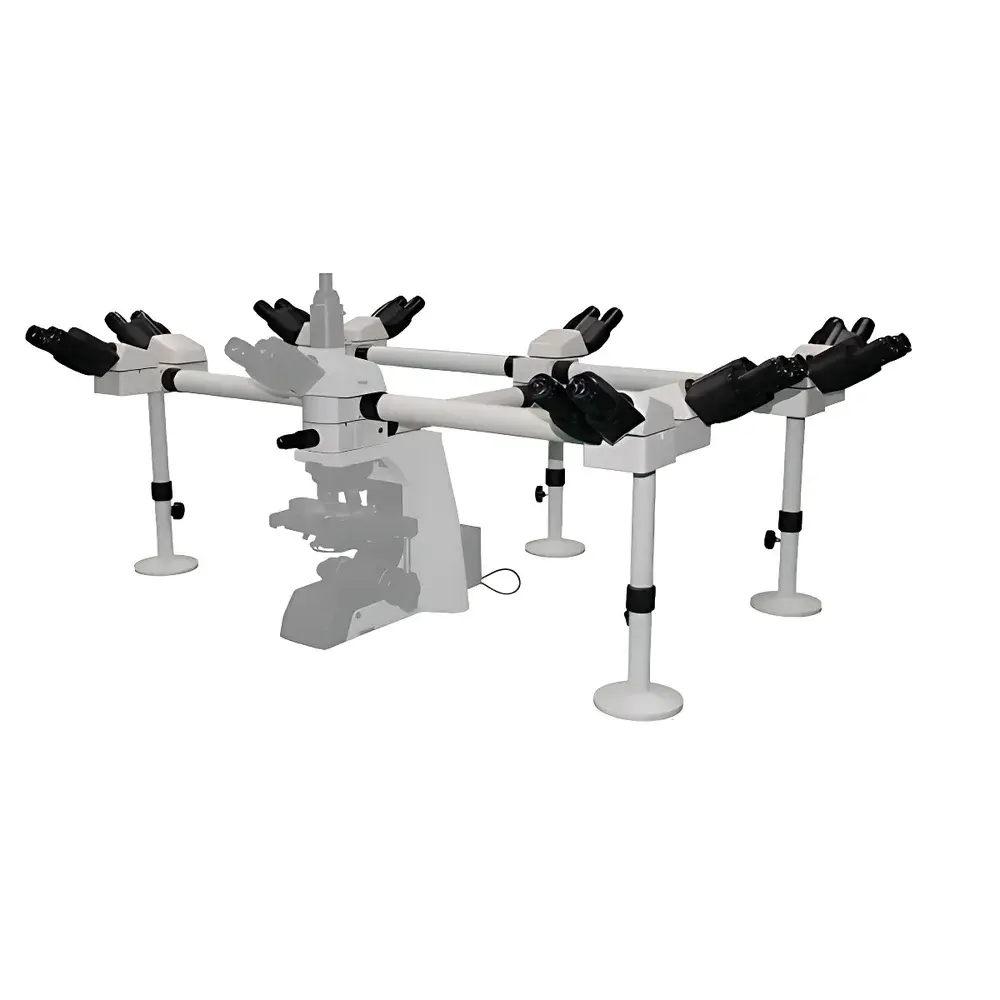
Nexcope NE900 Multi-Observer Comparison Microscope System
| Brand | Nexcope |
|---|---|
| Origin | Zhejiang, China |
| Model | NE900 Multi-Observer |
| Price Range | USD 42,000 – 70,000 |
| Observer Capacity | 2–10 stations |
| Integrated Teaching Pointer | Dual-color LED, 360° rotatable, brightness-adjustable |
| Camera Interface | Standard C-mount |
| Software Compatibility | Proprietary microscopy imaging suite (measurement, counting, fluorescence channel merging, real-time projection) |
| Ergonomic Design | Adjustable eyepiece height, low-fatigue viewing posture, modular station expansion |
| Optical Path | Shared objective/camera path with beam-splitting architecture ensuring zero image distortion and uniform luminance across all observation ports |
Overview
The Nexcope NE900 Multi-Observer Comparison Microscope System is an optically engineered platform designed for collaborative visual analysis in academic instruction, clinical pathology training, forensic comparison, and quality assurance laboratories. Unlike conventional single-user microscopes, the NE900 employs a precision-balanced optical train based on coaxial beam-splitting technology—ensuring that each observer station receives an identical, parfocal, and photometrically matched image derived from a shared objective lens and illumination source. This architecture eliminates inter-station discrepancies in resolution, contrast, color fidelity, and brightness, which are critical when multiple users must reach consensus on morphological features, structural anomalies, or comparative evidence (e.g., bullet striations, fiber morphology, tissue architecture). The system is built around the NE900 upright microscope chassis, featuring infinity-corrected optics, a high-transmission Köhler illumination system, and motorized focus with optional encoder feedback for repeatable Z-positioning. Its mechanical stability and thermal management support extended-duration group sessions without drift or thermal-induced focus shift.
Key Features
- Ergonomic multi-station architecture supporting 2 to 10 simultaneous observers—each equipped with independently adjustable interpupillary distance, diopter correction, and eyepiece height to accommodate diverse anthropometric profiles.
- Integrated dual-color (red/green) LED teaching pointer with 360° rotational freedom and continuous brightness control; visible in real time across all viewing stations and synchronized with digital camera output.
- Optical path design maintains full NA transmission and MTF integrity across all split channels—no compromise in resolution (≥180 lp/mm at 100× objective) or contrast transfer efficiency.
- C-mount interface compliant with industry-standard 1/2″ and 2/3″ sensors; supports live HDMI/USB3.0 video output for classroom projection, telepathology workflows, or integration into LMS platforms.
- Modular expansion capability: Additional observer heads can be added without recalibration; mechanical coupling ensures long-term alignment stability per ISO 10934-1 requirements for comparison microscopy.
- Compliance-ready configuration options include audit-trail-enabled software logging, user-access tiers, and timestamped image metadata generation aligned with GLP documentation practices.
Sample Compatibility & Compliance
The NE900 accommodates standard glass slides (1″ × 3″), petri dishes (up to 100 mm diameter), and macro specimens via optional stage adapters. It supports brightfield, phase contrast, and polarized light modalities—enabling routine histopathology, cytology, metallurgical grain analysis, and polymer crystallinity assessment. All optical components meet ISO 8578 (microscope labeling), ISO 10934-2 (comparison microscope performance criteria), and ASTM E2812 (standard guide for forensic comparison microscopy). The system’s mechanical design conforms to EN 61000-6-3 (EMC emissions) and EN 61000-6-2 (immunity), ensuring reliable operation in shared laboratory environments with mixed instrumentation.
Software & Data Management
The bundled Nexcope Imaging Suite v4.x provides FDA 21 CFR Part 11–compatible functionality—including electronic signatures, role-based access control, and immutable audit trails for all image acquisition, annotation, measurement, and export actions. Quantitative tools include calibrated linear/area measurement, particle counting with threshold-based segmentation, multi-channel fluorescence overlay (RGB + optional NIR), and geometric annotation with export to TIFF/PDF/DICOM-SR formats. Image metadata embeds microscope configuration (objective ID, magnification, exposure settings), operator ID, date/time stamp, and calibration certificate reference—supporting traceability under ISO/IEC 17025 and CAP accreditation frameworks.
Applications
- University histology and pathology labs: Enabling real-time instructor-guided dissection of tissue sections with synchronous annotation and peer discussion.
- Clinical training centers: Standardized evaluation of Pap smears, bone marrow aspirates, or dermatopathology specimens across rotating resident cohorts.
- Forensic science units: Side-by-side ballistic, toolmark, or questioned document comparisons with legally defensible image provenance.
- Materials QA labs: Concurrent review of coating thickness uniformity, inclusion distribution in alloys, or composite fiber orientation by cross-functional teams.
- Industrial R&D: Collaborative failure analysis where engineers, metallurgists, and quality specialists jointly interpret microstructural defects.
FAQ
Does the NE900 maintain optical fidelity when expanded to 10 stations?
Yes—the beam-splitting optics are engineered to preserve numerical aperture, modulation transfer function, and photometric uniformity across all ports, verified per ISO 10934-2 Annex B test protocols.
Can the teaching pointer be recorded in video output?
Yes—both red and green pointer states are overlaid in real time onto HDMI and USB3.0 streams, with configurable opacity and position anchoring.
Is the system compatible with third-party image analysis software?
It supports TWAIN and DirectShow drivers; raw frame capture is accessible via SDK for integration with MATLAB, Python (OpenCV), or commercial packages such as HALO or Visiopharm.
What maintenance intervals are recommended for optical alignment verification?
Annual verification using NIST-traceable resolution targets and photometric standards is advised; factory recalibration service includes collimation, parfocality, and luminance homogeneity testing.
Does the NE900 support DIC or differential interference contrast?
Yes—when configured with the optional NE900-DIC module, including strain-free objectives, Nomarski prisms, and polarization rotators meeting ISO 8578 Class A specifications.




