
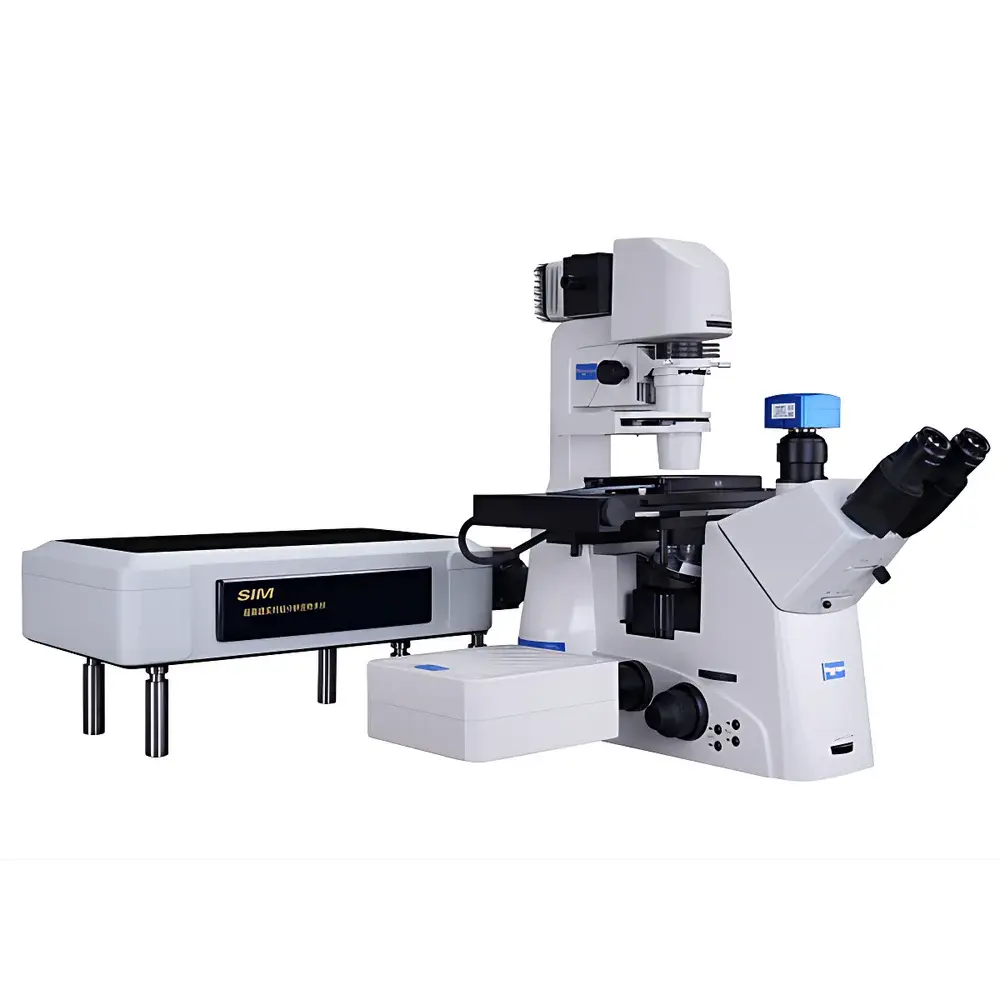
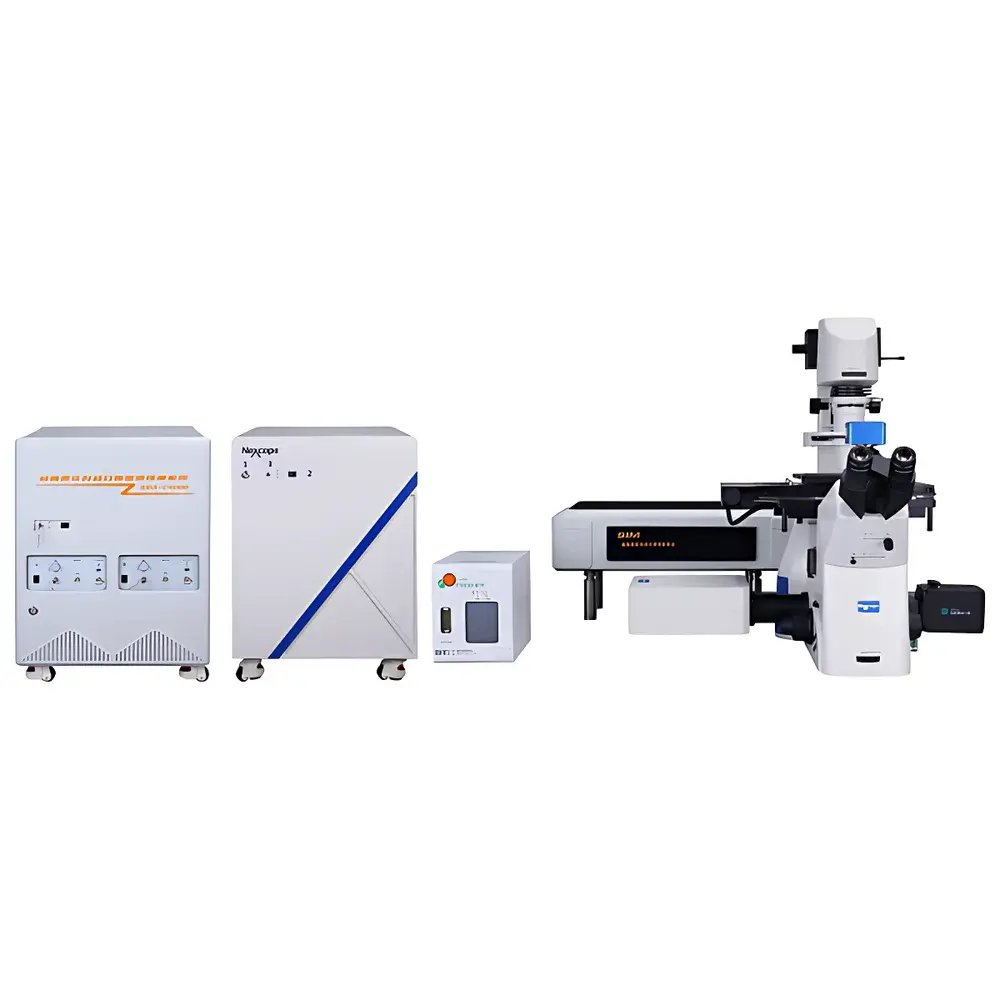
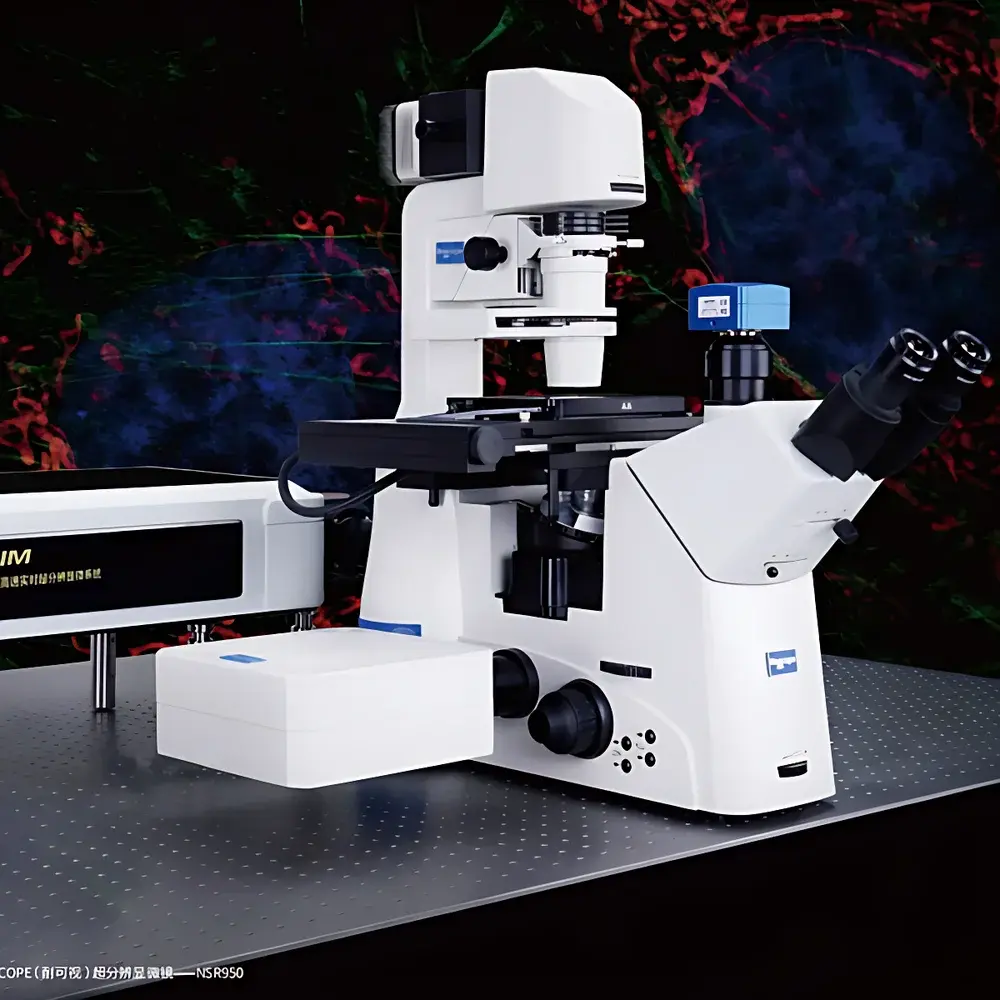
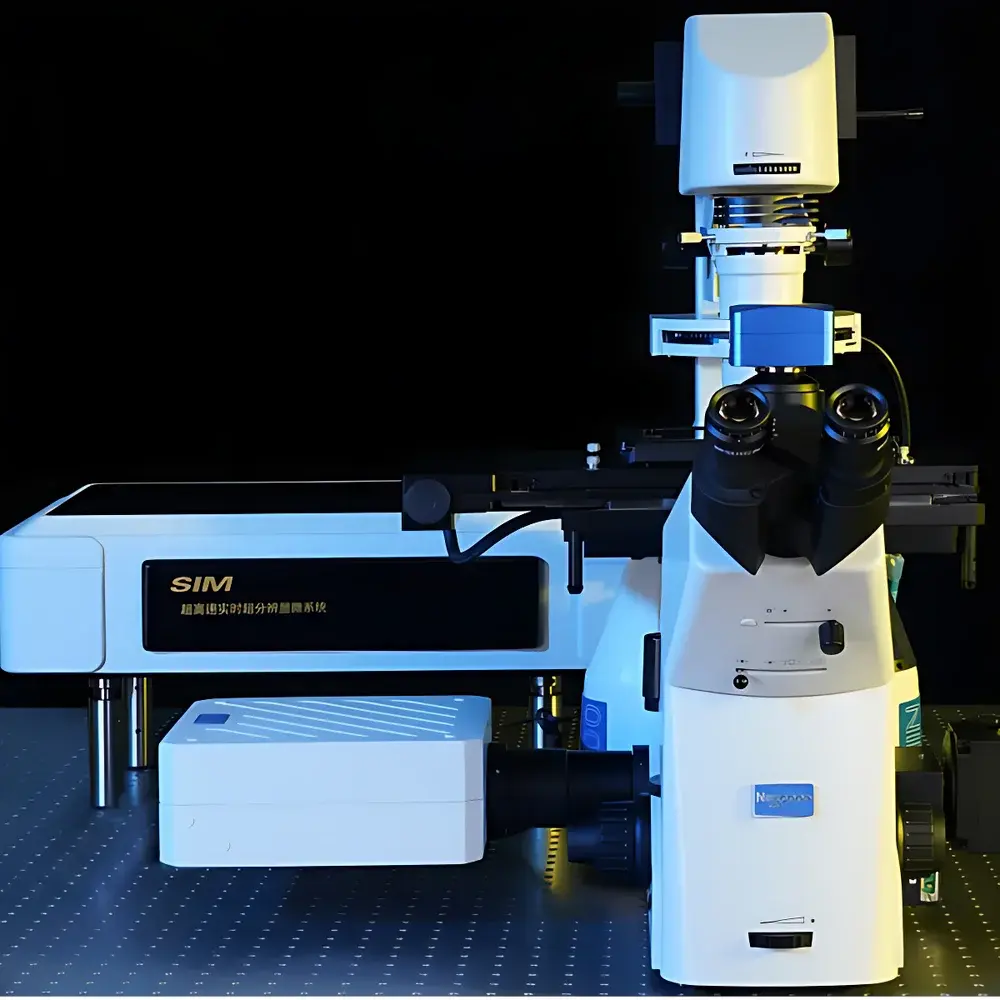
Nexcope NSR950 SIM Super-Resolution Microscope
| Brand | Nexcope |
|---|---|
| Model | NSR950 |
| Technology | Structured Illumination Microscopy (SIM) |
| Laser Wavelengths | 405 nm, 488 nm, 561 nm, 640 nm |
| Lateral Resolution | ≤86 nm (TIRF-SIM), ≤115 nm (3D-SIM) |
| Field of View | Square inscribed in Φ22 mm |
| Imaging Speed | 120 fps |
| Eyepieces | 10× (25 mm field number), EP 17.5 mm, diopter adjustment range −5 to +5 |
| Objectives | 10×, 20×, 40×, 60×, 100× |
Overview
The Nexcope NSR950 SIM Super-Resolution Microscope is an advanced optical imaging platform engineered for life science laboratories requiring nanoscale structural resolution beyond the diffraction limit of conventional widefield fluorescence microscopy. Based on structured illumination microscopy (SIM) principles, the NSR950 achieves up to twofold resolution enhancement by projecting high-frequency sinusoidal light patterns onto the specimen and computationally reconstructing high-resolution images from multiple phase-shifted raw acquisitions. Its dual-mode capability supports both total internal reflection SIM (TIRF-SIM) for ultra-thin surface layer imaging (≤86 nm lateral resolution) and volumetric 3D-SIM for subcellular organelle reconstruction (≤115 nm lateral resolution). Designed for live-cell compatibility, the system integrates high-speed sCMOS detection with synchronized laser modulation and piezo-driven stage control, enabling dynamic sub-diffraction imaging at up to 120 frames per second—critical for capturing rapid intracellular events such as vesicle trafficking, cytoskeletal remodeling, or chromatin dynamics.
Key Features
- Multi-wavelength solid-state laser excitation (405 nm, 488 nm, 561 nm, 640 nm) with precise intensity control and fast switching (<10 µs) for optimal fluorophore compatibility and minimal phototoxicity.
- Intelligent, fully automated microscope control architecture: unified software management of motorized objectives, filter cubes, focus drive, stage positioning, and SIM pattern modulation.
- Real-time SIM reconstruction preview with zero-latency rendering—enabling rapid region-of-interest localization without post-acquisition delay.
- Integrated TIRF and epifluorescence illumination paths with automatic alignment calibration and angle optimization for consistent evanescent field depth control.
- Motorized nosepiece supporting five high-NA objectives (10×–100×), including oil-immersion and silicone-oil options for deep-tissue 3D-SIM applications.
- Large-field imaging capability with a Φ22 mm circular field accommodating a 19.4 mm × 19.4 mm square FOV—ideal for mosaic acquisition and tissue-level contextual correlation.
Sample Compatibility & Compliance
The NSR950 accommodates diverse biological specimens across fixed and live preparations: cultured mammalian cells, primary neurons, zebrafish embryos, C. elegans larvae, and thin tissue sections (≤100 µm). Its low-photodamage SIM protocol enables extended time-lapse imaging under physiological conditions (37°C, 5% CO₂). The system complies with ISO 10993-5 biocompatibility standards for optical components in contact with live samples and meets IEC 61000-6-3 electromagnetic emission requirements for laboratory environments. All hardware timing, metadata logging, and image provenance tracking conform to GLP/GMP-aligned data integrity practices—including timestamped parameter recording, user audit trails, and immutable acquisition logs compatible with FDA 21 CFR Part 11-compliant workflows when deployed with validated software configurations.
Software & Data Management
NOMIS Pro X serves as the unified acquisition and analysis platform, merging confocal and super-resolution functionality into a single, modular interface. It supports six-dimensional experimental paradigms (x, y, z, λ, t, and intensity-modulation phase), with native support for multi-channel timelapse, FRAP (fluorescence recovery after photobleaching), and quantitative co-localization analysis (Pearson’s, Manders’, and Costes’ coefficients). Built-in AI-assisted deconvolution utilizes deep learning-based noise suppression trained on >50,000 experimentally acquired noisy/ground-truth image pairs, significantly improving SNR without compromising structural fidelity. All acquired images retain embedded EXIF-style metadata—including objective ID, laser power, exposure time, SIM pattern phase offsets, and environmental sensor readings (temperature, humidity). Data export adheres to OME-TIFF standard compliance, ensuring interoperability with Fiji/ImageJ, Imaris, Huygens, and commercial LIMS systems.
Applications
- Sub-diffraction mapping of nuclear pore complexes, centrioles, and synaptic protein clusters in fixed and live cells.
- Dynamic quantification of endosomal maturation, mitochondrial fission/fusion cycles, and microtubule plus-end tracking in real time.
- Multi-color 3D-SIM of co-localized signaling complexes (e.g., EGFR–Grb2–SOS) with spatial registration accuracy <20 nm.
- High-content screening of drug-induced organelle morphology changes using automated large-area mosaic stitching and machine-learning-enabled feature extraction.
- Correlative imaging workflows integrating SIM with TEM or expansion microscopy (ExM) for cross-scale validation.
FAQ
What is the minimum required sample preparation for TIRF-SIM imaging?
Standard glass-bottom dishes (No. 1.5 coverslip thickness) or plasma-cleaned coverslips are recommended. No special mounting media are required; aqueous buffers (e.g., PBS, HBSS) or low-fluorescence imaging media (e.g., FluoroBrite DMEM) yield optimal evanescent field coupling.
Can the NSR950 be integrated into existing confocal or light-sheet infrastructure?
Yes—the system provides TTL and analog I/O ports for external synchronization, and its SDK supports Python and MATLAB APIs for third-party instrument control (e.g., patch-clamp amplifiers, environmental chambers, or light-sheet scanners).
Is the AI deconvolution module validated for regulatory submissions?
The algorithm is qualified per ASTM E2925-22 guidelines for image processing tools in regulated bioimaging. Validation reports—including linearity, precision, robustness, and specificity assessments—are available upon request for GxP environments.
Does the system support multi-user role-based access control?
Yes—NOMIS Pro X implements configurable user profiles with hierarchical permissions (operator, supervisor, administrator), including password-protected method locking and electronic signature enforcement for critical acquisition parameters.
What maintenance protocols ensure long-term optical alignment stability?
The NSR950 features a monolithic optical baseplate with passive thermal compensation and factory-calibrated alignment markers. Annual preventive maintenance includes interferometric verification of laser collimation, SIM grating positional repeatability (<±50 nm), and objective turret centering tolerance (<0.1 µm).





