
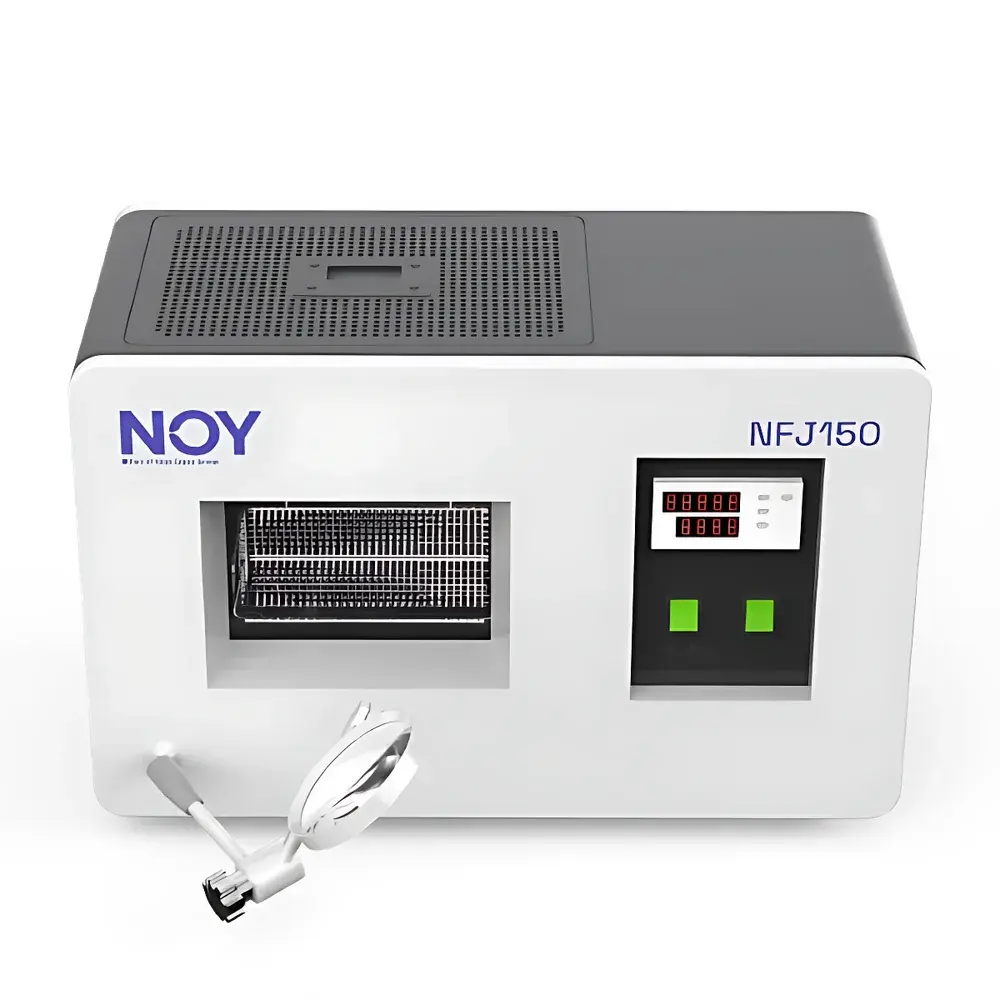
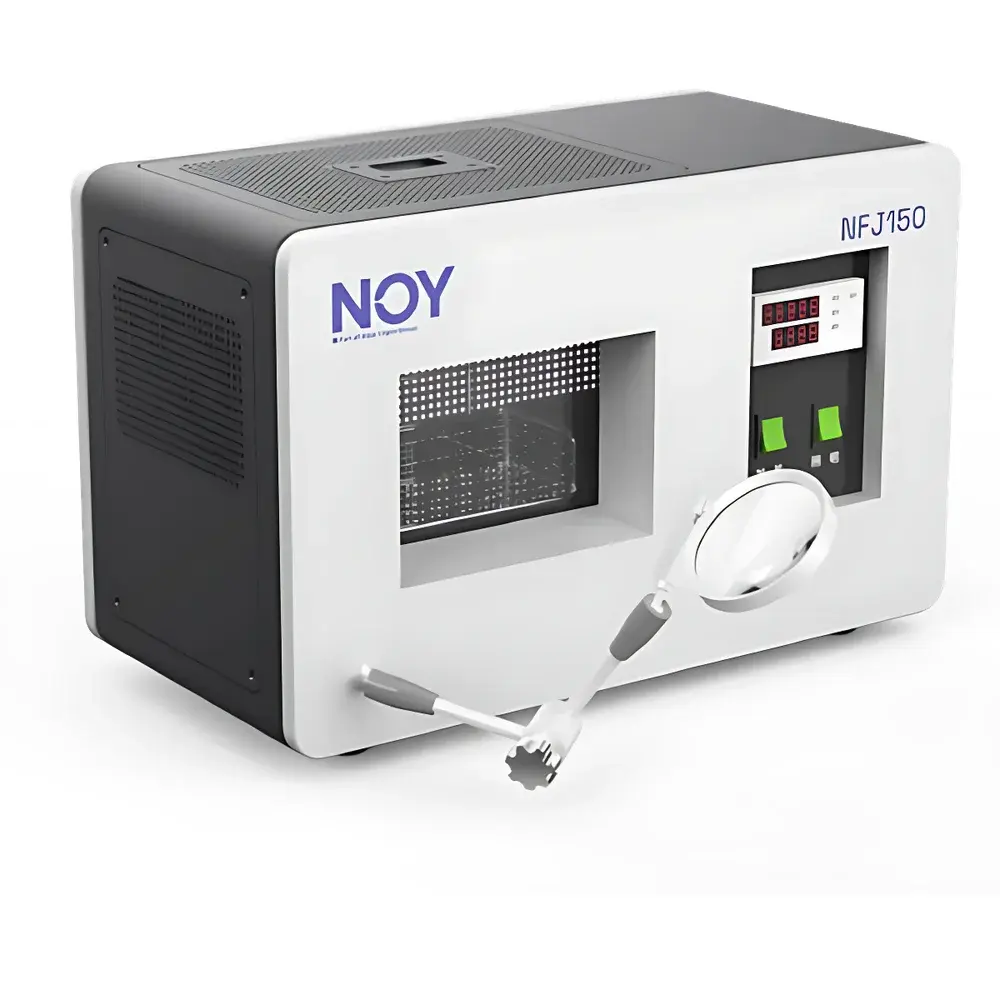
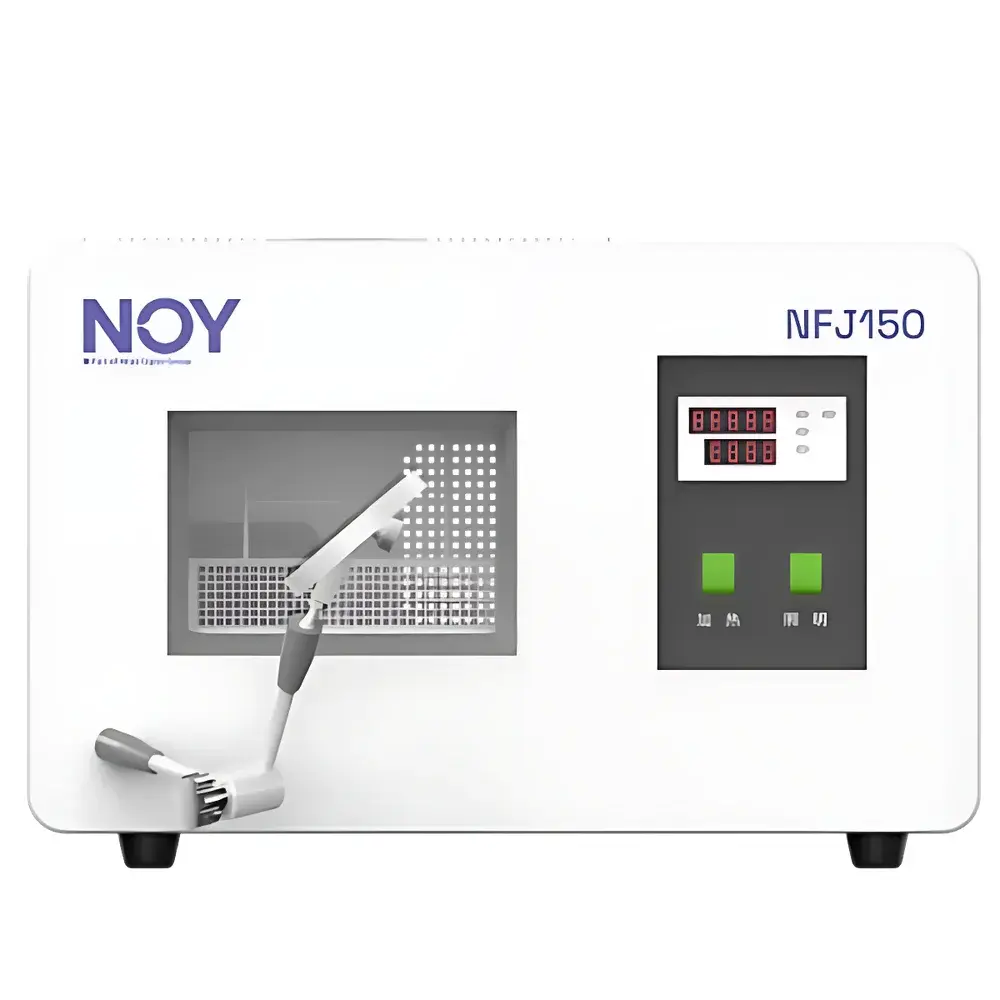
NFJ150 Helium Mass Spectrometer Leak Detector by NOY
| Brand | NOY |
|---|---|
| Origin | Anhui, China |
| Manufacturer Type | Direct Manufacturer |
| Instrument Type | Benchtop |
| Detection Method | Vacuum Mode |
| Minimum Detectable Leak Rate | 3×10⁻¹³ Pa·m³/s |
| Startup Time | ≤90 s |
| Response Time | ≤0.5 s |
| Maximum Pressure at Test Port | ≤2000 Pa |
Overview
The NFJ150 Helium Mass Spectrometer Leak Detector is a benchtop vacuum-mode helium leak detection system engineered for high-sensitivity, quantitative identification of minute leaks in sealed components and vacuum systems. It operates on the principle of magnetic sector mass spectrometry, selectively ionizing helium atoms introduced into the test chamber or sniffer probe path and detecting them via a high-transmission ion optics system and Faraday cup or electron multiplier detector. With a minimum detectable leak rate of 3×10⁻¹³ Pa·m³/s—comparable to Class A helium leak detectors per ISO 9927-1—the NFJ150 meets stringent requirements for aerospace component validation, semiconductor vacuum chamber integrity testing, cryogenic system verification, and hermetic packaging qualification in medical device manufacturing.
Key Features
- Benchtop architecture with integrated vacuum pumping system (turbo-molecular pump + backing pump), enabling rapid system evacuation and stable base pressure below 1×10⁻⁴ Pa.
- Vacuum-mode operation compatible with both vacuum chamber (vacuum-atmosphere) and vacuum-vacuum configurations, supporting standardized test protocols per ASTM E499 and ISO 10648-2.
- Optimized ion source design with thermal stabilization ensures long-term signal stability and minimizes drift during extended calibration intervals.
- Dedicated helium-specific mass filter (mass-to-charge ratio m/z = 4) eliminates interference from hydrogen (m/z = 2), water vapor (m/z = 18), and nitrogen/oxygen fragments, delivering high specificity without spectral overlap.
- Front-panel controls with embedded tactile switches and recessed power interface enhance operator safety and reduce accidental actuation in laboratory or production environments.
- Integrated observation window with adjustable magnifier lens enables real-time visual correlation between detected helium signals and physical defect locations during localized sniffer-mode inspection.
- Counterbalanced hinged lid mechanism minimizes thermal conduction between upper housing and internal sensor modules, preserving temperature-sensitive detector performance during prolonged operation.
Sample Compatibility & Compliance
The NFJ150 supports leak testing of metallic, ceramic, and glass-sealed assemblies—including vacuum flanges, feedthroughs, MEMS packages, laser cavities, and implantable device housings—under controlled environmental conditions. Its maximum allowable test port pressure of ≤2000 Pa permits safe integration with roughing-stage vacuum lines and compatibility with standard ISO-KF and CF flange interfaces. The instrument conforms to electromagnetic compatibility requirements per IEC 61326-1 and safety standards per IEC 61010-1. While not certified for FDA 21 CFR Part 11 compliance out-of-the-box, its analog/digital output architecture supports integration into validated GMP/GLP workflows when paired with compliant data acquisition software and audit-trail-enabled controllers.
Software & Data Management
The NFJ150 includes embedded firmware with real-time leak rate display (logarithmic scale), automatic zero tracking, and programmable alarm thresholds. Optional RS-232/RS-485 and analog 0–10 V outputs enable connection to SCADA systems or centralized QA databases. For advanced traceability, third-party software packages (e.g., LabVIEW-based custom modules or vendor-provided PC utilities) support CSV export of time-stamped leak rate logs, pump status flags, and calibration history—facilitating alignment with ISO/IEC 17025 documentation requirements. All firmware updates are delivered via secure USB firmware loader with version checksum verification.
Applications
- Leak integrity verification of vacuum insulation panels (VIPs) and evacuated glazing units in energy-efficient building materials.
- Quality control of hermetically sealed lithium-ion battery cells prior to electrolyte filling.
- Validation of weld seams and brazed joints in ultra-high vacuum (UHV) systems used in synchrotron beamlines and surface science instrumentation.
- Final acceptance testing of medical imaging detector modules (e.g., PET/MRI hybrid sensors) where sub-10⁻¹² Pa·m³/s leakage compromises radiation shielding integrity.
- Routine maintenance screening of cryostat vacuum jackets in superconducting magnet installations.
FAQ
What vacuum level is required before initiating a leak test?
A base pressure ≤1×10⁻⁴ Pa is recommended; the integrated turbo-molecular pump achieves this within 60–90 seconds from atmospheric conditions.
Can the NFJ150 perform both vacuum-chamber and sniffing-mode tests?
Yes—it supports vacuum-mode (test part placed inside chamber) and external sniffer probe mode using optional helium spray and flexible probe tubing.
Is helium calibration gas included with the instrument?
No; users must supply certified 10% helium in nitrogen (or pure helium) calibration standards traceable to NIST or equivalent national metrology institutes.
Does the system include automated calibration routines?
It features manual zero and span calibration via front-panel interface; automated multi-point calibration requires optional PC-based software.
What maintenance intervals are recommended for optimal sensitivity?
Ion source cleaning every 6 months under continuous use; turbomolecular pump oil replacement every 12 months; annual full-system sensitivity verification against certified leak standards.






