
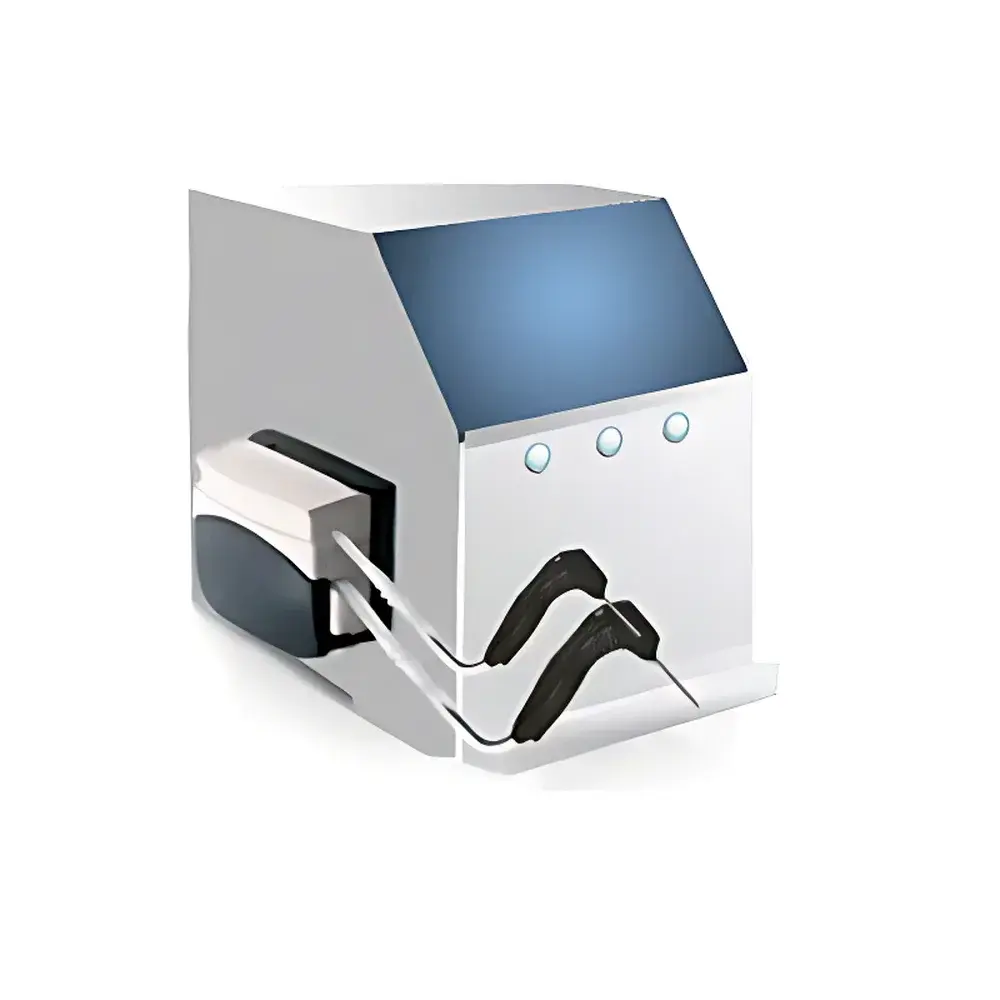
NicePlate-10 Multi-Function Automated Plate Dispenser
| Brand | KEZHE SHANGHAI |
|---|---|
| Origin | Shanghai, China |
| Manufacturer Type | Direct Manufacturer |
| Country of Origin | China |
| Model | NicePlate-10 |
| Price Range | USD 1,400 – 2,800 |
| Dispensing Volume Range | 0–30 mL |
| Pump Speed | 0.1–600 rpm |
| Flow Rate | 0.006–2300 mL/min |
| Compatible Vessels | Petri Dishes (standard 90 mm diameter, up to 9 positions), Test Tubes, and Custom Open-Top Containers |
Overview
The NicePlate-10 Multi-Function Automated Plate Dispenser is an engineered solution for high-reproducibility liquid handling in microbiology, cell culture, and quality control laboratories. Designed around a precision peristaltic pump coupled with a fully programmable XYZ robotic stage, the system delivers accurate, repeatable dispensing into open-top receptacles—including standard 90 mm Petri dishes, test tubes, and custom vessels—without requiring positive-pressure manifolds or disposable tips. Its core operating principle relies on volumetric displacement via calibrated roller compression of flexible tubing, enabling consistent delivery across variable viscosity ranges (e.g., agar-based media, buffered saline, glycerol solutions) without cross-contamination risk. Unlike gravity-fed or syringe-based dispensers, the NicePlate-10 maintains flow stability independent of liquid head height or container geometry, making it especially suitable for routine preparation of solid and semi-solid growth media where volume consistency directly impacts colony isolation fidelity and assay reproducibility.
Key Features
- Intuitive 7-inch capacitive touchscreen interface supporting multilingual UI (English, Chinese, Spanish), with preloaded protocols for common media types (e.g., LB, TSA, Sabouraud Dextrose Agar)
- Three-axis (X-Y-Z) motorized stage with ±0.1 mm positional repeatability, enabling precise alignment over irregular or non-uniform vessel arrays
- High-torque peristaltic pump with digitally controlled speed (0.1–600 rpm), delivering flow rates from 0.006 mL/min (for low-volume precision dispensing) up to 2300 mL/min (for rapid bulk filling)
- Onboard self-diagnostic suite that monitors tubing wear, motor load variance, and stage homing accuracy; triggers audible/visual alerts and logs error codes for traceability
- Modular architecture supporting optional handheld dispenser integration for manual override during validation runs or small-batch operations
- IP20-rated enclosure with corrosion-resistant stainless-steel frame and chemical-resistant polymer housing, compliant with ISO 13485 cleanroom-adjacent installation requirements
Sample Compatibility & Compliance
The NicePlate-10 accommodates standard 90 mm Petri dishes arranged across nine fixed positions, with mechanical adaptability for alternative diameters (e.g., 35 mm, 150 mm) via user-installed stage inserts. It accepts any open-top container with vertical sidewalls ≥10 mm tall and internal clearance ≥25 mm, including conical tubes (15–50 mL), deep-well plates, and custom glassware. The system supports media formulations containing suspended particles ≤100 µm (e.g., yeast extract, peptone aggregates) without clogging, provided tubing ID ≥1.6 mm is selected. While not certified for GMP production environments, its firmware architecture supports audit-ready operation: all parameter changes, run logs, and fault events are timestamped and stored locally with export capability (CSV/Excel). The device meets CE marking requirements under Directive 2014/30/EU (EMC) and 2014/35/EU (LVD), and aligns with ISO/IEC 17025 clause 5.5.2 for equipment verification in testing laboratories.
Software & Data Management
Firmware version 2.3.x includes embedded data logging with 32 GB internal flash memory (retaining ≥10,000 run records). Each log entry captures dispensing volume per position, pump RPM, total cycle time, ambient temperature (via onboard sensor), and operator ID (optional RFID badge integration). Export is supported via USB 2.0 port or Ethernet (TCP/IP) to LIMS or ELN systems. No cloud dependency or proprietary software installation is required—the interface operates natively in browser mode when connected to local network. For regulated environments, optional 21 CFR Part 11-compliant user access controls (role-based permissions, electronic signatures, immutable audit trail) are available through KEZHE’s validated LabLink Suite (v4.1+), which also enables remote monitoring and protocol synchronization across multi-unit installations.
Applications
- Routine preparation of microbiological growth media for clinical diagnostics, food safety testing, and environmental monitoring labs
- Standardized pouring of selective/differential agars (e.g., MacConkey, XLD, CHROMagar) to ensure uniform thickness and optimal colony morphology
- Dispensing of cell culture reagents into multiwell plates prior to seeding, reducing manual pipetting variability
- High-throughput setup of antimicrobial susceptibility testing (AST) plates using CLSI M07-A10-compliant volumes
- Supporting GLP-compliant stability studies where media batch consistency must be documented per ICH Q5C guidelines
- Educational use in undergraduate microbiology labs for teaching aseptic technique and quantitative plating principles
FAQ
What tubing materials are compatible with the peristaltic pump?
Pharmed BPT, Tygon® LFL, and Norprene® A-60-F are validated for continuous operation; silicone tubing is supported for non-sterile applications only.
Can the system dispense viscous media such as 2% molten agar at 45°C?
Yes—provided tubing ID ≥2.4 mm is used and pump speed is maintained between 120–300 rpm to prevent premature solidification within the line.
Is calibration traceable to national standards?
KEZHE provides factory calibration certificates (NIST-traceable gravimetric verification at 5, 15, and 30 mL points) with each unit; annual recalibration services are available via authorized service centers in APAC and EU regions.
Does the device support integration with robotic arms or LIS systems?
RS-232 and Modbus TCP interfaces enable bidirectional communication with third-party automation controllers; hardware handshaking signals (Ready/Busy/Complete) are exposed via DB9 connector for seamless integration into automated workflows.
What maintenance intervals are recommended?
Tubing replacement every 500 operational hours or 6 months (whichever occurs first); stage rail lubrication every 2,000 hours; full functional verification quarterly per ISO/IEC 17025 Section 6.4.10.






