
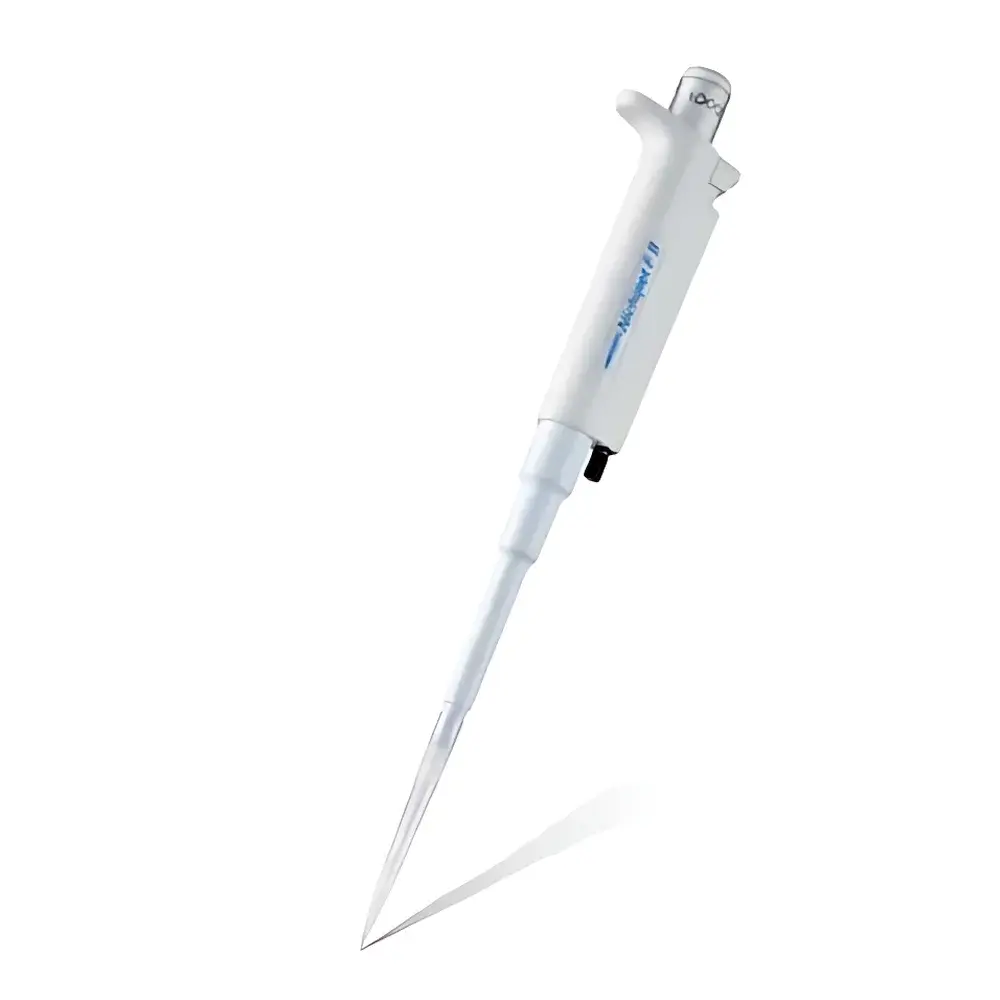
Nichipet FII & VII Manual Single-Channel Pipettes by Nichiryo (Japan)
| Brand | Nichiryo |
|---|---|
| Origin | Japan |
| Model | Nichipet FII & VII |
| Type | Manual Single-Channel Adjustable-Volume Pipette |
| Volume Range | 10–1000 µL |
| Accuracy | ±0.5% to ±1.2% (varies by volume) |
| Coefficient of Variation (CV) | ≤0.2% to ≤0.6% (volume-dependent) |
| Tip Compatibility | BMT2-series and F-series sterile filtered tips (e.g., BMT2-SG, FSGRB, BMT2-LE, FLERB) |
| Operating Principle | Air-displacement positive displacement (FII: fixed-volume |
| VII | triple presettable volumes) |
Overview
The Nichipet FII and VII are precision-engineered manual single-channel pipettes manufactured in Japan by Nichiryo — a long-standing specialist in high-reliability liquid handling instrumentation for analytical, clinical, and research laboratories. Designed for rigorous daily use under GLP- and GMP-aligned workflows, these pipettes operate on the air-displacement principle, ensuring consistent volumetric delivery across defined ranges. The FII series comprises fixed-volume models (10–1000 µL), optimized for high-frequency repetitive dispensing where minimal operator variability is critical — such as ELISA plate filling, standard curve preparation, or QC sample dilution. In contrast, the VII series offers three user-selectable preset volumes per unit (e.g., 10/20/50 µL, 50/100/200 µL, or 200/500/1000 µL), enabling rapid reconfiguration without recalibration — ideal for multi-step protocols requiring discrete transfer volumes within a single assay run. Both lines feature a lightweight, ergonomically elongated body that reduces thumb and wrist fatigue during extended operation, while maintaining mechanical stability essential for reproducible piston actuation.
Key Features
- Japanese-engineered precision mechanics with stainless-steel internal components and PTFE-sealed air chambers for long-term dimensional stability and minimal drift
- Fixed-volume (FII) and triple-preset adjustable (VII) configurations — no tools required for volume switching on VII models
- Thumb-wheel volume selector with tactile feedback and alignment marker (triangular index) for unambiguous setting verification
- Integrated tip ejection mechanism reducing finger strain and preventing accidental tip drop or contamination
- Calibration-friendly design compliant with ISO 8655-2:2022 for gravimetric performance verification and traceable adjustment
- Autoclavable lower assembly (excluding digital display or electronic modules — not applicable here, as both models are fully mechanical)
Sample Compatibility & Compliance
The Nichipet FII & VII are compatible with a broad spectrum of sterilized, low-retention, and filtered pipette tips — including Nichiryo’s proprietary BMT2-SG, FSGRB, BMT2-LE, and FLERB series — ensuring minimal carryover and optimal seal integrity across viscosity ranges (aqueous solutions to 60% glycerol). All models meet ISO 8655-1:2022 requirements for pipette classification and performance labeling. Their mechanical architecture supports routine calibration according to ASTM E1154-20 and EUROLAB Technical Guide No. 09/2021. While not electronic, their design facilitates integration into audit-ready environments: volume settings are physically locked post-adjustment, and calibration records can be maintained in accordance with FDA 21 CFR Part 11-compliant documentation practices when paired with validated lab management systems.
Software & Data Management
As fully manual, non-electronic instruments, the Nichipet FII & VII do not incorporate onboard software or digital interfaces. However, they are engineered to support robust data integrity frameworks through physical traceability: each pipette bears a unique serial number engraved on the barrel, enabling direct linkage to calibration logs, maintenance history, and user assignment records in LIMS or paper-based QA archives. Laboratories implementing ISO/IEC 17025 or CLIA-certified workflows routinely document these units via standardized calibration certificates (e.g., UKAS-accredited or NIST-traceable), with performance verification conducted at minimum annually or per usage thresholds defined in internal SOPs.
Applications
- High-throughput sample preparation in molecular biology (cDNA synthesis, PCR setup, NGS library normalization)
- Pharmaceutical QC testing requiring repeatable small-volume transfers (e.g., dissolution media dosing, reference standard dilution)
- Clinical diagnostics — hematology controls, immunoassay reagent dispensing, and microbiological suspension preparation
- Academic research labs performing titration series, inhibitor dose-response curves, or cell culture passaging
- Environmental testing labs handling water extracts, soil leachates, and spiked recovery standards
FAQ
Are the Nichipet FII & VII compliant with ISO 8655?
Yes — both series conform to ISO 8655-1 (general requirements) and ISO 8655-2 (volumetric performance testing) for manual air-displacement pipettes.
Can these pipettes be calibrated in-house?
Yes — they support two-point gravimetric calibration using certified weights and Class A volumetric flasks, following procedures outlined in ISO 8655-6 and manufacturer-supplied service manuals.
What tip types are recommended for viscous or volatile liquids?
For high-viscosity samples (e.g., glycerol, serum), low-retention filtered tips such as BMT2-LGRB or FLGRB are recommended; for volatile solvents (e.g., ethanol, acetone), use PTFE-coated tips like FSSRB to minimize evaporation-related error.
Is autoclaving supported?
The lower shaft and tip cone assemblies are autoclavable at 121 °C for 20 minutes (max. 10 cycles); the upper body housing must be disassembled first, and all O-rings inspected for deformation pre- and post-sterilization.
Do Nichipet pipettes require annual recalibration?
Per ISO 8655-5, recalibration frequency depends on usage intensity and risk assessment — but annual verification is widely adopted in regulated environments and mandated in many pharmaceutical QA protocols.



