
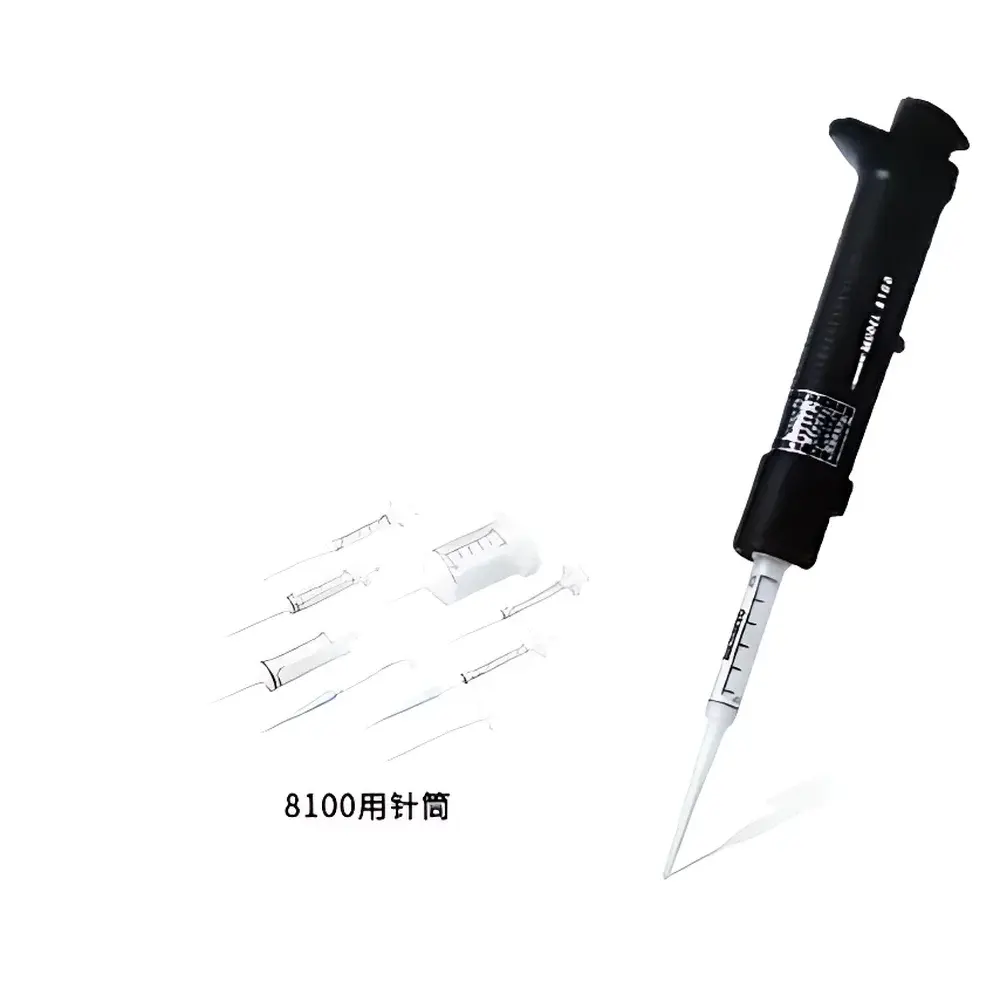
Nichiryo MODEL8100 Adjustable Continuous Dispenser
| Brand | Nichiryo |
|---|---|
| Origin | Japan |
| Model | MODEL8100 |
| Type | Motorized Multi-Step Electronic Dispenser |
| Sample Volume Range | 1 µL – 5 mL (configurable via 7 interchangeable syringe barrels) |
| Accuracy | ±0.8% to ±2.5% (volume-dependent) |
| Precision (CV) | ≤0.3% to ≤4.0% (volume-dependent) |
| Max. Dispensing Cycles per Fill | 10–58 (barrel-dependent) |
| Sterilization | Autoclavable at 121 °C for 20 min (all barrels except 3.0 mL and 60 mL) |
| Syringe Tip Length | 50 mm |
| Materials | PP (standard), PE (N3 and Z barrels) |
| Drive Mechanism | Pulse-driven positive displacement |
| Compliance | Designed for GLP-compliant liquid handling workflows |
Overview
The Nichiryo MODEL8100 Adjustable Continuous Dispenser is a precision-engineered motorized liquid handling instrument designed for high-reproducibility, multi-step dispensing in analytical, quality control, and routine laboratory environments. Unlike conventional single-channel or multi-channel pipettes, the MODEL8100 employs a pulse-driven positive displacement mechanism—where each electronic pulse advances the syringe plunger by a fixed mechanical increment—ensuring consistent volumetric delivery independent of liquid viscosity, surface tension, or vapor pressure. This principle makes it particularly suitable for challenging fluids including glycerol solutions, serum, cell suspensions, and high-salt buffers where air-displacement pipettes exhibit significant variability. The system supports seven interchangeable syringe barrels (0.06 mL to 60 mL), each calibrated across five discrete volume settings, enabling 35 distinct, pre-defined dispense volumes without recalibration. Its modular architecture integrates seamlessly into standardized benchtop workflows while maintaining full traceability under ISO/IEC 17025 and FDA 21 CFR Part 11–aligned data governance frameworks.
Key Features
- Seven autoclavable syringe barrels (excluding 3.0 mL and 60 mL variants), rated for sterilization at 121 °C for 20 minutes—ensuring compliance with microbiological safety protocols.
- 50 mm extended tip length on all barrels, permitting direct access to narrow-bore vials (e.g., 12 × 32 mm GC vials or 8-mm-diameter microcentrifuge tubes) without adapter interference.
- Pulse-driven positive displacement actuation eliminates air cushion effects, delivering stable accuracy (±0.8–2.5%) and coefficient of variation (CV ≤ 0.3–4.0%) across the full operational range.
- Ergonomic, low-mass housing (<280 g) reduces operator fatigue during extended batch dispensing; intuitive rotary dial enables rapid volume selection and barrel exchange without tools.
- Residual fluid retention design: After final dispense, residual liquid remains within the barrel bore rather than being expelled—preventing bubble-induced volume deviation and improving inter-run consistency.
- Chemically resistant construction: Standard barrels fabricated from medical-grade polypropylene (PP); N3 and Z-series barrels use high-density polyethylene (PE) for enhanced compatibility with organic solvents.
Sample Compatibility & Compliance
The MODEL8100 accommodates aqueous, viscous (up to 500 mPa·s), and moderately volatile liquids without performance degradation. Its positive displacement architecture ensures reliable handling of proteins, nucleic acid solutions, and particulate-laden samples (e.g., whole blood lysates) where air-displacement systems risk carryover or incomplete aspiration. All syringe barrels meet USP Class VI biocompatibility requirements. Instrument design aligns with ISO 8655-3 (volumetric accuracy of piston-operated instruments) and supports audit-ready operation under GLP and GMP environments—particularly when paired with validated electronic logbook integration. Calibration certificates are available per ISO/IEC 17025-accredited laboratories upon request.
Software & Data Management
While the MODEL8100 operates as a standalone, manually configured dispenser, its repeatable mechanical indexing enables seamless integration with third-party laboratory information management systems (LIMS) via RS-232 or optional USB-to-serial interface. Each dispense cycle generates a timestamped event record—including barrel ID, selected volume, and cycle count—which can be exported for traceability in regulated QC/QA workflows. Firmware supports user-defined dispense sequences (up to 99 steps), and optional PC-based configuration software allows remote parameter locking, usage logging, and electronic signature enforcement per 21 CFR Part 11 Annex 11 requirements.
Applications
- Preparation of calibration standards and reference material dilutions in environmental and pharmaceutical testing labs.
- Serial dilution of ELISA reagents, PCR master mixes, and cell culture media in life science research.
- High-throughput sample aliquoting for ICP-MS, HPLC, and GC sample introduction—especially where consistent sub-10 µL delivery into autosampler vials is required.
- QC release testing of injectables and ophthalmic solutions, where regulatory guidelines (e.g., USP and EP 2.9.33) mandate documented volumetric repeatability.
- Automated buffer exchange in protein purification workflows using gravity-fed or vacuum-assisted manifold setups.
FAQ
Is the MODEL8100 compliant with ISO 8655?
Yes—the instrument adheres to ISO 8655-3 for piston-operated volumetric dispensers, and individual barrel calibrations are traceable to NMI-Japan (National Metrology Institute of Japan) standards.
Can the dispenser be used with corrosive solvents such as DMSO or acetone?
Standard PP barrels show limited resistance to strong organics; PE barrels (N3 and Z models) provide improved compatibility—consult the chemical resistance chart prior to extended exposure.
Does the device support variable dispensing intervals (e.g., timed pauses between drops)?
No—the MODEL8100 delivers fixed-interval pulses only; programmable timing requires external controller integration via RS-232.
What maintenance is required to ensure long-term accuracy?
Monthly visual inspection of plunger seals and syringe barrel integrity; annual recalibration recommended for GLP/GMP applications—certified service available through authorized Nichiryo partners.
Is firmware upgrade capability built-in?
Firmware updates are performed via dedicated service tool at authorized service centers; no field-upgrade functionality is provided to maintain regulatory stability.



