
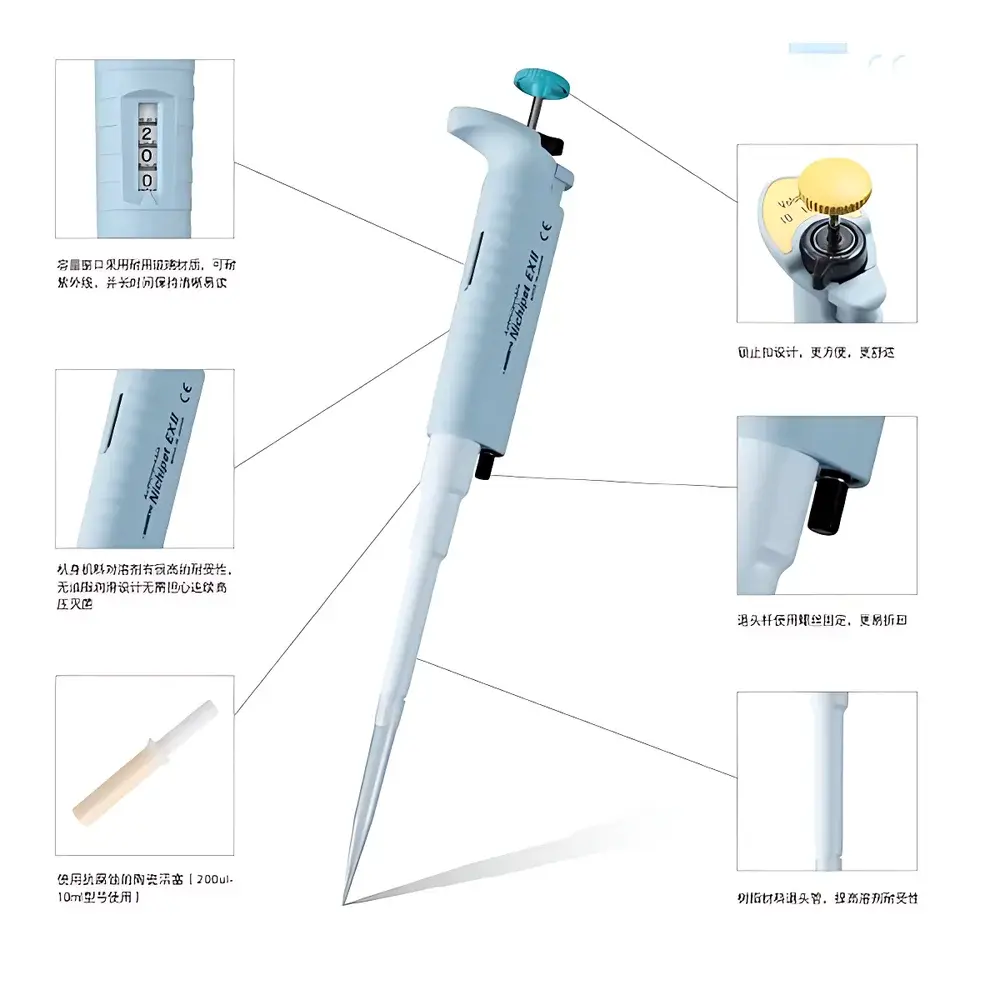
Nichiryo Nichipet EX II Single-Channel Digital Adjustable Pipette
| Brand | Nichiryo |
|---|---|
| Origin | Japan |
| Model | Nichipet EX II |
| Type | Manual Single-Channel Pipette |
| Volume Range | 0.1–10,000 µL |
| Maximum Capacity | 10 mL |
| Accuracy | ±2.0% |
| Sterilization | Autoclavable at 121°C for 20 min |
| Tip Ejection | Non-contact, plastic ejector mechanism |
| Sealing Material | PTFE in air-tight components |
| Piston Material | Ceramic (for ≥200 µL models) |
| Filter Tip Compatibility | Integrated filter sleeve (≥1000 µL models) |
| Volume Adjustment | Digital dial with lockable knob |
| Minimum Increment | 0.002–10 µL (model-dependent) |
| Tip Compatibility | BMT2-series tips (UT, SS, SG, LE, X, Z) |
Overview
The Nichiryo Nichipet EX II is a precision-engineered single-channel manual pipette designed for high-reproducibility liquid handling across academic, clinical, and industrial laboratories. Based on positive displacement air-cushion technology, it delivers consistent aspiration and dispensing performance across an exceptionally broad volume range—from 0.1 µL to 10 mL—without requiring model-swapping or accessory reconfiguration. Its modular architecture integrates a ceramic piston (standard in models ≥200 µL), PTFE-sealed internal pathways, and a non-contact tip ejection system to ensure long-term dimensional stability, chemical resistance, and operator ergonomics. Developed and manufactured in Japan under strict JIS Q 9001-compliant quality control, the Nichipet EX II meets international expectations for traceability, mechanical durability, and metrological reliability in GLP and ISO/IEC 17025 environments.
Key Features
- Digital volume setting with tactile feedback and a lockable rotary dial—enabling rapid, error-resistant adjustment even while wearing gloves.
- Full autoclavability at 121°C for 20 minutes (including shaft, piston, and tip cone), validated per ISO 8655-5 for repeated sterilization cycles without drift or seal degradation.
- UV-resistant housing and internal components, permitting routine surface decontamination in biosafety cabinets or cleanrooms without material embrittlement.
- Enhanced airflow dynamics in low-volume variants (e.g., 0.1–20 µL and 0.5–100 µL), minimizing evaporation-induced variability and improving repeatability at critical sub-10 µL transfers.
- Non-contact tip ejection via integrated plastic actuator—eliminates lateral force on tube walls during tip removal and reduces risk of sample carryover or vessel damage.
- PTFE-coated air-tight zones and ceramic pistons (≥200 µL) provide exceptional longevity and resistance to organic solvents, acids, and bases commonly used in HPLC sample prep, ELISA workflows, and nucleic acid purification.
- Filter-equipped tip cones (standard on 1000–10,000 µL models) prevent aerosol contamination of internal mechanisms during volatile or viscous liquid handling.
Sample Compatibility & Compliance
The Nichipet EX II accommodates a full spectrum of aqueous, viscous, and volatile liquids—including glycerol solutions, ethanol-based reagents, cell suspensions, and PCR master mixes—without recalibration. All models are compatible with Nichiryo’s BMT2 tip family (UT, SS, SG, LE, X, Z), engineered for optimal sealing force and low retention. The device conforms to ISO 8655 Parts 1–6 (Piston-operated volumetric apparatus), supports traceable calibration using gravimetric methods per ASTM E542 and ISO/IEC 17025, and maintains documented performance stability over ≥10,000 operational cycles. It is routinely deployed in FDA-regulated QC labs where adherence to 21 CFR Part 11–aligned documentation practices is required for audit readiness.
Software & Data Management
While the Nichipet EX II operates as a standalone manual instrument, its design facilitates seamless integration into digital lab ecosystems. Each unit carries a unique serial number engraved on the barrel for asset tracking, and volume settings are mechanically recorded—enabling manual logbook entries or synchronization with LIMS via barcode-scanned calibration certificates. Optional calibration reports (available upon request) include uncertainty budgets, environmental conditions, and technician signatures—structured to satisfy internal QA audits and external accreditation bodies (e.g., CAP, CLIA, UKAS). No embedded firmware or cloud connectivity is present, preserving data sovereignty and eliminating cybersecurity exposure vectors common in motorized systems.
Applications
This pipette serves as a foundational tool in diverse workflows: quantitative RNA/DNA dilution series in molecular diagnostics; serial dilution of reference standards for ICP-MS calibration; precise addition of catalysts in synthetic chemistry; preparation of cytotoxic drug formulations under ISO 13485-controlled conditions; and high-sensitivity immunoassay plate setup where coefficient of variation (CV) <1.5% at 2 µL is routinely achieved. Its extended upper range (up to 10 mL) also supports buffer preparation, media aliquoting, and solvent transfer tasks traditionally requiring separate volumetric equipment—reducing cross-contamination risk and benchtop footprint.
FAQ
Is the Nichipet EX II compliant with ISO 8655?
Yes—the entire EX II series is tested and certified per ISO 8655-2 (accuracy and precision) and ISO 8655-5 (durability under sterilization), with validation data provided in the manufacturer’s technical dossier.
Can I use third-party tips with this pipette?
While functional compatibility may exist, Nichiryo recommends BMT2-series tips to guarantee specified accuracy, seal integrity, and filter efficacy—particularly at volumes ≤10 µL.
What maintenance is required between calibrations?
Routine cleaning with 70% ethanol and visual inspection of tip cone integrity are sufficient; no lubrication or internal servicing is needed under normal use conditions.
How often should the pipette be calibrated?
Annual calibration is standard; however, high-throughput labs or those operating under GMP/GLP must perform interval checks per SOP—typically every 3–6 months or after 5,000 cycles, whichever occurs first.
Does the filter tip option affect accuracy at low volumes?
No—the integrated filter sleeve in ≥1000 µL models is pressure-compensated and does not introduce additional dead volume or flow resistance that impacts gravimetric performance.



