
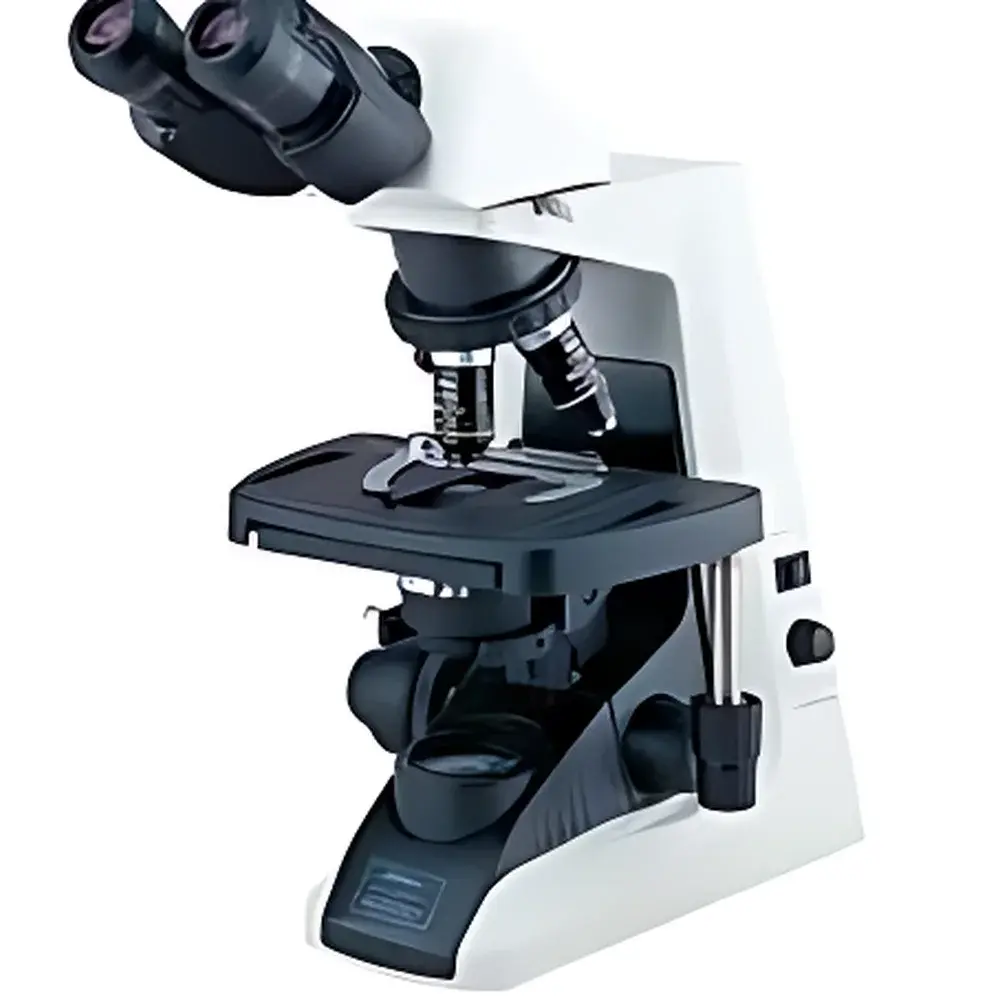
NIKON Eclipse E200 Trinocular Upright Biological Microscope
| Brand | NIKON |
|---|---|
| Origin | Japan |
| Model | E200 Trinocular |
| Optical System | CFI60 Infinity-Corrected |
| Observation Head | Trinocular (E2-TF), 30° Inclination, Interpupillary Distance 47–75 mm |
| Eyepieces | CFI 10×/20 mm Field Number (FN) |
| Objective Lenses | CFI E Plan Achromat 4×, 10×, 40×, 100× (anti-fungal coated) |
| Nosepiece | Inclined 4-position Revolving Nosepiece |
| Condenser | E2 Abbe Condenser, NA 1.25 |
| Focusing Mechanism | Coaxial Coarse/Fine Focus, Fine Focus Graduation 2 µm, Coarse Travel 37.7 mm/rev, Fine Travel 0.2 mm/rev |
| Stage | Rectangular Mechanical Stage, 216 × 150 mm, Travel Range 78 × 54 mm |
| Illumination | LED Light Source (60,000 hr lifetime), Constant CCT Across Intensity Range, IR-Free, Low Heat & Power Consumption |
| Anti-Fungal Protection | Internal Anti-Mold Coating + Desiccant Mold-Prevention Strips (validated for 3 years at 30°C / 80% RH) |
| Ergonomics | Adjustable Tilting Eyepiece Tube (±30°), Height-Optimized Stage Controls, Low-Profile Knob Placement |
| Compatibility | CFI60 Objective Mount, Full Eclipse Series Accessory Ecosystem (Phase Contrast, Fluorescence, Polarization, Digital Imaging) |
Overview
The NIKON Eclipse E200 Trinocular Upright Biological Microscope is a rigorously engineered entry-level research and teaching platform built upon Nikon’s proven CFI60 optical architecture. Designed for sustained daily use in academic laboratories, quality control environments, and preclinical training facilities, the E200 delivers consistent, high-fidelity imaging across magnifications from 40× to 1000× (with oil immersion). Its infinity-corrected optical path eliminates chromatic and spherical aberrations across the full field of view (FN 20 mm), ensuring sharpness, contrast, and color fidelity without reliance on compensating eyepieces or tube lenses. The trinocular head (E2-TF) enables simultaneous visual observation and digital documentation—critical for GLP-compliant recordkeeping, student instruction, or collaborative analysis. Unlike finite-conjugate systems, the CFI60 design provides extended working distance and higher numerical aperture support, facilitating compatibility with thicker specimens and future accessory integration.
Key Features
- Long-life, IR-free LED illumination system rated for 60,000 hours—eliminates bulb replacement cycles, reduces thermal load on live specimens, and maintains stable correlated color temperature (CCT) across all intensity settings (no color shift during dimming).
- Anti-fungal protection engineered for tropical and high-humidity operational environments: dual-layer defense comprising vapor-phase anti-mold coating on internal optical surfaces and replaceable desiccant mold-prevention strips—validated per JIS Z 2911:2018 for continuous resistance under 30°C / 80% RH for ≥36 months.
- Ergonomic trinocular viewing head with 30° inclination and ±30° adjustable tilt; eyepoint height increases by 34 mm when rotating the ocular sleeve 180° (optimized for users with 64 mm interpupillary distance).
- Rectangular mechanical stage (216 × 150 mm) with 78 × 54 mm travel range and low-profile coaxial controls aligned at optimal hand-height—minimizing shoulder and wrist strain during extended sessions.
- CFI E Plan Achromat objectives (4×, 10×, 40×, 100× oil) feature anti-fungal surface treatment and are fully backward-compatible with higher-tier CFI60 objectives (e.g., CFI S Plan Fluor, CFI LU Plan Fluor) across the Eclipse platform.
- Integrated safety mechanisms: objective collision limiter on fine focus, parfocal design across all objectives (≤2 µm refocusing tolerance), and fixed-stage Z-stop to protect both specimen and lens during high-magnification work.
Sample Compatibility & Compliance
The E200 supports standard glass slide preparations (26 × 76 mm), petri dishes (up to 100 mm diameter), and multi-well plates—compatible with transmitted-light techniques including brightfield, phase contrast, darkfield, and simple polarization. Optional accessories enable fluorescence imaging using standard FITC/TRITC/DAPIC filter sets (excitation/emission certified per ISO 10934-1). All optical components comply with ISO 8578:2017 (microscope mechanical and optical requirements) and JIS B 7151-1:2018 (objective labeling and performance). The LED illumination meets IEC 62471:2006 photobiological safety Class 1 (exempt) for retinal blue-light hazard. The instrument’s construction adheres to RoHS 2011/65/EU and REACH SVHC regulations.
Software & Data Management
The trinocular port accepts industry-standard C-mount adapters (0.5× or 1.0× relay lenses) for seamless integration with USB 3.0 or HDMI-enabled digital cameras (including Nikon DS-Fi3, Lumenera Lt545, or third-party OEM sensors). Raw image capture supports TIFF, BMP, and JPEG formats; metadata embedding includes magnification, objective ID, exposure time, and illumination intensity—enabling traceability per FDA 21 CFR Part 11 Annex 11 requirements when paired with validated acquisition software (e.g., NIS-Elements BR v5.0+ or open-source alternatives like MicroManager 2.0). Audit trails, user access logs, and electronic signature workflows may be implemented via middleware solutions compliant with ISO/IEC 17025:2017 clause 7.11.
Applications
- Undergraduate and graduate life science education: histology, microbiology, botany, and hematology labs requiring reproducible, maintenance-light instrumentation.
- Pharmaceutical QC labs performing compendial tests (USP , EP 2.2.17) for particle morphology, crystal habit analysis, and microbial enumeration.
- Clinical training environments conducting peripheral blood smear evaluation, urinalysis sediment identification, and basic cytology screening.
- Industrial R&D settings requiring routine inspection of thin films, polymer blends, or textile fibers under standardized transmitted-light protocols.
- Field-deployable core facilities where reliability, low power draw (<8 W), and resistance to environmental degradation are operational imperatives.
FAQ
Is the E200 compatible with digital camera systems from non-Nikon manufacturers?
Yes—the trinocular port features a standardized 23.2 mm C-mount interface with optional reduction lenses; compatibility has been verified with FLIR, Basler, and Thorlabs scientific cameras using appropriate adapters.
Can the LED illumination be calibrated for quantitative intensity measurement?
While the E200 does not include built-in radiometric calibration, its constant CCT output and stable spectral profile (450–650 nm peak) allow external validation using NIST-traceable photometers (e.g., ILT950) for semi-quantitative intensity mapping.
Does the anti-fungal treatment affect optical transmission or require periodic reapplication?
No—the vapor-phase coating is molecularly bonded to optical surfaces and exhibits no measurable attenuation at visible wavelengths (400–700 nm); the desiccant strips are replaceable every 12 months as part of routine preventive maintenance.
What is the maximum usable magnification with the included 100× oil objective?
With the E2 Abbe condenser (NA 1.25) and optimal Köhler illumination, the practical resolution limit is ~0.22 µm (per Rayleigh criterion), supporting effective magnification up to 1000× under standard daylight-balanced LED illumination.
Are service manuals and spare parts available through authorized Nikon distributors outside Japan?
Yes—NIKON Medical & Scientific Instruments provides global technical documentation, firmware updates, and OEM-grade spares (e.g., LED modules, stage assemblies, focusing gears) via ISO 13485-certified distribution partners in EMEA, APAC, and the Americas.




