
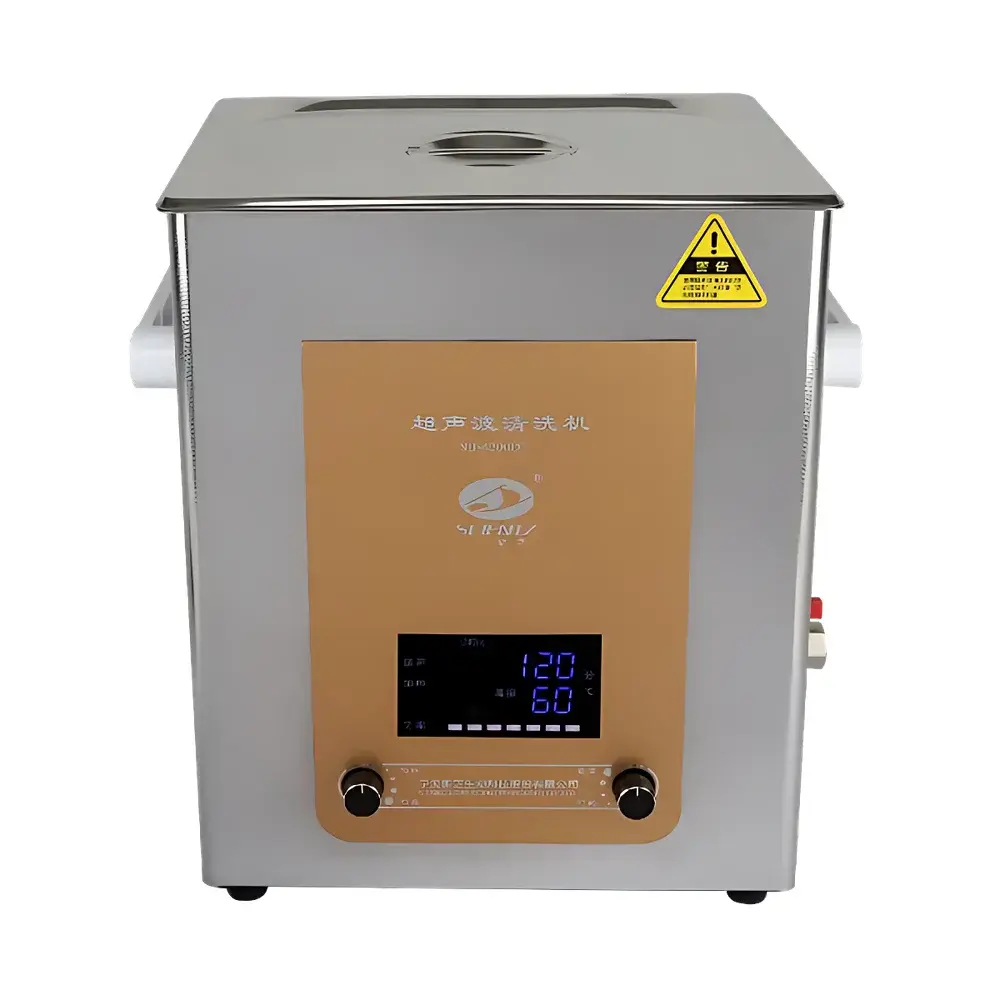
Ningbo Scientz SB-4200DT Digital Heating Ultrasonic Cleaner
| Brand | Scientz |
|---|---|
| Origin | Zhejiang, China |
| Manufacturer Type | Direct Manufacturer |
| Instrument Type | General-Purpose Ultrasonic Cleaner |
| Tank Capacity | 14.4 L |
| Ultrasonic Frequency | 40 kHz |
| Ultrasonic Power Output | 480 W |
| Adjustable Power | No |
| Temperature Control Range | Ambient to 80 °C |
| Timer Range | 1–999 min |
| Sound-Dampening Lid | Included |
| Drain & Fill Fitting | Equipped |
Overview
The Ningbo Scientz SB-4200DT is a digitally controlled, heating-capable ultrasonic cleaner engineered for reproducible, high-efficiency cleaning and auxiliary sample preparation tasks in regulated laboratory environments. It operates on the principle of acoustic cavitation: high-frequency (40 kHz) ultrasonic energy is transmitted into the cleaning medium via piezoelectric transducers bonded to the stainless-steel tank base. This generates transient microbubbles that rapidly grow and collapse under alternating pressure cycles, releasing localized shockwaves and intense shear forces (up to ~5,000 K and ~1,000 atm at collapse sites). These physical phenomena enable non-contact removal of particulate contaminants, organic residues, biofilms, and adsorbed oils from complex geometries—including blind holes, capillary channels, and porous surfaces—without mechanical abrasion or surface damage. Unlike passive soaking or manual scrubbing, ultrasonic cleaning achieves uniform treatment across submerged surfaces, making it indispensable for pre-analytical sample integrity, instrument maintenance, and compliance-critical workflows.
Key Features
- Digital microprocessor control with real-time display of elapsed/remaining time and actual bath temperature (±1 °C accuracy)
- Heating function adjustable from ambient temperature up to 80 °C, supporting enhanced solubilization of waxy, polymeric, or high-viscosity residues
- Programmable timer (1–999 minutes) with auto-shutdown and power-failure memory retention—preserves user-defined settings after unexpected interruption
- Integrated sound-dampening lid reduces airborne noise to <55 dB(A) at 1 m distance, improving ergonomic conditions in shared lab spaces
- Stainless-steel (304 grade) tank with integrated drain valve and fill port for rapid solution exchange and contamination control
- Over-temperature protection and dry-run safety cutoff prevent heater element damage during low-fluid operation
Sample Compatibility & Compliance
The SB-4200DT accommodates standard laboratory glassware (e.g., volumetric flasks, centrifuge tubes, HPLC vials), metal components (surgical instruments, precision bearings, watch mechanisms), optical elements (microscope slides, quartz cuvettes), and polymer-based consumables. Its cleaning efficacy has been validated per ASTM D2603 (Standard Test Method for Sonic Shear Stability of Lubricants) and aligns with ISO 13485 requirements for medical device reprocessing validation. While not certified as a sterilizer, it supports critical pre-sterilization cleaning steps compliant with AAMI ST79 and FDA Guidance for Reprocessing Medical Devices. The unit’s sealed electronics and corrosion-resistant construction meet IP20 environmental rating standards for indoor laboratory use.
Software & Data Management
This model operates without external software or PC connectivity; all parameters are managed locally via the front-panel keypad and LCD interface. However, its deterministic timer and thermal control architecture support GLP/GMP documentation practices: users may record batch-specific cleaning protocols—including duration, temperature setpoint, and solution composition—in lab notebooks or electronic lab notebooks (ELNs). The power-failure memory feature ensures protocol continuity, reducing risk of deviation during extended runs—a requirement referenced in USP Analytical Instrument Qualification and Annex 11 of EU GMP guidelines.
Applications
- Routine decontamination of HPLC autosampler vials, GC liners, and ICP-MS nebulizers to eliminate carryover and baseline drift
- Preparation of biological samples for TEM/SEM imaging—removing residual fixatives and embedding media from grids and stubs
- Removal of cutting fluids and metal fines from machined parts prior to dimensional metrology or coating adhesion testing
- Ultrasonic-assisted extraction of plant metabolites or soil-bound contaminants using aqueous or mixed-solvent systems
- Deaeration of mobile phases and buffer solutions prior to LC analysis to prevent pump cavitation and column voiding
- Cleaning of reusable surgical forceps, dental scalers, and endoscope channels in accordance with CDC-recommended reprocessing workflows
FAQ
Is the SB-4200DT suitable for cleaning delicate optics such as coated lenses or diffraction gratings?
Yes—when operated at lower temperatures (≤40 °C) with low-surface-tension, non-ionic detergents (e.g., Liquinox™), it removes submicron particles without compromising anti-reflective or metallic coatings.
Can this unit be used for cell lysis or nanoparticle dispersion?
It is not designed for high-intensity sonication applications requiring probe-type energy delivery. For reproducible lysis or dispersion, dedicated bath sonicators with calibrated power density (W/L) and temperature feedback loops are recommended.
Does the unit comply with electrical safety standards for international laboratories?
It conforms to GB 4793.1 (equivalent to IEC 61010-1) for laboratory electrical equipment, including dielectric strength, creepage/clearance, and protective earth continuity requirements.
What maintenance is required to ensure long-term performance?
Monthly inspection of transducer bonding integrity, quarterly descaling of the heater element using diluted citric acid, and annual verification of timer accuracy against a calibrated stopwatch are advised.



