
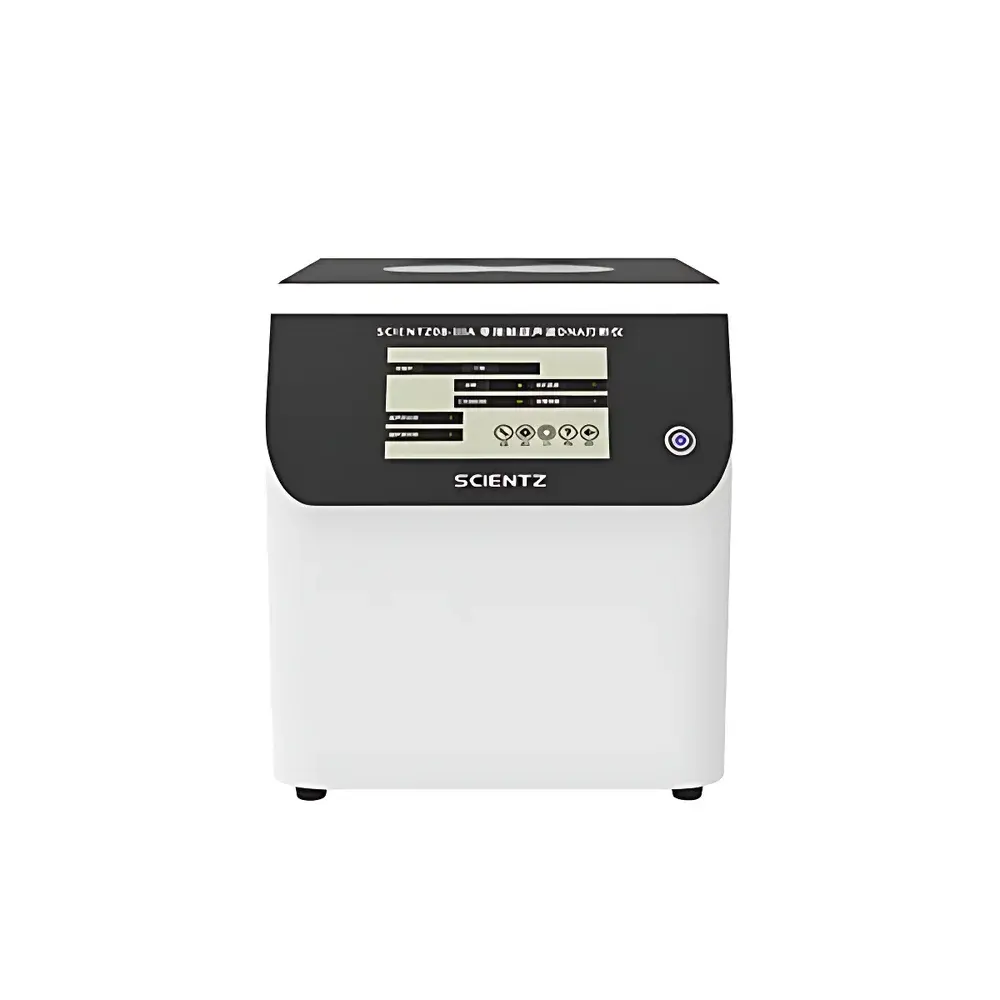
Ningbo Scientz SCIENTZ-08-IIIA Non-contact Ultrasonic DNA Shearer
| Brand | Ningbo Scientz |
|---|---|
| Origin | Zhejiang, China |
| Manufacturer Type | Direct Manufacturer |
| Country of Origin | China |
| Model | SCIENTZ-08-IIIA |
| Pricing | Upon Request |
Overview
The Ningbo Scientz SCIENTZ-08-IIIA Non-contact Ultrasonic DNA Shearer is an engineered platform for precise, reproducible, and contamination-free nucleic acid fragmentation—specifically optimized for next-generation sequencing (NGS) library preparation and chromatin immunoprecipitation (ChIP) workflows. Unlike probe-based sonicators that generate localized cavitation and thermal gradients, the SCIENTZ-08-IIIA employs a bath-type transducer architecture mounted at the base of a temperature-controlled water reservoir. This design enables uniform acoustic energy distribution across the entire sample volume via broadband ultrasonic transmission (20–400 kHz), minimizing standing wave formation, foam generation, and sample heating. Samples remain sealed within individual microcentrifuge tubes during sonication—eliminating aerosolization, cross-contamination, and operator exposure risks. The system operates under isothermal conditions, preserving epitope integrity in ChIP applications and preventing DNA denaturation or oxidative damage common in high-intensity mechanical shearing methods.
Key Features
- 7-inch capacitive touchscreen interface with intuitive graphical navigation and real-time parameter feedback
- Programmable ultrasonic duration from 0.1 seconds to 199 hours, 59 minutes, 59.9 seconds—enabling both rapid pulse-mode fragmentation and extended low-power chromatin shearing
- Adjustable output power (1–100% of nominal transducer capacity) for fine-tuned energy delivery across diverse sample viscosities and concentrations
- Automated tube rotation mechanism ensures homogeneous energy coupling across all samples—critical for inter-sample reproducibility in high-throughput NGS prep
- Onboard memory storage for up to 50 user-defined protocols, supporting audit-ready workflow standardization
- CE-marked and RoHS-compliant; manufactured under ISO 13485-aligned quality management practices
Sample Compatibility & Compliance
The SCIENTZ-08-IIIA accommodates standard 0.5 mL, 1.5 mL, and 2.0 mL microcentrifuge tubes (including Axygen, Eppendorf, and Sarstedt formats) without adapters. It supports aqueous suspensions of cells (bacterial, mammalian, yeast), nuclei, chromatin lysates, and purified genomic DNA—without requiring cryogenic handling or enzymatic pretreatment. All processing occurs within fully sealed vessels, satisfying biosafety Level 2 (BSL-2) containment requirements per CDC/NIH guidelines. The instrument complies with IEC 61000-6-3 (EMC emission standards) and IEC 61000-6-2 (immunity), and its non-invasive operation aligns with GLP/GMP principles for regulated nucleic acid QC environments. While not FDA-cleared as a diagnostic device, its operational consistency supports data integrity for CLIA-lab–validated NGS workflows.
Software & Data Management
No external software installation is required—the embedded firmware provides full local control, protocol recall, and timestamped execution logging. Each run records start time, total sonication duration, average power setting, and cycle count. Audit trails are exportable via USB flash drive in CSV format, supporting traceability for ISO/IEC 17025-accredited laboratories. The system does not integrate with LIMS or cloud platforms natively; however, its deterministic timing and repeatable acoustic output enable seamless incorporation into validated SOPs compliant with 21 CFR Part 11 when paired with institutional electronic signature policies.
Applications
- Fragmentation of genomic DNA for Illumina, Ion Torrent, and Oxford Nanopore library construction
- Controlled chromatin shearing in ChIP-seq, CUT&RUN, and CUT&Tag assays
- Cell lysis and nuclear extraction for epigenomic profiling
- Preparation of subcellular fractions for proteomic analysis (e.g., soluble vs. insoluble protein recovery)
- Homogenization of viscous biological matrices prior to RNA/DNA co-extraction
- Generation of defined-size DNA fragments for spike-in controls and reference standards
FAQ
Is the SCIENTZ-08-IIIA compatible with chilled operation for heat-sensitive samples?
Yes—the water bath supports external recirculating chillers (e.g., Julabo F25) to maintain temperatures between 4 °C and 25 °C during extended runs.
Can it process multiple tube types simultaneously?
It accepts heterogeneous tube sizes in a single run only if all tubes contain identical volumes and are balanced radially; optimal reproducibility is achieved using matched tubes.
Does the system require calibration or annual servicing?
No scheduled recalibration is mandated; however, periodic verification of acoustic output uniformity using standardized fluorescent bead assays (per ASTM E2810) is recommended for critical applications.
What maintenance is required for long-term reliability?
Regular deionized water replacement, descaling every 3 months (with 5% acetic acid), and visual inspection of transducer mounting integrity constitute routine upkeep.
Is third-party validation support available?
Scientz provides technical documentation packages—including electrical safety reports, CE declarations, and test summaries—for integration into internal validation protocols.
Related Products



