
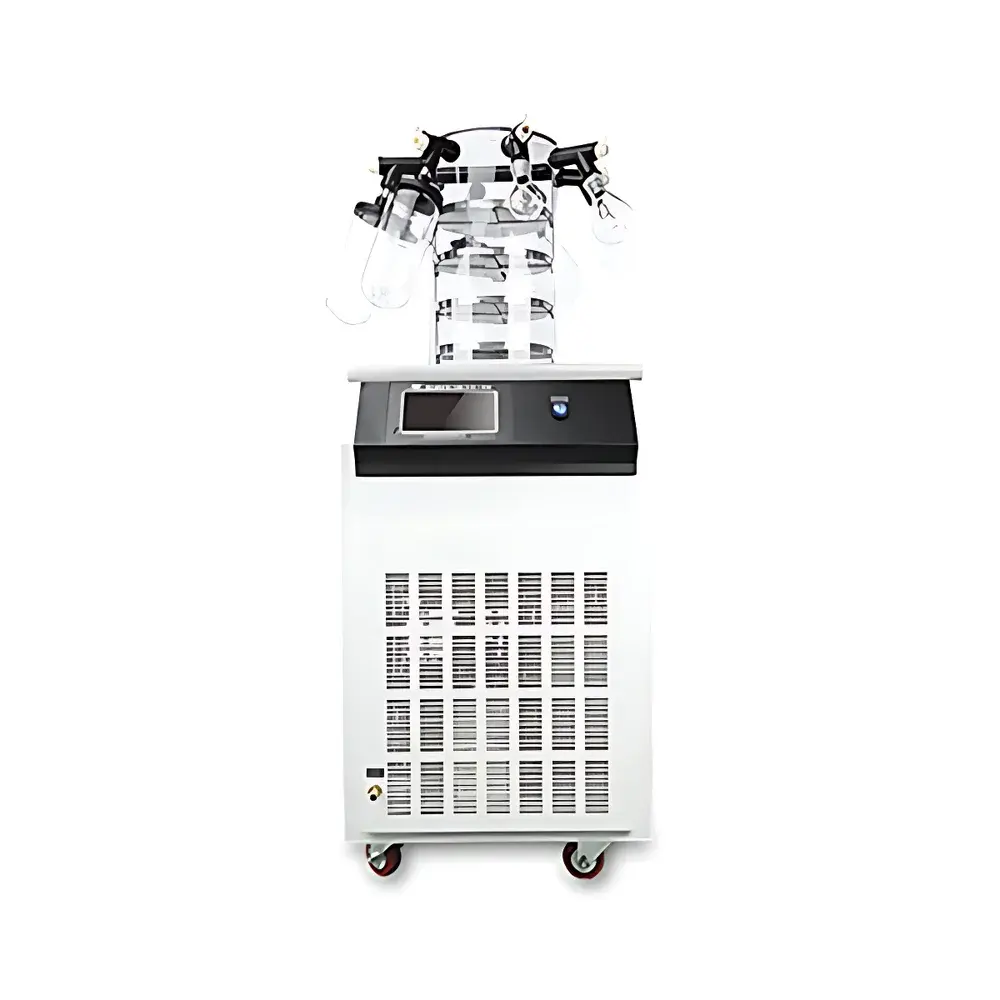
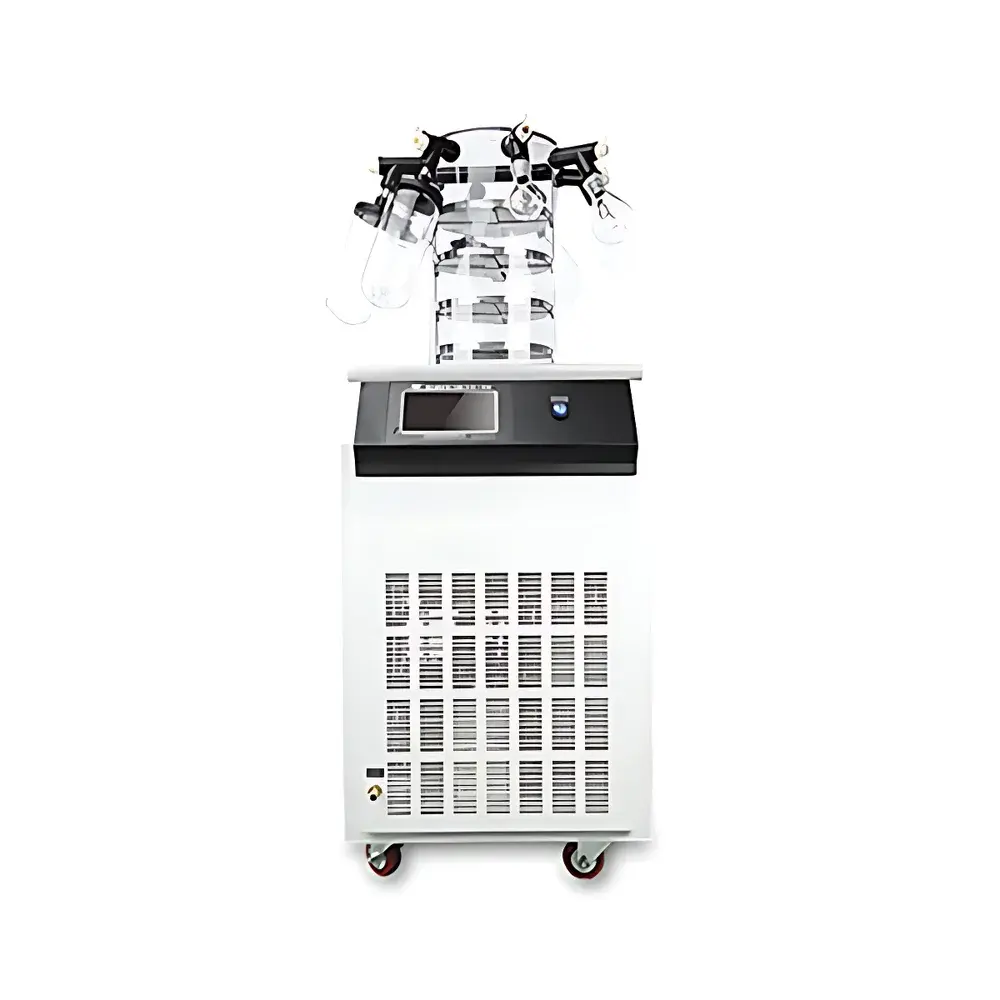
Ningbo Scientz SCIENTZ-18N/C Benchtop Manifold Freeze Dryer
| Brand | Scientz |
|---|---|
| Origin | Zhejiang, China |
| Manufacturer Type | Direct Manufacturer |
| Instrument Type | Manifold Benchtop Freeze Dryer |
| Application Scale | Pilot-Scale |
| Freeze-Drying Area | 0.12 m² |
| Ultimate Vacuum | ≤5 Pa |
| Condensate Capacity (24 h) | 4 kg/batch |
| Cold Trap Temperature | ≤−56 °C |
| Dimensions (L×W×H) | 600 × 450 × 720 mm + 440 mm (condenser height) |
Overview
The Ningbo Scientz SCIENTZ-18N/C is a pilot-scale manifold freeze dryer engineered for reproducible, high-integrity lyophilization of thermolabile biological, pharmaceutical, and material science samples. It operates on the principle of sublimation under deep vacuum—where frozen water transitions directly from solid to vapor without passing through the liquid phase—preserving structural integrity, bioactivity, and chemical conformation of sensitive analytes. Designed with an integrated cold trap, vacuum-controlled drying chamber, and modular manifold interface, the system delivers consistent primary drying performance across diverse sample formats including vials, flasks, and ampoules. Its compact footprint (600 × 450 × 720 mm main unit + 440 mm condenser height) enables seamless integration into regulated laboratory environments where space efficiency and operational reliability are critical.
Key Features
- High-efficiency refrigeration system featuring imported compressors, achieving ≤−56 °C cold trap temperature (optional −80 °C dual-stage cascade configuration available)
- 7-inch true-color LCD touchscreen with industrial-grade embedded OS; real-time display of cold trap temperature, chamber pressure, shelf temperature (if equipped), and vacuum level
- Automated process control with built-in data logging: freeze-drying curves stored internally and exportable via USB to PC-based analysis software
- Optically transparent, one-piece polycarbonate drying chamber—chemically resistant, shatter-resistant, and fully sealable—enabling full visual monitoring of sublimation progression
- Manifold port configuration (standard 8 ports) compatible with internationally standardized lyophilization flasks and stopcock vials (e.g., Kimble, Wheaton)
- Vacuum pump protection logic: vacuum pump activation is inhibited until cold trap reaches setpoint temperature, extending pump service life and reducing oil contamination risk
- Optional accessories include vacuum oil mist filter, automatic pressure differential valve (prevents oil backstreaming), electrical defrost function, and eutectic point detection module
Sample Compatibility & Compliance
The SCIENTZ-18N/C accommodates a broad spectrum of sample types requiring low-temperature, low-pressure desiccation—including microbial cultures, viral suspensions, serum proteins, monoclonal antibodies, nucleic acids, plant extracts, food matrices (vegetables, meat), environmental solids (soil, sludge), and nanomaterial dispersions. Its design supports GLP-compliant workflows: all process parameters are timestamped and auditable; data storage meets minimum retention requirements for method validation. While not certified to ISO 22000 or FDA 21 CFR Part 11 out-of-the-box, the system’s deterministic control architecture and traceable parameter logging facilitate qualification under internal SOPs aligned with USP <1211>, ISO 13485, and ICH Q5C stability testing guidelines.
Software & Data Management
The embedded operating system records time-stamped values for vacuum pressure (Pa), cold trap temperature (°C), and chamber status at user-defined intervals (default: 10 s). Up to 100 freeze-drying protocols may be saved onboard; each includes ramp rates, hold durations, and endpoint criteria. Data exports in CSV format via USB flash drive for post-processing in Excel, MATLAB, or dedicated lyo-analytics platforms. Optional PC-based software provides curve overlay, deviation analysis, and batch comparison tools—supporting root cause investigation during process optimization or deviation review. Audit trail functionality (user login, parameter changes, start/stop events) is configurable per institutional IT security policies.
Applications
- Academic & Government Research: Lyophilization of bacterial/viral stocks (e.g., ATCC strains), plant tissue specimens, pesticide residue standards, soil microbiome samples, and vaccine candidates
- Pharmaceutical Development: Preparation of sterile powders for injectables, formulation screening of biologics, stability studies per ICH Q1A–Q1E, and excipient compatibility testing
- Food & Agriculture Science: Preservation of probiotics, enzymatic extracts, functional food ingredients, and reference materials for nutritional profiling
- Materials Science: Drying of colloidal nanoparticles, aerogel precursors, and catalytic metal-organic frameworks—minimizing aggregation and preserving surface area
- Environmental Testing Labs: Processing of contaminated soils, wastewater biosolids, and airborne particulate filters prior to elemental or organic contaminant analysis
FAQ
What is the maximum batch capacity for this freeze dryer?
The SCIENTZ-18N/C supports up to 4 kg of ice condensation per 24-hour cycle, with a nominal drying area of 0.12 m²—optimized for pilot-scale processing of multiple small-volume samples simultaneously.
Is the system compatible with GMP/GLP documentation requirements?
Yes—its deterministic control logic, timestamped data logging, and USB-exportable records enable alignment with internal quality systems; however, formal 21 CFR Part 11 compliance requires supplementary validation documentation and access controls implemented at the institutional level.
Can the cold trap temperature be lowered below −56 °C?
An optional dual-stage cascade refrigeration system is available, enabling cold trap operation down to −80 °C—recommended for low-eutectic-point formulations such as high-sugar or high-salt biological matrices.
Does the manifold configuration support automated stoppering?
No—the SCIENTZ-18N/C is a non-stoppering manifold system; vial stoppering must be performed manually post-drying under controlled inert gas (e.g., nitrogen or argon) using the integrated gas inlet valve.
What vacuum pump options are recommended for optimal performance?
Scientz validates compatibility with multiple international vacuum pump brands (e.g., Edwards, Welch, Leybold); selection should consider ultimate vacuum specification (<1 Pa), pumping speed (>4 L/s), and inclusion of an oil mist filter for extended maintenance intervals.



