
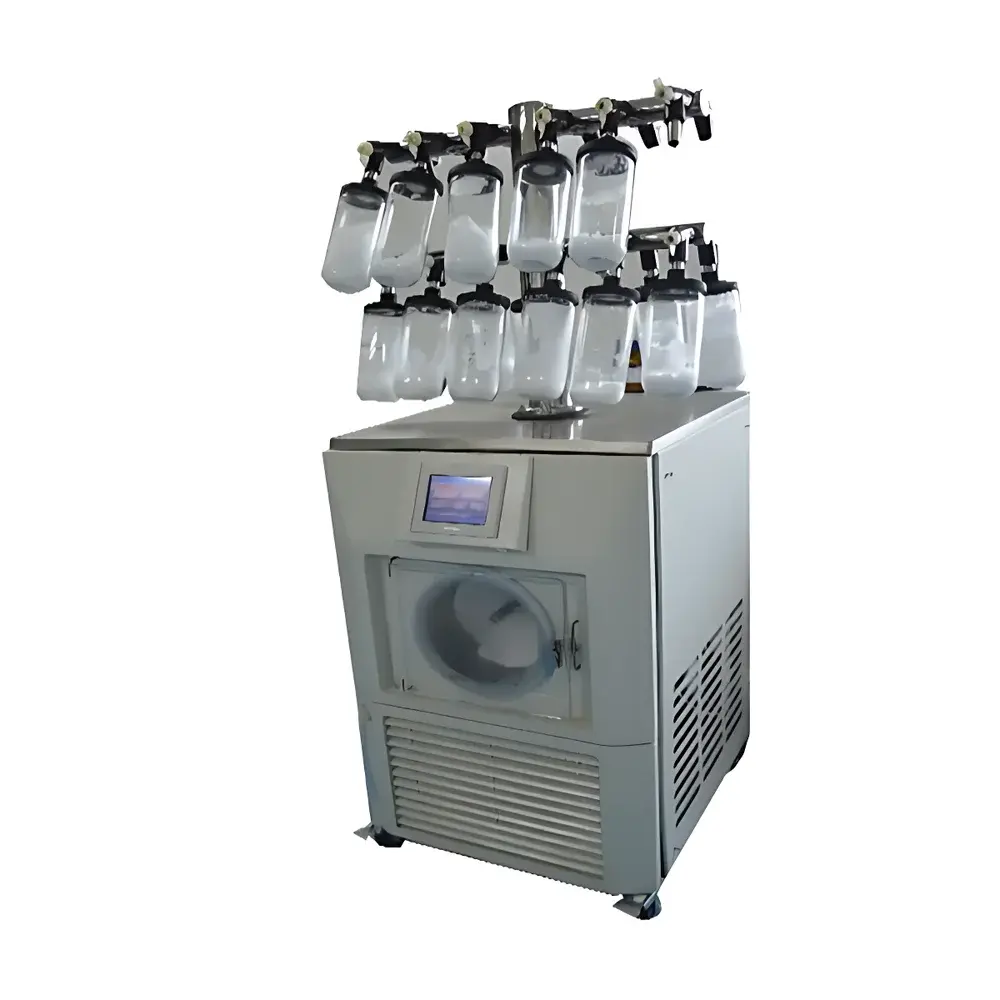
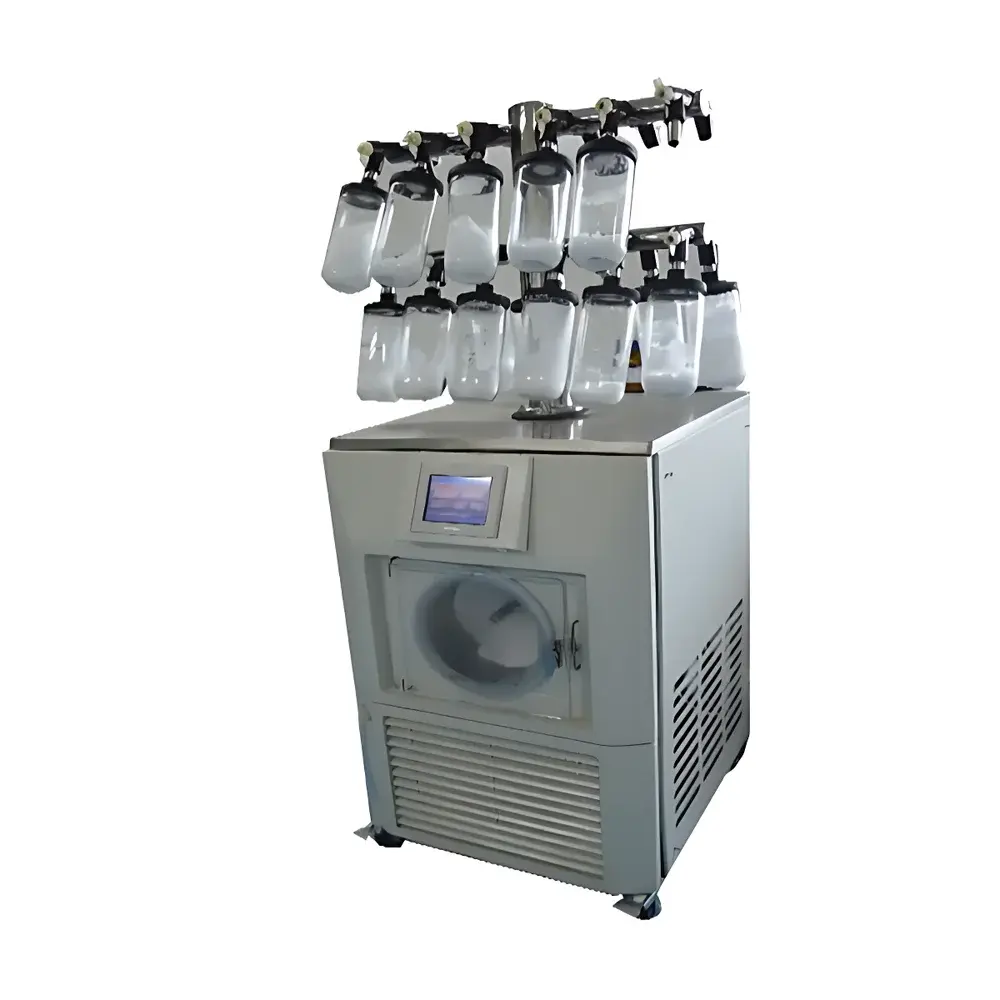
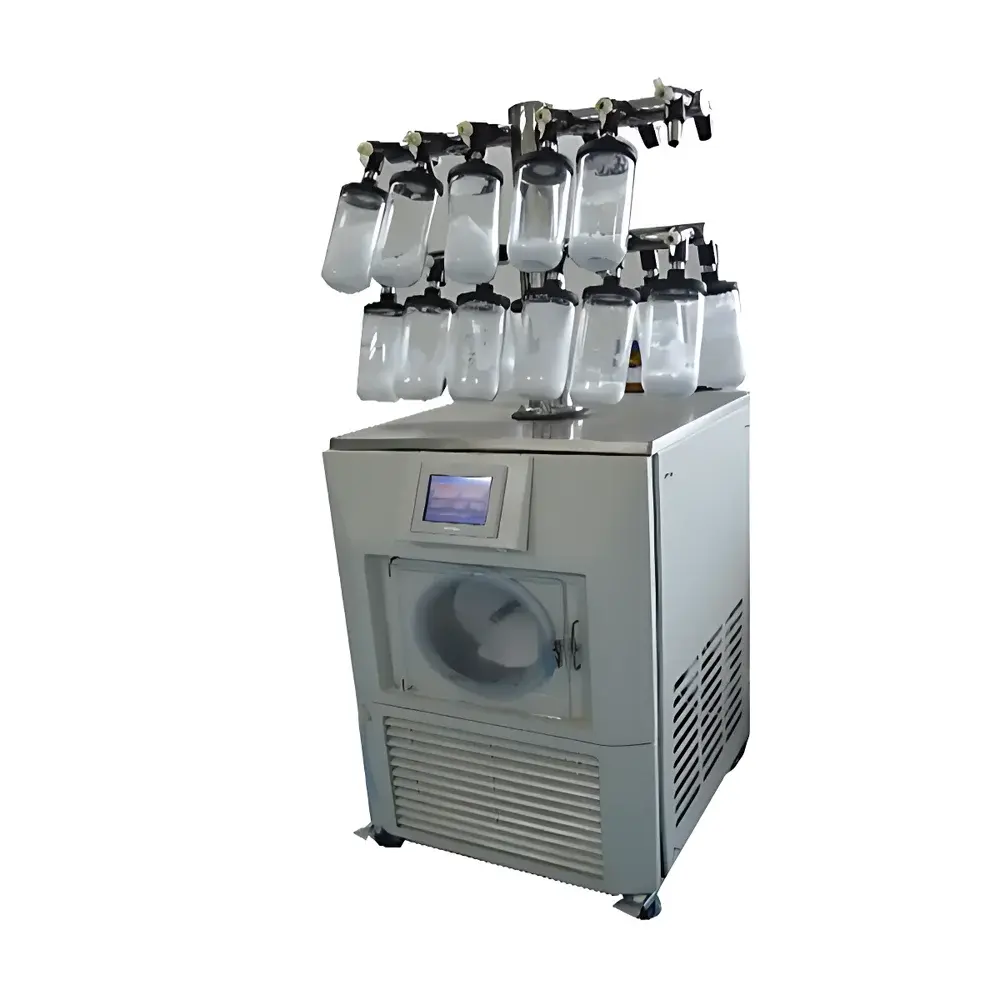
Ningbo Scientz Scientz-25T Benchtop Freeze Dryer
| Brand | Scientz |
|---|---|
| Origin | Zhejiang, China |
| Model | Scientz-25T |
| Instrument Type | Standard Shelf-Type Freeze Dryer |
| Application | Laboratory-Scale Lyophilization |
| Freeze-Drying Area | 2.5 m² |
| Ultimate Vacuum | ≤10 Pa |
| Condensate Capacity (24 h) | 15 kg/24 h |
| Cold Trap Temperature | ≤ −85 °C |
| Dimensions (W×D×H) | 2300 × 1200 × 2200 mm |
| Control System | PLC + Touchscreen HMI |
| Data Compliance | FDA 21 CFR Part 11–Ready Audit Trail & Exportable Log Files |
| Refrigeration Technology | Single-Unit Self-Contained Cascade Refrigeration System |
| Valve Actuation | Individual Silicone Rubber Stopper Valves per Flask |
| Optional Accessories | Customizable Flask Racks, Glass Vials, Vacuum Inlet Nozzles, Nitrogen Backfill Valve |
Overview
The Ningbo Scientz Scientz-25T is a laboratory-scale shelf-type freeze dryer engineered for reproducible, GxP-aligned lyophilization of heat-sensitive biologicals, pharmaceuticals, and research samples. It operates on the fundamental principle of sublimation—removing water from frozen material under deep vacuum while maintaining product integrity below its eutectic and collapse temperatures. Designed for benchtop-to-floor-standing deployment in QC labs, academic core facilities, and early-stage bioprocess development environments, the Scientz-25T integrates a self-contained cascade refrigeration system capable of sustaining cold trap temperatures ≤ −85 °C—critical for efficient vapor capture during primary drying of high-moisture or low-eutectic formulations. Its 2.5 m² shelf area supports scalable batch processing across multiple vial formats, while the ≤10 Pa ultimate vacuum ensures rapid mass transfer kinetics and minimizes residual moisture content in final dried cakes.
Key Features
- Self-contained cascade refrigeration system: Single-compressor architecture with dual-refrigerant circuit enables stable cold trap operation at ≤ −85 °C without external chillers or cryogens—reducing footprint, maintenance overhead, and operational risk.
- PLC-based control with industrial touchscreen HMI: Pre-programmable drying cycles (freeze, primary dry, secondary dry, purge) with real-time monitoring of shelf temperature, chamber pressure, cold trap temperature, and elapsed time.
- FDA 21 CFR Part 11–compliant data management: Built-in audit trail logs all operator actions, parameter changes, and alarm events; encrypted CSV export via USB port supports GLP/GMP documentation requirements.
- Automated vacuum protection logic: Monitors cold trap ice load and temperature in real time; automatically disengages vacuum pump if condenser saturation or thermal breakthrough is detected—preventing oil contamination and pump degradation.
- Intelligent defrost cycle: Pressure- and temperature-triggered automatic defrost reduces downtime between batches and improves energy efficiency versus manual or timer-based systems.
- Individual silicone rubber stopper valves per port: Enables selective, sequential flask isolation during drying—supporting multi-sample optimization and minimizing cross-contamination risk in heterogeneous batches.
- Integrated nitrogen backfill valve: Allows controlled inert gas purging post-drying to stabilize oxygen-sensitive products prior to sealing.
Sample Compatibility & Compliance
The Scientz-25T accommodates standard pharmaceutical glass vials (10–50 mL), serum bottles, and custom flask configurations via optional rack systems. Its shelf design permits uniform heat transfer across loaded surfaces, supporting both bulk tray drying and individual container processing. The system meets key international standards relevant to laboratory lyophilizers: ISO 22000–aligned hardware architecture, CE-marked electrical safety compliance (EN 61000-6-3, EN 61000-6-4), and mechanical design conforming to PED 2014/68/EU for vacuum vessels. While not certified as a Class A medical device, its data logging structure satisfies baseline traceability expectations for USP , ICH Q5C, and EU Annex 15 validation protocols when operated within validated parameters.
Software & Data Management
Data acquisition occurs at 1-second intervals across all critical sensors, stored locally in non-volatile memory with timestamped metadata. The embedded software generates time-stamped log files (.csv) containing shelf temp setpoint/actual, chamber pressure (Pirani + capacitance gauge), cold trap temp, vacuum pump status, and valve actuation events. All entries are digitally signed and append-only—no modification or deletion permitted post-generation. USB export supports integration into LIMS or electronic lab notebooks (ELN). Optional remote monitoring via Ethernet (Modbus TCP) allows centralized supervision in multi-unit lab environments without compromising local control authority.
Applications
- Stabilization of monoclonal antibodies, recombinant proteins, and viral vectors for preclinical storage and transport.
- Drying of microbial cultures, probiotics, and enzyme preparations where thermolability prohibits conventional dehydration.
- Preparation of calibration standards and reference materials requiring long-term matrix stability.
- Routine lyophilization of tissue homogenates, plasma fractions, and botanical extracts in analytical method development.
- Process parameter scouting for scale-up studies—shelving geometry and thermal response closely mirror production-scale shelf dryers.
FAQ
Does the Scientz-25T support validation protocols such as IQ/OQ/PQ?
Yes—the system provides calibrated sensor outputs, deterministic control logic, and full-cycle data logs required for installation qualification (IQ), operational qualification (OQ), and performance qualification (PQ) under ASTM E2500 and EU GMP Annex 15 guidelines.
Can shelf temperature be ramped independently of chamber pressure?
Yes—PLC sequencing allows independent programming of shelf temperature ramps, holds, and cooling rates synchronized with vacuum ramp profiles and pressure-controlled drying phases.
Is the cold trap accessible for routine ice removal without system shutdown?
No—ice removal requires full system shutdown and manual defrost; however, the automated defrost function significantly reduces cycle-to-cycle dwell time compared to passive melt methods.
What is the maximum allowable total load volume per batch?
Based on condensate capacity (15 kg/24 h) and typical aqueous sample densities, the recommended maximum load is 12–14 L of frozen solution at ≤15% solids concentration to ensure complete vapor capture within primary drying timeframes.
Are third-party calibration certificates available for temperature and pressure sensors?
Yes—NIST-traceable calibration reports for Pt100 shelf sensors and Pirani/capacitance gauges can be provided upon request, including as-found/as-left data and uncertainty budgets.



