
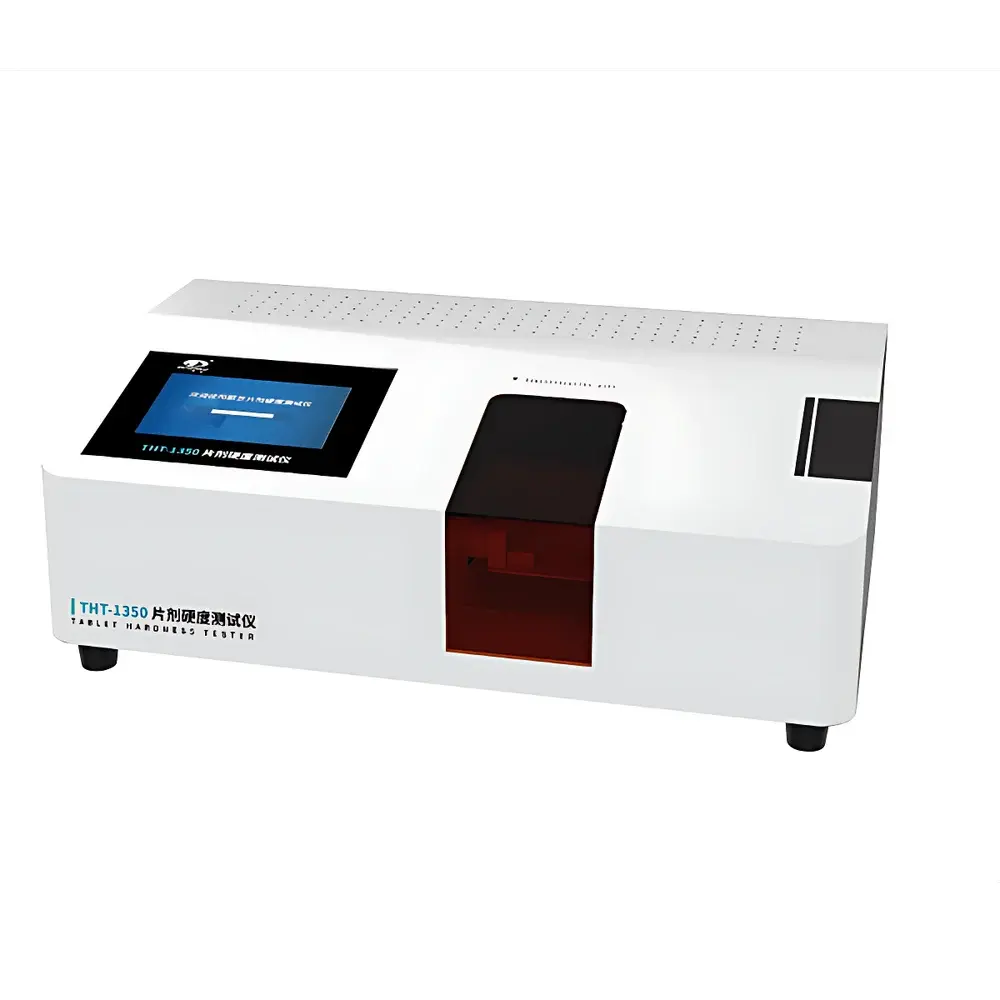
Ningbo Scientz THT-1350 Tablet Hardness Tester
| Brand | Scientz |
|---|---|
| Origin | Zhejiang, China |
| Manufacturer Type | Direct Manufacturer |
| Country of Origin | China |
| Model | THT-1350 |
| Pricing | Available Upon Request |
Overview
The Ningbo Scientz THT-1350 Tablet Hardness Tester is a precision-engineered instrument designed for the quantitative mechanical evaluation of pharmaceutical tablets in compliance with pharmacopoeial standards. It operates on the fundamental principle of axial compression testing—applying controlled, uniaxial force perpendicular to the tablet’s flat face until fracture occurs—and measures the maximum load (in Newtons or kiloponds) required to induce structural failure. This value—commonly reported as “tablet hardness”—is a critical quality attribute directly correlated with tablet integrity during packaging, transportation, and patient handling, as well as with downstream performance parameters such as disintegration time and dissolution rate. The THT-1350 is explicitly validated against the methodology described in Chapter 0901 (“Tablet Hardness”) of the Chinese Pharmacopoeia (ChP) 2020 Edition, ensuring alignment with national regulatory expectations for solid oral dosage forms.
Key Features
- High-resolution capacitive touch interface with intuitive navigation and dual-language support (English/Chinese), enabling rapid method setup and real-time operation without external software dependency.
- Integrated real-time clock (RTC) module synchronized to system time, automatically embedding date-and-time stamps into printed test reports—supporting traceability requirements under GLP and GMP frameworks.
- Calibrated high-stability load cell with temperature-compensated strain gauge technology, delivering repeatable force measurements across the full operational range (typically 0–200 N, configurable per calibration certificate).
- Embedded self-diagnostic firmware that monitors sensor linearity, actuator positioning, and signal noise thresholds; alerts users via on-screen prompts when deviations exceed predefined tolerance bands.
- Non-volatile memory storage for user-defined test protocols—including force ramp rate, dwell time, pass/fail thresholds, and units—retained after power cycling without manual reconfiguration.
- Onboard statistical engine performing automatic calculation of mean, standard deviation, relative standard deviation (RSD), min/max, and histogram distribution for batch-level data sets (up to 999 samples per session).
Sample Compatibility & Compliance
The THT-1350 accommodates standard convex, flat, and beveled tablets within a diameter range of 3–25 mm and thickness up to 12 mm. Its adjustable sample holder includes interchangeable anvils and centering guides to minimize lateral stress and ensure consistent load application geometry. All mechanical and electronic components comply with IEC 61010-1:2010 safety standards for laboratory equipment. While primarily aligned with ChP 2020, the instrument’s measurement methodology is functionally equivalent to USP <1217> (Mechanical Testing of Solid Oral Dosage Forms) and EP 2.9.8 (Hardness of Tablets), facilitating cross-regional validation. Optional IQ/OQ documentation packages are available to support installation and operational qualification under FDA 21 CFR Part 11-compliant environments.
Software & Data Management
Data output is generated via built-in thermal printer supporting both raw measurement logs and summary reports with header metadata (operator ID, batch ID, instrument serial number, calibration status). Export functionality is limited to printed hardcopy; no USB, Ethernet, or Bluetooth connectivity is provided—intentionally minimizing cybersecurity surface area and aligning with closed-system validation strategies common in regulated manufacturing. Calibration records—including zero offset, span verification, and linearity checks—are stored internally and printable on demand, satisfying audit requirements for metrological traceability to national standards (e.g., CNAS-accredited reference weights).
Applications
- QC release testing of commercial tablet batches prior to packaging and distribution.
- Formulation development studies assessing excipient impact on compactibility and tensile strength.
- Stability program monitoring to detect hardness drift over accelerated or long-term storage conditions.
- In-process control during rotary press operation, where real-time hardness feedback informs parameter adjustments (e.g., compression force, turret speed).
- Comparative analysis between generic and innovator products under bioequivalence investigation protocols.
FAQ
Does the THT-1350 support automated data export to LIMS or Excel?
No—the device outputs exclusively via its integrated thermal printer. Digital data transfer requires manual transcription or third-party optical character recognition (OCR) of printed reports.
Is external calibration certification included with purchase?
A factory calibration certificate is supplied; however, users must arrange periodic recalibration through an accredited metrology provider per internal SOPs and ISO/IEC 17025 requirements.
Can the instrument measure friability or disintegration?
No—hardness testing is a distinct mechanical parameter. Friability and disintegration require dedicated instruments (e.g., rotating drum testers or basket-rack dissolution apparatus) per ChP/USP monographs.
What maintenance is required for long-term accuracy?
Routine cleaning of the anvil surfaces and verification of mechanical alignment every 1000 cycles; annual verification of load cell linearity using certified test weights is strongly recommended.
Is the THT-1350 suitable for coated or film-coated tablets?
Yes—provided the coating does not significantly alter the tablet’s elastic modulus or introduce interfacial delamination under axial load. Users should validate method suitability for specific coated formulations per ICH Q5A.





