NISQ-5 Superconducting Quantum Processing Unit (QPU) System
| Brand | 1124123/13213112 |
|---|---|
| Origin | France |
| Supplier Type | Authorized Distributor |
| Import Status | Imported |
| Model | NISQ-5 |
| Price | USD 1.4M (FOB) |
Overview
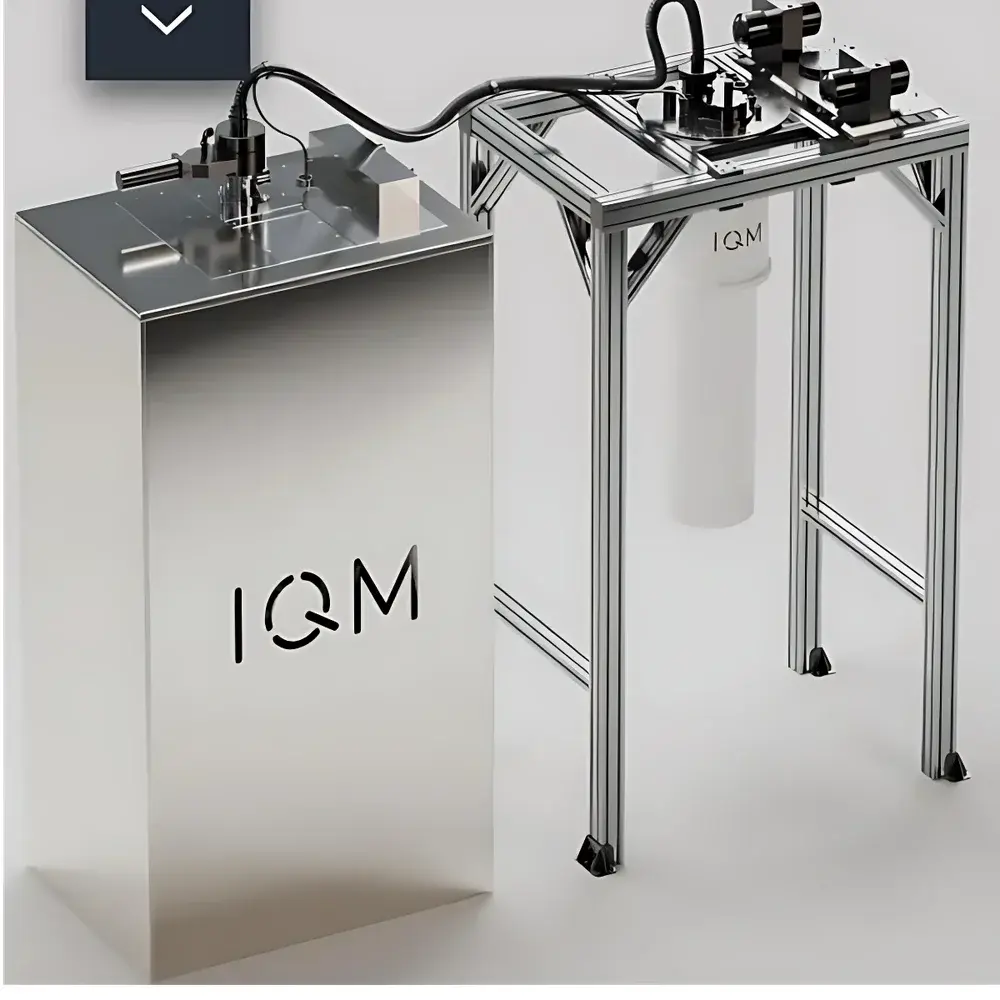
The NISQ-5 Superconducting Quantum Processing Unit (QPU) System is a turnkey, cryogenically integrated quantum computing platform engineered for academic laboratories and applied quantum research groups. Built on transmon-based superconducting qubit architecture, it implements microwave-driven gate operations within a dilution refrigerator environment operating below 15 mK. This system enables direct physical access to the full quantum stack—from microwave pulse generation and qubit control electronics to real-time readout and low-level calibration firmware—making it a foundational instrument for experimental quantum information science education and hardware-aware algorithm development. Unlike cloud-accessed quantum processors, the NISQ-5 provides deterministic latency, full-stack observability, and reproducible hardware conditions essential for benchmarking gate fidelity, characterizing T₁/T₂ coherence times, and validating error mitigation strategies in the Noisy Intermediate-Scale Quantum (NISQ) regime.
Key Features
- Five superconducting transmon qubits fabricated using standard Nb/AlOx/Nb Josephson junction process flow, with individual frequency tunability via flux bias lines
- Integrated dilution refrigerator with base temperature ≤15 mK, equipped with multi-stage thermal filtering and magnetic shielding compliant with ISO 14644-1 Class 5 cleanroom-compatible installation requirements
- Modular room-temperature control electronics: 16-channel arbitrary waveform generator (AWG) with 1 GS/s sampling rate and <100 ps timing resolution, plus 8-channel high-fidelity homodyne readout chain
- Firmware-level access to pulse-level scheduling, real-time feedback loops, and qubit-specific calibration routines (e.g., Rabi oscillation, Ramsey interferometry, randomized benchmarking)
- Open API architecture supporting Python-based control via QCoDeS and Qiskit Pulse frameworks; compatible with LabVIEW and MATLAB instrument drivers
Sample Compatibility & Compliance
The NISQ-5 system is designed exclusively for operation with superconducting quantum circuits mounted on silicon or sapphire substrates. It does not support solid-state spin systems, trapped ions, or photonic qubits. All cryogenic components meet IEC 61000-6-3 electromagnetic compatibility standards for laboratory environments. The control software architecture supports audit trails and user session logging aligned with GLP-compliant documentation workflows. While not certified for clinical or industrial production use, the system’s firmware and calibration protocols are structured to align with ISO/IEC 17025 principles for measurement uncertainty quantification in research-grade instrumentation.
Software & Data Management
The system ships with QuantumLab OS—a Linux-based real-time operating system optimized for deterministic pulse sequencing and low-latency feedback. Data acquisition is performed at native ADC/DAC resolution (16-bit, 1 GS/s), with raw IQ waveforms stored in HDF5 format alongside metadata tags (timestamp, temperature, flux bias, gate sequence ID). Software includes built-in tools for coherence time extraction (T₁, T₂*, echo), gate set tomography (GST), and cross-talk matrix characterization. Export functionality supports CSV, JSON, and QASM 3.0 formats. All software binaries are signed and version-controlled via Git LFS; source code for calibration utilities is provided under a research-use license compliant with US export control regulations (EAR99).
Applications
- Hands-on quantum hardware instruction: students calibrate qubits, visualize Bloch sphere trajectories, and implement single- and two-qubit gates using microwave pulses
- Experimental validation of quantum error mitigation techniques—including zero-noise extrapolation, probabilistic error cancellation, and Clifford data regression
- Characterization of material-induced decoherence mechanisms (e.g., two-level system defects, quasiparticle poisoning) through spectral noise mapping and flux noise spectroscopy
- Development and testing of variational quantum algorithms (VQE, QAOA) under realistic gate fidelity constraints (average single-qubit gate fidelity >99.95%, two-qubit CZ fidelity >99.2%)
- Integration with classical instrumentation: synchronization with oscilloscopes, spectrum analyzers, and fast digitizers for time-resolved microwave signal analysis
FAQ
What cryogenic infrastructure is required for on-site installation?
A dedicated 220 V / 32 A single-phase power circuit and floor-mounted vibration-isolated foundation are mandatory. The system includes its own closed-cycle dilution refrigerator; no liquid helium or nitrogen supply is needed.
Is remote operation supported without compromising hardware access?
Yes—SSH-based secure shell access enables full command-line control from external networks. However, real-time pulse streaming requires local network latency <100 µs; remote execution of time-critical sequences is not recommended.
Can third-party microwave sources or digitizers be integrated?
The control electronics feature standard PXIe and GPIB interfaces. Integration with external instruments is possible via SCPI or vendor-specific APIs, subject to timing synchronization validation by the user.
Does the system support quantum volume (QV) benchmarking?
Yes—the included benchmarking suite implements the QV protocol per IBM’s open specification (arXiv:1907.13347), with results exportable for comparative analysis against published NISQ device metrics.