
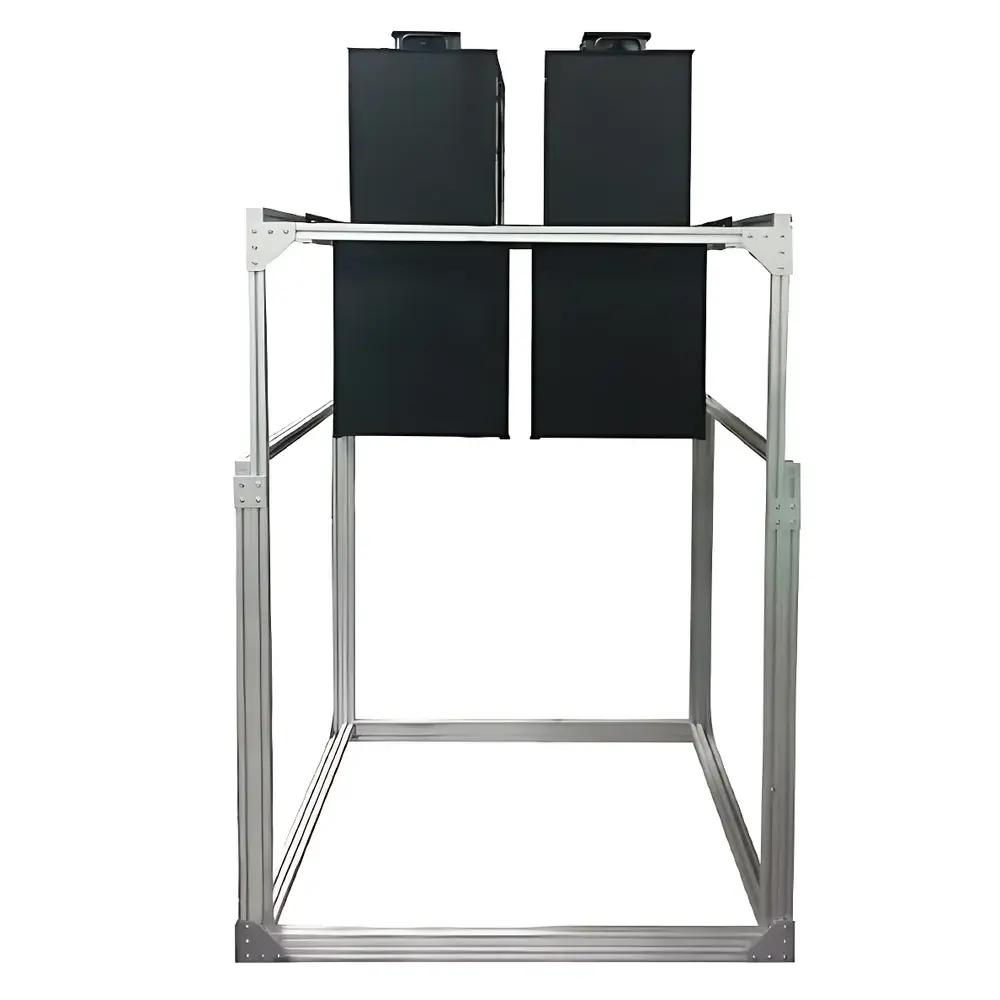
Nmerry LASI Large-Area Solar Simulator
| Brand | Nmerry |
|---|---|
| Origin | Beijing, China |
| Manufacturer Type | Manufacturer |
| Product Category | Domestic |
| Model | LASI |
| Price Range | USD 42,000 – 70,000 (FOB) |
| Operating Mode | Steady-State |
Overview
The Nmerry LASI Large-Area Solar Simulator is an engineered optical system designed to replicate the spectral irradiance and spatial uniformity of natural sunlight under controlled laboratory conditions. Based on the principles of broadband xenon arc illumination coupled with precision beam homogenization and spectral filtering, the LASI system delivers Class C spectral match per ASTM E927-23, IEC 60904-9:2020, and JIS C 8912:2015 for AM1.5G reference spectra. Its core architecture integrates a 1600 W xenon short-arc lamp, multi-element collimating optics, IR-rejecting thermal filters, and a custom-engineered light integrator—enabling stable, continuous-output irradiance at 1-sun intensity (1000 W/m² ±5% at target plane center) across scalable illumination areas. The system is explicitly engineered for integration into environmental test chambers, wind tunnels, and climate-controlled enclosures used in automotive, rail, aerospace, and defense applications—where large-format irradiation, depth-of-field tolerance, and long-duration stability are critical.
Key Features
- Modular scalability: Each LASI unit measures 0.5 × 0.5 × 1.6 m and can be tiled in 2×2, 4×4, or 6×6 configurations to achieve illumination areas up to 3.0 × 3.0 m².
- High optical efficiency: Delivers up to 40% greater luminous efficacy than conventional metal halide solar simulators—reducing power consumption, thermal load, and operational cost without compromising irradiance fidelity.
- Deep uniformity volume: Maintains ±15% spatial non-uniformity over defined test zones (e.g., <±15% over 2.5 × 2.5 m for 6×6 configuration) with ±0.5 m depth tolerance at ±20% intensity variation.
- Steady-state operation: Continuous-duty cycling with forced-air cooling ensures thermal equilibrium and temporal instability compliant with Class B per IEC 60904-9 (ΔI/I ≤ ±2% over 10 s, ±0.5% over 1 h).
- AM1.5G spectral compliance: Standard configuration includes integrated thermal cutoff filters achieving ASTM Class C spectral match; optional A- or B-class filters available upon request.
- Robust mechanical design: IP54-rated enclosure, integrated lamp power supply, and field-serviceable optical train support GLP-aligned maintenance protocols.
Sample Compatibility & Compliance
The LASI simulator accommodates irregularly shaped, three-dimensional test articles—including full-scale vehicle cabins, railcar façades, UAV airframes, and military equipment housings—without requiring repositioning or secondary collimation. Its ±10° collimation half-angle and 3-meter depth of uniformity enable reliable irradiance delivery across complex geometries. The system meets structural and performance requirements of IEC 61215-1:2021 (crystalline silicon PV module qualification), IEC 61646:2008 (thin-film PV modules), and MIL-STD-810H Method 505.6 (solar radiation testing). All delivered irradiance profiles are traceable to NIST-calibrated reference cells and documented per ISO/IEC 17025-accredited calibration procedures.
Software & Data Management
While the LASI operates as a hardware-integrated standalone system, it supports analog/digital I/O interfaces (0–10 V, RS-485, Ethernet TCP/IP) for synchronization with external data acquisition platforms, climate chamber controllers, and IV curve tracers. Optional integration with Nmerry’s SolarSim Control Suite enables real-time irradiance logging, spectral drift trending, lamp aging compensation, and automated reporting aligned with FDA 21 CFR Part 11 audit trail requirements. All calibration certificates, spectral scans, and uniformity maps are stored in vendor-neutral CSV and XML formats compatible with LIMS and QMS environments.
Applications
- Photovoltaic module performance validation under standardized AM1.5G illumination
- UV resistance and photochemical degradation testing of polymers, coatings, and composites
- Thermal stress evaluation of aerospace thermal control surfaces and satellite solar array substrates
- Accelerated aging studies for automotive interior materials (ISO 4892-2, SAE J2527)
- Colorfastness assessment of textiles and paints per ISO 105-B02 and AATCC TM16
- System-level reliability testing of solar-powered avionics and unmanned ground systems
FAQ
What spectral classification does the standard LASI configuration achieve?
Standard LASI units meet ASTM E927 Class C spectral match for AM1.5G, verified via calibrated spectroradiometer measurements across 350–1800 nm.
Can LASI be integrated into an existing environmental chamber?
Yes—LASI modules are designed for ceiling-mount or side-mount integration with configurable beam steering mirrors and sealed optical ports compliant with IEC 60529 IP54 ingress protection.
Is radiometric calibration included with delivery?
Each unit ships with a factory-issued NIST-traceable calibration certificate covering spectral irradiance, spatial uniformity, and temporal stability—valid for 12 months under normal operating conditions.
What cooling method is employed?
Forced-air convection with thermostatically regulated airflow ensures lamp and optic temperature stability during continuous operation; no liquid cooling infrastructure required.
Are custom spectral filters available?
Yes—Nmerry offers application-specific filter sets for extended UV (280–400 nm), enhanced NIR (1100–1800 nm), or narrowband spectral tuning, all characterized and certified per IEC 60904-9 Annex D.




