
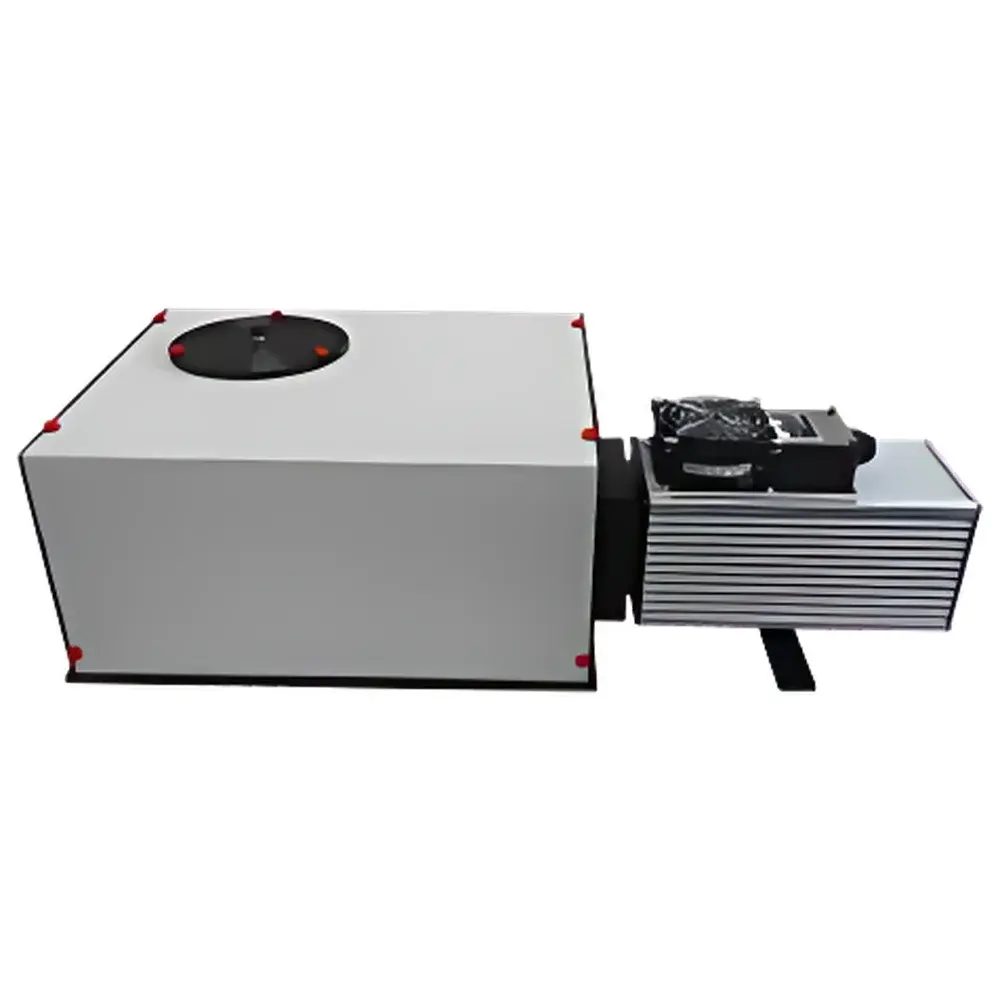
Nmerry SS150 Full-Reflection Solar Simulator
| Brand | Nmerry |
|---|---|
| Origin | Beijing, China |
| Manufacturer Type | Direct Manufacturer |
| Model | SS150 |
| Illumination Mode | Steady-State |
| Light Source | 150 W Xenon Short-Arc Lamp |
| Spectral Classification | ASTM E927-05 Class A (AM1.5G & AM0) |
| Collimation Angle | ±2.5° |
| Irradiance at Target | 100 mW/cm² |
| Spatial Uniformity | <2% (Class A) |
| Temporal Instability | <2% (Class A) |
| Spectral Match Range | 300–1400 nm |
| Working Distance | 76 ± 2.5 cm |
| Line Regulation Requirement | 0.01% |
| Filter Compatibility | 3″ Slot, 0° & 45° Incidence Options |
| Optional Accessories | Computer-Controlled Shutter, Beam Turner Assembly, Downward-Facing Vertical Stand (DFS-150), IR Water Filter, Air Mass Filters (AM0), UV/VIS/IR Selective Filters |
Overview
The Nmerry SS150 Full-Reflection Solar Simulator is a compact, Class A-certified illumination source engineered for high-fidelity photovoltaic (PV) device characterization and accelerated exposure testing under standardized solar spectra. Unlike refractive optical systems—whose spectral transmission is constrained by material dispersion, absorption edges, and chromatic aberration—the SS150 employs an all-reflective optical architecture based on precision-machined, metal-coated mirrors. This design ensures broadband spectral fidelity from 300 nm to 1400 nm without intrinsic color shift or wavelength-dependent focus drift. The system utilizes a stabilized 150 W xenon short-arc lamp as its primary source, coupled with collimating and homogenizing reflectors to deliver a spatially uniform, temporally stable, and spectrally matched irradiance of 100 mW/cm² at the target plane. Its ±2.5° collimation angle supports accurate angular response evaluation in PV cell and module testing, while the 76 ± 2.5 cm working distance enables integration into gloveboxes, environmental chambers, or custom test rigs.
Key Features
- ASTM E927-05 Class A spectral match for both AM1.5G and AM0 reference spectra across 300–1400 nm
- Full-reflective optical path eliminates chromatic aberration and material-induced spectral attenuation
- Steady-state operation with temporal instability <2%, meeting Class A stability requirements
- Optical uniformity <2% over a 5 cm diameter target area, verified per ASTM E927-05
- Modular lamp housing with optional light intensity stabilizer (FS-02) for long-term irradiance consistency
- Computer-controlled shutter (SSES) for precise exposure timing and automated test sequencing
- Beam-turner assembly (CTBT) enabling 45° redirection without optical loss or polarization distortion
- Downward-facing vertical stand (DFS-150) for gravity-assisted sample mounting and thermal management
Sample Compatibility & Compliance
The SS150 is compatible with standard PV test coupons (up to 5 cm Ø), mini-modules, perovskite films, organic photovoltaics (OPVs), and photoelectrochemical cells. Its reflective optics support direct integration with vacuum chucks, thermoelectric coolers, water-jacketed stages, and micro-positioning platforms—enabling controlled temperature, pressure, and alignment during I-V curve tracing or quantum efficiency mapping. All spectral match data are traceable to NIST-calibrated reference detectors and conform to ASTM G173-03 (AM1.5G) and ASTM E490-00a (AM0). The system supports GLP-compliant workflows through optional audit-trail-capable control software and meets baseline requirements for ISO/IEC 17025-accredited laboratories performing PV calibration and qualification per IEC 61215, IEC 61646, and UL 1703.
Software & Data Management
The SS150 operates via Nmerry’s proprietary SolarSim Control Suite, a Windows-based application supporting real-time irradiance monitoring, shutter actuation scheduling, lamp warm-up profiling, and automated filter wheel sequencing. Data logging includes timestamped irradiance values (±0.5% repeatability), lamp voltage/current traces, and thermal feedback from optional stage sensors. Export formats include CSV, MATLAB .mat, and HDF5 for downstream analysis in PVsyst, SCAPS, or custom Python/Matlab pipelines. When configured with FDA 21 CFR Part 11-compliant firmware (optional), the system provides electronic signatures, user-level access control, and immutable audit trails—essential for regulated R&D environments conducting pre-commercial validation or regulatory submissions.
Applications
- Primary and secondary calibration of reference cells and pyranometers against AM1.5G and AM0 standards
- Current–voltage (I–V) characterization of silicon, CIGS, CdTe, perovskite, and tandem solar cells
- UV-enhanced degradation studies (e.g., UVA/UVB-selective irradiation using 400 nm longpass or UVA-pass filters)
- Photo-stability assessment of encapsulants, anti-reflective coatings, and polymer substrates
- Spectral response (QE/IPCE) measurement with monochromator-coupled configurations
- In-situ electrochemical impedance spectroscopy (EIS) under simulated sunlight
- Accelerated aging protocols compliant with IEC 61215-2 MQT 03 (UV preconditioning) and MQT 10 (damp heat)
FAQ
What spectral classes does the SS150 meet, and which standards are used for verification?
The SS150 achieves Class A spectral match per ASTM E927-05 for both AM1.5G (300–1400 nm) and AM0 (300–1400 nm) spectra, validated using calibrated spectroradiometers traceable to NIST SRM 2065 and 2066.
Can the SS150 be integrated into an automated test station with external triggers?
Yes—digital I/O ports support TTL-compatible start/stop signals, and the control software exposes a COM interface for LabVIEW, Python, or MATLAB integration.
Is ozone generation mitigated in the 150 W xenon lamp configuration?
All standard SS150 lamps are ozone-free quartz envelopes; optional UV-blocking hot mirrors further suppress sub-200 nm emission.
How is irradiance uniformity measured and maintained over time?
Uniformity is mapped using a 100-point scanning radiometer before shipment; recalibration is recommended annually or after 500 lamp-hours, with Nmerry providing traceable recalibration services.
Are air mass filters included by default, or are they optional accessories?
AM0 filters (160-8020 series) are optional add-ons; the base SS150 delivers unfiltered xenon output, allowing users to select spectral shaping based on application-specific requirements.






