
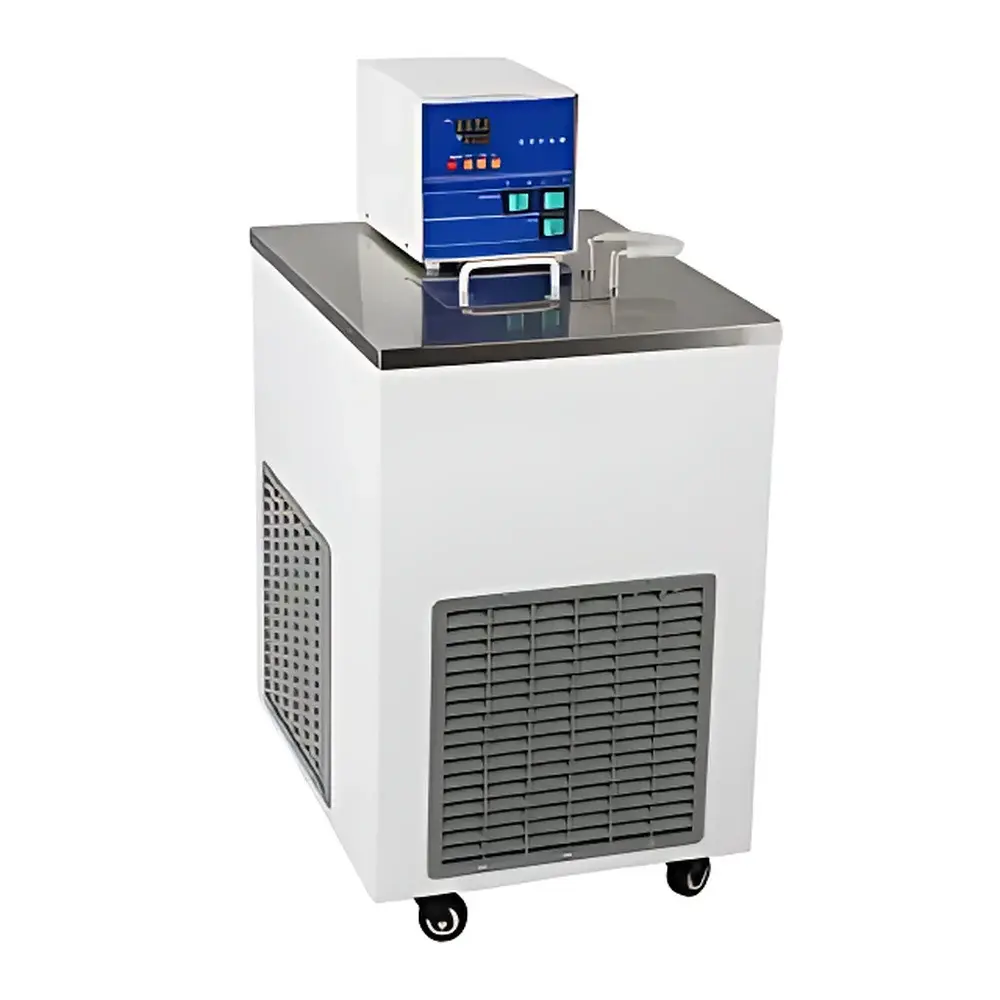
NOKI DC-2010 10L Low-Temperature Constant-Temperature Bath
| Brand | NOKI |
|---|---|
| Origin | Jiangsu, China |
| Model | DC-2010 |
| Capacity | 10 L |
| Temperature Range | −20 °C to +100 °C |
| Bath Chamber Dimensions | 290 × 200 × 180 mm (W×D×H) |
| Depth | 180 mm |
| Opening Size | 160 × 120 mm |
| Flow Rate | 8 L/min |
| Heating Power | 1 kW |
| Refrigeration Capacity | 280–1100 W |
| Temperature Display Resolution | 0.1 °C |
| Control Method | PID-based microprocessor control |
| Internal/External Circulation | Yes |
| Over-Temperature & Over-Current Protection | Yes |
| Compressor Type | High-efficiency low-noise anti-interference compressor |
| Display | Dual LED digital display (red PV / green SP) |
Overview
The NOKI DC-2010 is a precision-engineered 10-liter low-temperature constant-temperature bath designed for stable thermal management in laboratory and quality control environments. It operates on the principle of active liquid circulation thermoregulation—utilizing a dual-mode refrigeration-heating system with a high-efficiency hermetic compressor and resistive heating element—to maintain setpoint temperatures across a broad range of −20 °C to +100 °C. The unit delivers uniform thermal distribution within its stainless-steel bath chamber via optimized internal fluid dynamics and supports both internal temperature stabilization and external temperature control through its dual-circulation architecture. Its design prioritizes long-term stability, repeatability, and operational safety—making it suitable for applications requiring sustained thermal conditioning of samples, calibration standards, or ancillary equipment such as viscometers, spectrophotometers, or reaction vessels.
Key Features
- PID-based microprocessor temperature controller with auto-tuning capability ensures rapid thermal equilibration and deviation correction, achieving ±0.1 °C temperature stability under steady-state conditions.
- Dual LED digital display interface: red PV (process value) and green SP (setpoint) enable immediate visual verification of operational status without ambiguity.
- Integrated over-temperature and over-current protection circuits safeguard against thermal runaway and electrical fault conditions—critical for unattended operation and GLP-compliant workflows.
- High-efficiency anti-interference compressor minimizes acoustic emission (<52 dB(A)) and mechanical vibration, preserving integrity of sensitive optical or microgravimetric instrumentation placed nearby.
- Internal circulation mode maintains homogeneous bath temperature; external circulation mode enables closed-loop temperature control of external apparatus via flexible tubing connections (standard 10 mm OD quick-fit ports).
- Thermal insulation layer and sealed bath lid reduce ambient heat exchange, improving energy efficiency and minimizing condensation at sub-zero operating points.
Sample Compatibility & Compliance
The DC-2010 accommodates standard laboratory glassware (e.g., beakers up to Ø120 mm, reaction flasks, cuvette holders) and is compatible with aqueous, ethylene glycol–water, and ethanol–water coolant mixtures. Its stainless-steel bath chamber resists corrosion from common organic solvents and buffer solutions when operated within specified concentration limits. The unit conforms to IEC 61010-1:2010 for electrical safety in laboratory equipment and meets CE marking requirements for electromagnetic compatibility (EMC Directive 2014/30/EU). While not certified for medical device use per ISO 13485, it supports GMP-aligned lab practices through programmable alarm logging, manual calibration offset entry, and traceable temperature setpoint history.
Software & Data Management
The DC-2010 operates as a standalone instrument with no embedded data logging or USB/RS232 connectivity. However, its analog output (0–5 V or 4–20 mA, optional upon request) permits integration into centralized SCADA or LIMS platforms for remote monitoring. Users may record temperature profiles manually or via external dataloggers connected to the analog port. For audit-trail compliance in regulated environments (e.g., pharmaceutical QC per USP <1058>), operators are advised to pair the unit with validated third-party recording systems that support 21 CFR Part 11 electronic signature functionality.
Applications
- Calibration of temperature-sensitive sensors (RTDs, thermistors, infrared thermometers) against NIST-traceable references.
- Thermal conditioning of reagents prior to HPLC injection or enzymatic assays requiring strict thermal pre-equilibration.
- Stabilization of optical components (e.g., laser diodes, interferometer stages) subject to thermal drift.
- Cooling of exothermic reactions in jacketed reactors or calorimeters where precise ΔT control is required.
- Supporting ASTM D2857 (solution viscosity), ISO 3104 (petroleum products), and USP <797> environmental control protocols in compounding labs.
FAQ
What is the minimum achievable temperature with a 100% water fill?
At ambient conditions ≤25 °C and with distilled water, the DC-2010 reliably reaches −20 °C. Use of 30% ethylene glycol/water mixture extends low-temperature performance and prevents freezing-related stress on the pump and heat exchanger.
Can the bath operate continuously at 100 °C?
Yes—the heating system is rated for continuous duty at maximum setpoint. Ensure adequate ventilation around rear grilles and avoid covering the unit during prolonged high-temperature operation.
Is external circulation flow rate adjustable?
Flow is fixed at 8 L/min nominal; however, users may throttle flow using an inline needle valve installed on the outlet line—provided backpressure remains within pump specifications (≤0.2 MPa).
Does the unit support RS485 Modbus communication?
No—standard configuration includes only analog voltage/current output. Modbus RTU or Ethernet interfaces require factory-installed optional modules, quoted separately.
What maintenance intervals are recommended?
Compressor oil and refrigerant levels require inspection every 24 months by authorized service personnel. Coolant should be replaced annually if used with glycol mixtures; biannually for pure water operation. Filter cleaning is advised quarterly.



