
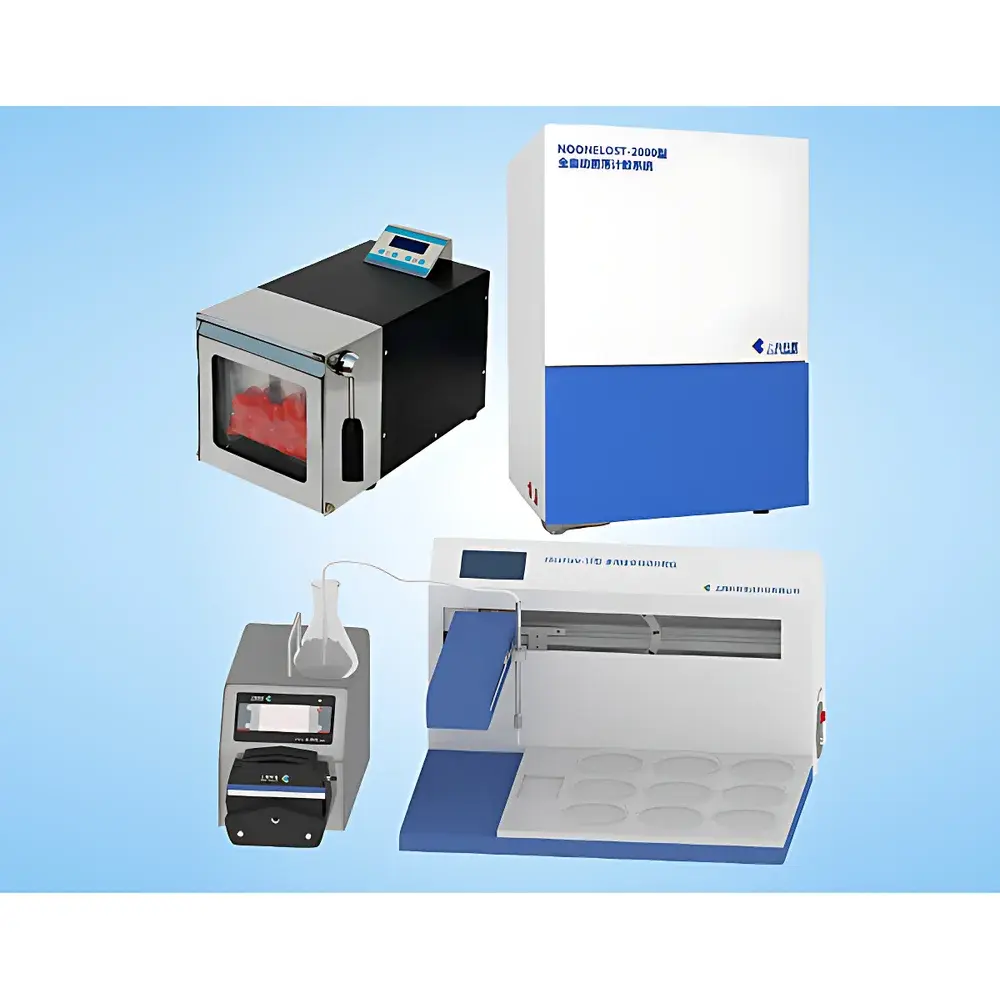
NooneLost-2300 Semi-Automatic Colony Counter System
| Brand | KEZHE SHANGHAI |
|---|---|
| Origin | Shanghai, China |
| Manufacturer Type | Direct Manufacturer |
| Instrument Type | Semi-Automatic Colony Counter |
| Counting Speed | >400 samples/h |
| Country of Origin | Domestic (China) |
Overview
The NooneLost-2300 Semi-Automatic Colony Counter System is an engineered solution for high-throughput microbial colony enumeration in quality control, clinical microbiology, food safety, and pharmaceutical testing laboratories. Designed around digital image acquisition and algorithm-assisted semi-automated detection, the system captures high-resolution images of agar plates under standardized illumination and applies morphological filtering, contrast enhancement, and adaptive thresholding to distinguish viable colonies from background noise or debris. Unlike fully automated systems requiring robotic plate handling, the NooneLost-2300 maintains operator oversight at critical decision points—such as colony merging resolution, edge discrimination, and contamination flagging—ensuring traceable, auditable, and scientifically defensible counts aligned with ISO 4833-1:2013, ISO 7218:2017, and FDA Bacteriological Analytical Manual (BAM) Chapter 3 guidelines.
Key Features
- Optimized optical path with uniform LED ring illumination (550 nm ± 20 nm) minimizing shadow artifacts and enhancing contrast between translucent colonies and opaque agar media.
- Semi-automated workflow: manual plate placement followed by one-click image capture, real-time preview, and interactive refinement of detection parameters (minimum/maximum colony size, circularity threshold, intensity cutoff).
- Integrated USB 3.0 camera module delivering ≥5 megapixel resolution with 12-bit dynamic range, supporting grayscale and color mode for differential colony identification (e.g., chromogenic media).
- Robust mechanical stage with adjustable height and centering guide, compatible with standard Petri dishes (90 mm, 100 mm, and 150 mm diameters) as well as square plates and membrane filters.
- Embedded firmware with onboard storage (8 GB) for temporary image caching and local backup prior to network transfer—critical for labs operating under restricted IT policies or offline validation environments.
- Compliance-ready audit trail: timestamped logs record user ID, plate ID, imaging settings, manual corrections, and final count values—supporting GLP/GMP documentation requirements per 21 CFR Part 11 when paired with validated LIMS integration.
Sample Compatibility & Compliance
The NooneLost-2300 accommodates a broad range of solid culture media, including but not limited to nutrient agar, TSA, VRBA, XLD, CHROMagar™ formulations, and membrane filtration assemblies on cellulose ester or polycarbonate filters. It supports both aerobic and anaerobic colony morphologies, provided sufficient contrast exists between colony and substrate. Validation protocols follow ISO/IEC 17025:2017 principles; users are advised to perform method-specific verification per ISO 11133:2014 (preparation and production of culture media) and internal SOPs. The system’s semi-automated architecture permits full operator intervention—essential for regulatory audits where algorithmic black-box counting is prohibited without documented justification.
Software & Data Management
The KEZHE ColonyCount Pro v3.2 software (Windows 10/11 64-bit) provides intuitive GUI navigation, multi-user role management (administrator, analyst, reviewer), and export options compliant with laboratory data integrity standards: CSV (tab-delimited), PDF reports with embedded images and metadata, and XML output compatible with major LIMS platforms (e.g., LabWare, STARLIMS, Thermo Fisher SampleManager). All counting sessions generate immutable .log files containing full parameter history, enabling retrospective reanalysis without image resampling. Optional API access allows scripted batch processing and integration into automated QA workflows governed by ASTM E2500-13 (verification of computerized systems).
Applications
- Quantitative microbial load assessment in raw materials, finished products, and environmental monitoring swabs (ISO 14644-1, ISO 14698).
- Validation of sterilization cycles and disinfectant efficacy studies (EN 13697, EN 1276).
- Stability-indicating assays for probiotic viability and shelf-life determination (USP <61> and <62>).
- Training and competency assessment in academic and contract research laboratories—leveraging dual-view comparison mode to align trainee counts with expert-reviewed benchmarks.
- Support for AOAC Official Methods of Analysis® (OMA) for foodborne pathogens when used in conjunction with selective enrichment and plating protocols.
FAQ
Is the NooneLost-2300 compliant with 21 CFR Part 11?
Yes—when deployed with validated software configuration, electronic signatures, and secure audit trail logging enabled, it meets baseline technical controls for electronic records and signatures in regulated environments.
Can the system count colonies on chromogenic or differential media?
Yes—color-mode imaging and customizable hue-saturation-value (HSV) filters enable reliable detection of pigmented colonies (e.g., E. coli on CHROMagar ECC, S. aureus on Baird-Parker agar).
What is the minimum colony size detectable?
Under optimal contrast conditions and with 90-mm plates, the system reliably detects colonies ≥0.15 mm diameter; performance depends on agar opacity, lighting uniformity, and user-defined size thresholds.
Does the system support network deployment or remote operation?
Local operation is standard; optional Ethernet/Wi-Fi module enables centralized image upload to shared drives or LIMS, though remote real-time control is not supported to preserve data integrity and chain-of-custody requirements.
How is calibration and performance verification performed?
KEZHE provides a NIST-traceable calibration slide with certified dot patterns (diameters 0.1–2.0 mm) and recommended verification protocol per ISO/IEC 17025 Annex A.4 for image-based measurement systems.
Related Products




