
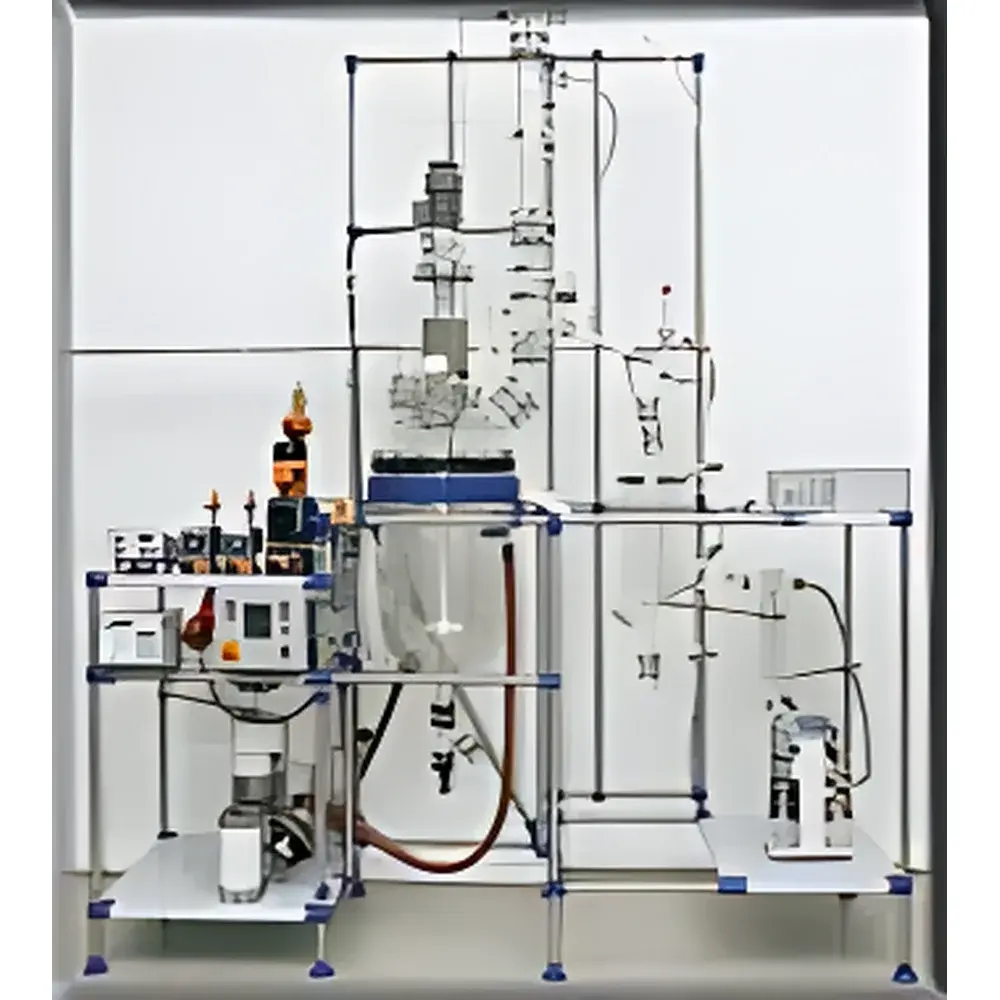
NORMAG 50L Borosilicate Glass Reactor System (Model: 50L-Glass-Reactor)
| Brand | NORMAG |
|---|---|
| Origin | Germany |
| Capacity | 50 L (adjustable range: 0.25 L to 200 L) |
| Construction Material | DIN 7080 / ISO 3585 borosilicate glass 3.3 (BSG 3.3) |
| Operating Pressure Range | -0.1 MPa (full vacuum) to +0.3 MPa (gauge) |
| Temperature Range | -30 °C to +200 °C |
| Contact Materials | BSG 3.3 and PTFE only |
| Modular Control Interface | Analog & digital I/O for temperature, pressure, stirring speed, and pH/DO sensors |
| Compliance | CE-marked, conforms to EN 61000-6-3 (EMC), EN 61000-6-2 (immunity), and DIN 12573 Part 1 (laboratory glassware standards) |
Overview
The NORMAG 50L Borosilicate Glass Reactor System is a modular, bench- to pilot-scale laboratory reactor engineered for precise control of liquid-phase chemical synthesis, extraction, crystallization, and bioprocess development. Based on Couette-type mixing geometry and jacketed thermal management, the system operates under controlled atmospheric conditions—vacuum, ambient, or mild overpressure—enabling reproducible kinetic studies and scalable process parameter mapping. Its core vessel is fabricated from certified DIN 7080 borosilicate glass 3.3, offering exceptional thermal shock resistance (ΔT ≤ 150 K), chemical inertness toward strong acids, alkalis, and organic solvents, and optical clarity for real-time visual monitoring of phase separation, precipitation, reflux behavior, and emulsion stability. Designed in accordance with ISO 3585 and DIN 12573-1 specifications for laboratory glass apparatus, the reactor supports both batch and semi-batch operation modes, with mechanical stirring driven by a brushless DC motor coupled to a PTFE-coated shaft and anchor or paddle impeller.
Key Features
- Full-view reaction chamber constructed entirely from borosilicate glass 3.3 (BSG 3.3), enabling direct observation of reaction homogeneity, gas evolution, solid formation, and interface dynamics
- Double-jacketed design compatible with circulating chillers (e.g., Huber Unistat) and heating media (e.g., silicone oil, glycol/water mixtures) for precise ±0.5 °C temperature regulation across the full -30 °C to +200 °C operational envelope
- Integrated pressure-rated lid assembly with standardized NS 29/32 and NS 45/50 ground-glass joints, PT100 sensor port, condenser inlet/outlet, addition funnel port, and gas inlet/outlet valves (all BSG 3.3 or PTFE-sealed)
- Modular measurement architecture supporting simultaneous acquisition of temperature (PT100), pressure (piezoresistive transducer), stirring speed (Hall-effect tachometer), and optional dissolved oxygen or pH via interchangeable sensor sleeves
- Stirring drive unit rated for continuous operation at up to 250 rpm with torque feedback and overload protection; impeller options include anchor, turbine, and pitched-blade configurations for Newtonian and non-Newtonian fluids
- CE-compliant electrical cabinet with IP54 enclosure, emergency stop circuit, and configurable analog/digital I/O for integration into centralized LabVantage or DeltaV DCS environments
Sample Compatibility & Compliance
The reactor is validated for use with corrosive reagents including concentrated HNO₃, H₂SO₄, NaOH (up to 50 % w/w), halogenated solvents (CH₂Cl₂, CHCl₃), and high-boiling-point media (DMSO, DMF, ethylene glycol). All wetted surfaces are limited to BSG 3.3 and virgin PTFE—no stainless steel, elastomers, or adhesives contact the reaction mixture. This ensures compatibility with GMP-aligned small-molecule API synthesis, catalyst screening (e.g., Pd/C, Raney Ni), and early-stage biocatalysis (lipase-, protease-, or oxidase-mediated transformations). The system meets requirements for GLP documentation per OECD Series on Testing and Assessment No. 112 and supports audit-ready electronic records when paired with 21 CFR Part 11–compliant data acquisition software.
Software & Data Management
Data logging is performed via optional NORMAG ControlSuite v3.2—a Windows-based SCADA platform supporting time-synchronized multi-channel recording at user-defined intervals (100 ms to 60 s resolution). Raw values are stored in .CSV and proprietary .NCS binary formats with embedded metadata (operator ID, timestamp, calibration certificates, method version). Trend analysis tools include derivative calculation (dT/dt, dP/dt), alarm thresholds with email/SMS notification, and export to MATLAB, Python (pandas), or LIMS via ODBC. Audit trails record all parameter changes, user logins, and file modifications in immutable format, satisfying FDA 21 CFR Part 11 and EU Annex 11 traceability mandates.
Applications
- Organometallic cross-coupling reactions (Suzuki, Heck, Stille) under inert atmosphere and controlled exotherm management
- Solvent-free esterification and transesterification for biodiesel process development
- Crystallization kinetics studies with in situ FBRM or PVM integration ports
- Enzymatic hydrolysis and fermentation modeling using pH-stat or gas evolution (CO₂) monitoring
- Photochemical reactions with optional quartz jacket or UV-transparent top port
- Process safety evaluation (RC1e, ARC) via controlled heat-wait-search protocols
FAQ
What is the maximum allowable working pressure for this reactor system?
The standard configuration is rated for continuous operation up to +0.3 MPa (gauge) and full vacuum (-0.1 MPa); custom pressure-rated lids up to +0.6 MPa are available upon request.
Can the system be integrated with automated dosing modules?
Yes—NS 29/32 ports accept third-party syringe pumps (e.g., CETONI neMESYS) or peristaltic feed systems with flow feedback and programmable ramp profiles.
Is the glass vessel replaceable as a standalone component?
Yes—the BSG 3.3 vessel is supplied with full dimensional drawings and ISO 9001 traceable material certification; replacement units are stocked for all standard capacities (0.25 L to 200 L).
Does the system support cGMP documentation packages?
NORMAG provides IQ/OQ protocols, calibration templates, and raw data integrity assessments compliant with ASTM E2500 and EU GMP Annex 15 upon order confirmation.



