
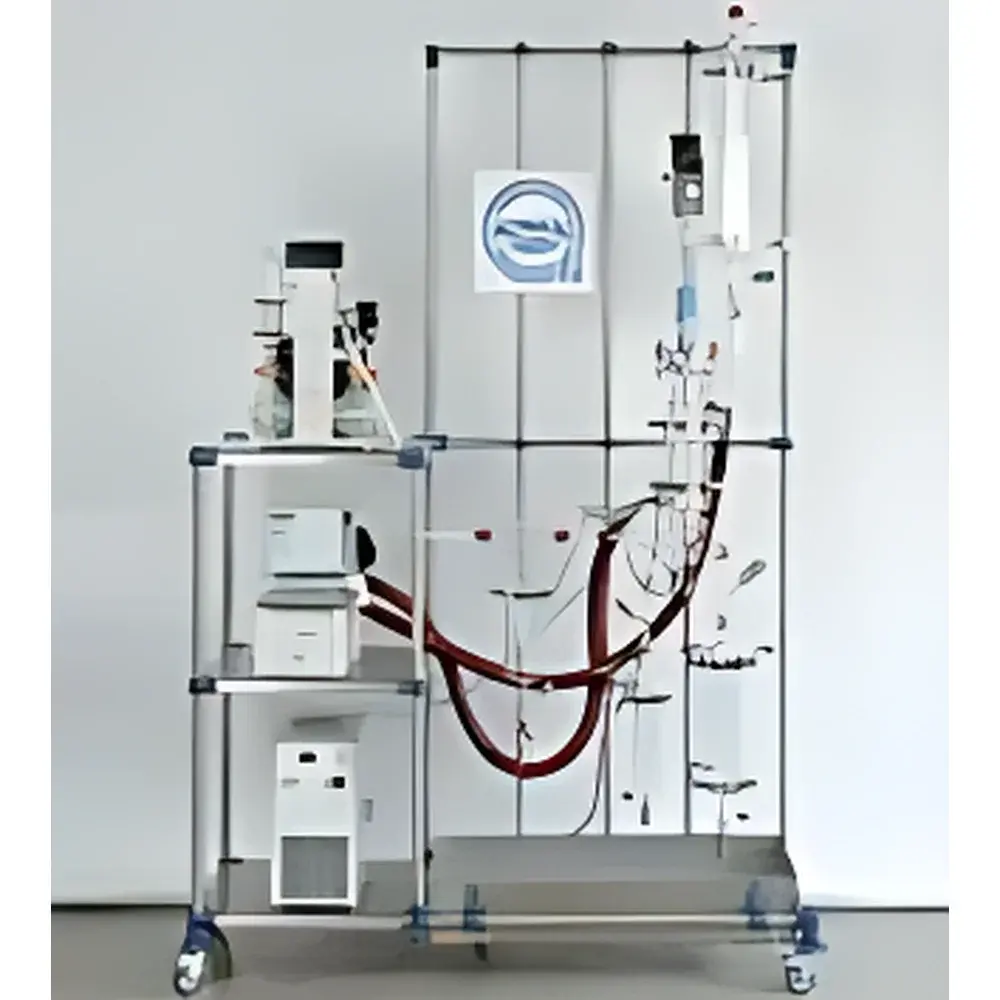
Normag DSV80 Short-Path Distillation System
| Brand | NORMAG |
|---|---|
| Origin | Germany |
| Model | DSV80 |
| Operating Pressure Range | 760 mbar to 1×10⁻³ mbar |
| Max. Heating Temperature | 250 °C |
| Feed Rate | 0.3–1 kg/h |
| Construction Material | High-purity quartz glass (Duran®-grade) |
| Vacuum Jacket | Ultra-high vacuum silvered insulation (10⁻⁶ mbar) |
| Visual Observation | Full-length vertical sight strip |
| Thermal Compensation | Expansion-compensating corrugated section |
Overview
The Normag DSV80 Short-Path Distillation System is a precision-engineered laboratory-scale molecular distillation instrument designed for the gentle, high-efficiency separation and purification of thermally labile, high-value compounds under controlled high-vacuum conditions. Operating on the principle of short-path evaporation—where evaporated molecules travel a distance shorter than their mean free path before condensing—the DSV80 enables phase separation at significantly reduced boiling points (typically <100 °C at ≤10⁻³ mbar), minimizing thermal degradation. This makes it indispensable for applications involving heat-sensitive actives such as vitamins, polyunsaturated fatty acids (PUFAs), cannabinoids, fragrances, pharmaceutical intermediates, and specialty polymers. The system integrates a vertically oriented quartz-glass distillation column with an internal condenser, ensuring minimal residence time (<5 seconds) in the heated zone and exceptional reproducibility across batch-to-batch operations. Its architecture conforms to fundamental mass and heat transfer principles taught in chemical engineering curricula, supporting both academic research into vapor–liquid equilibrium (VLE) behavior and industrial process development.
Key Features
- Ultra-high vacuum compatibility: Integrated vacuum system supports stable operation from atmospheric pressure down to 1×10⁻³ mbar, with optional upgrade paths to 10⁻⁴ mbar for ultra-low-boiling components.
- Quartz-glass construction: All wetted parts fabricated from Duran®-grade fused quartz—exhibiting negligible thermal expansion (α ≈ 5.5×10⁻⁷ K⁻¹), superior chemical inertness toward strong acids, bases, and halogenated solvents, and high UV transparency for in-situ process monitoring.
- Vacuum-insulated column: Double-walled column with silvered inner surface and 10⁻⁶ mbar interstitial vacuum layer eliminates radial heat loss, maintains precise axial temperature gradients, and prevents disturbance of vapor-phase equilibria during fractional separation.
- Full-height vertical sight strip: Continuous borosilicate observation window enables real-time visualization of film formation, vapor flow dynamics, reflux behavior, and condensate distribution—critical for method optimization and troubleshooting.
- Thermally compensated column design: Engineered corrugated expansion section accommodates differential thermal expansion between upper and lower column segments during rapid heating/cooling cycles, eliminating mechanical stress-induced seal failure or cracking.
- Modular configuration options: Interchangeable column internals—including Vigreux, packed, sieve-plate, and rotating band variants—allow adaptation to diverse separation challenges without hardware replacement.
Sample Compatibility & Compliance
The DSV80 accommodates feedstocks ranging from low-viscosity solvents to highly viscous materials (up to 50,000 cP), including crude plant extracts, polymer melts, silicone oils, and reactive monomer streams. Its inert quartz surface ensures compatibility with aggressive reagents (e.g., AlCl₃-catalyzed systems, lithium aluminum hydride reductions) and avoids metal leaching common in stainless-steel alternatives. The system meets essential requirements for GLP-compliant laboratories: all critical parameters (vacuum level, jacket temperature, feed rate, distillate collection time) are manually recordable with traceable calibration certificates available per component. While not inherently 21 CFR Part 11 compliant (as a non-digital standalone unit), its operational parameters align with ASTM D2892 and ISO 6618 standards for vacuum distillation methodology validation. Documentation packages support IQ/OQ protocols for regulated environments.
Software & Data Management
The base DSV80 operates via analog/manual control interfaces—prioritizing mechanical reliability and operator transparency over automation. Optional digital upgrades include programmable vacuum controllers with RS485 output, PT100-based temperature logging modules (±0.5 °C accuracy), and PC-integrated data acquisition systems compatible with LabVIEW™ and MATLAB™. All digital add-ons maintain audit-trail functionality, timestamped event logging, and user-access-level permissions—facilitating alignment with FDA-regulated workflows where electronic records are required. Raw sensor outputs are exported in CSV format for statistical analysis of separation efficiency (e.g., cut-point sharpness, enrichment factor, thermal decomposition onset).
Applications
- Purification of omega-3 concentrates (EPA/DHA) from fish oil hydrolysates without cis–trans isomerization.
- Deacidification and deodorization of edible oils and biodiesel feedstocks under oxygen-free conditions.
- Isolation of volatile aroma compounds (e.g., linalool, citral) from botanical distillates while preserving stereochemical integrity.
- Removal of residual catalysts and oligomers from silicone polymer synthesis batches.
- Recovery of unreacted monomers (e.g., caprolactam, ethylene oxide derivatives) in fine chemical manufacturing R&D.
- Teaching platform for undergraduate chemical engineering labs studying McCabe–Thiele diagrams, HETP determination, and non-ideal VLE modeling.
FAQ
What vacuum level is required for effective short-path operation?
Optimal performance is achieved between 1×10⁻² and 1×10⁻³ mbar; lower pressures reduce boiling points further but require enhanced sealing and outgassing protocols.
Can the DSV80 handle corrosive halogenated compounds?
Yes—quartz construction provides full resistance to HCl, Br₂, Cl₂, and chlorinated solvents at temperatures ≤250 °C.
Is fractional separation possible with this system?
Yes, when equipped with structured packing or rotating band internals, the DSV80 achieves theoretical plate counts of 3–8 depending on feed composition and vacuum stability.
How is temperature uniformity maintained along the column?
Via the silvered vacuum jacket and independently controllable heating zones (evaporator, rectification section, condenser), enabling precise ΔT control within ±2 °C.
Does Normag provide validation documentation for GMP use?
Factory-issued calibration reports, material traceability certificates (EN 10204 3.1), and IQ/OQ templates are available upon request for regulated facility integration.



