Normag Parallel Combination Distillation System
| Brand | NORMAG |
|---|---|
| Origin | Germany |
| Manufacturer Type | Authorized Distributor |
| Origin Category | Imported |
| Model | Normag |
| Pricing | Available Upon Request |
Overview
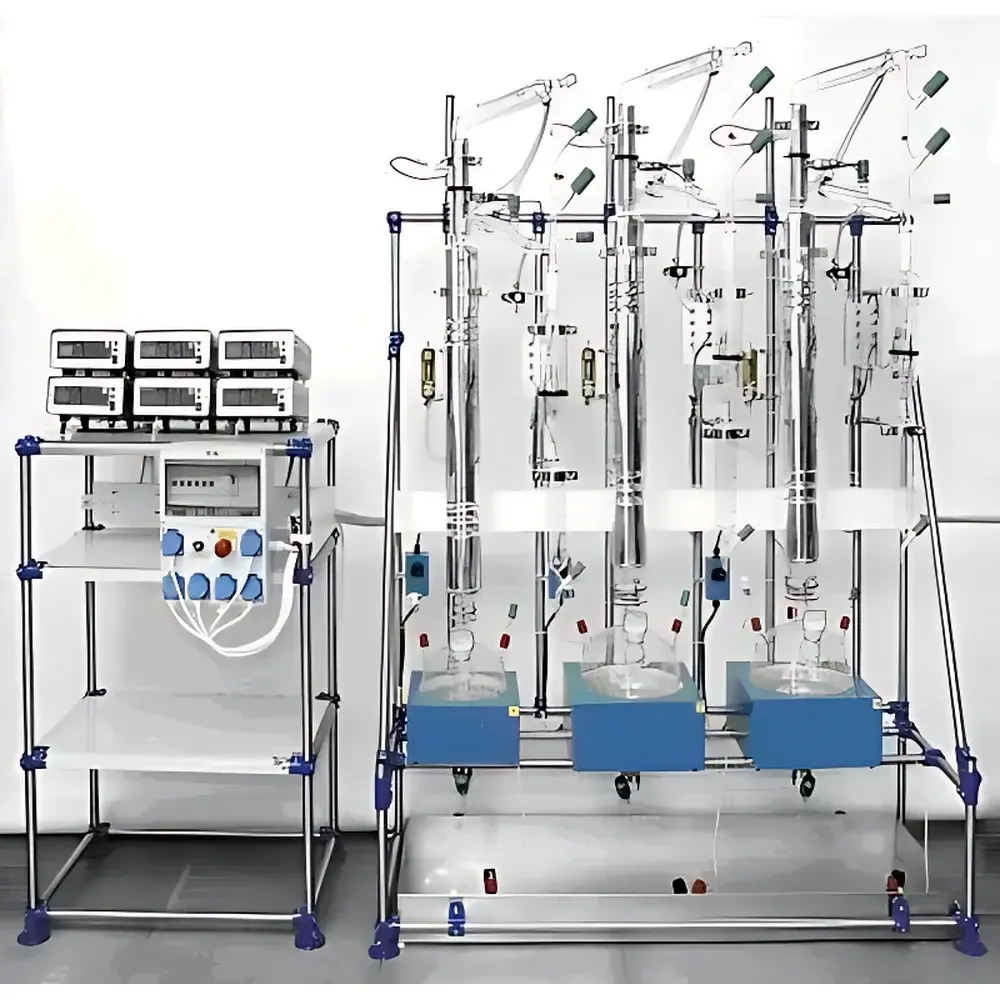
The Normag Parallel Combination Distillation System is a modular, research-grade laboratory distillation platform engineered for rigorous process development, thermodynamic characterization, and integrated reaction–separation studies in petroleum refining, fine chemical synthesis, and academic process engineering. Based on classical vapor–liquid equilibrium (VLE) principles and continuous mass transfer theory, the system supports both batch and continuous operation modes—enabling precise control over reflux ratio, boil-up rate, feed composition, and column temperature profiles. Its core architecture centers on transparent, insulated distillation columns designed to minimize radial and axial thermal losses while permitting real-time visual observation of phase behavior, liquid distribution, flooding onset, and tray or packing efficiency—critical for validating simulation models (e.g., Aspen Plus, CHEMCAD) and teaching fundamental unit operations.
Key Features
- Modular column configuration: Supports single-column, series (cascaded), or parallel arrangements using standardized flanged interfaces; compatible with packed columns (e.g., Raschig rings, structured metal gauze), plate columns (bubble-cap or sieve trays), and hybrid configurations.
- Optically transparent column sections: Constructed from borosilicate glass with vacuum-jacketed insulation, enabling direct visualization of vapor–liquid contact, froth formation, entrainment, and weeping—essential for pedagogical demonstration and mechanistic process analysis.
- Integrated continuous feed & withdrawal system: Precision metering pumps (±0.5% accuracy) and automated three-way valves allow stable long-term operation under steady-state conditions, supporting dynamic studies of residence time distribution and transient column response.
- Distributed control unit: PLC-based interface with PID-regulated heating mantles, condenser coolant flow, and reflux divider; all setpoints and feedback signals are accessible via analog I/O and Modbus TCP for external SCADA integration.
- PC-based data acquisition: Synchronized logging of up to 32 channels—including temperature (Pt100, ±0.1 °C), pressure (capacitive transducer, ±0.5 kPa), flow (Coriolis or thermal mass, ±0.3% FS), and level (capacitive or guided wave radar)—at 1 Hz resolution with timestamped CSV export.
Sample Compatibility & Compliance
The system handles hydrocarbon mixtures across the full petroleum boiling range (IBP–700 °C), including naphtha, kerosene, diesel fractions, vacuum gas oils, and synthetic bio-feedstocks. It is compatible with corrosive media (e.g., H₂S-containing streams, organic acids) when equipped with optional Hastelloy C-276 wetted parts. All electrical components comply with CE marking requirements (EN 61000-6-4, EN 61000-6-2), and mechanical design adheres to PED 2014/68/EU for pressure equipment up to 6 bar g. The system supports GLP-compliant operation through audit-trail-enabled software logging, user access levels, and electronic signature capability per FDA 21 CFR Part 11 when used with validated third-party LIMS or ELN platforms.
Software & Data Management
Data acquisition and control are managed via Normag’s proprietary DistiSoft™ v4.2 platform, running on Windows 10 IoT Enterprise. The software provides real-time trend plots, customizable dashboards, automated report generation (PDF/Excel), and built-in calculation modules for relative volatility, Murphree tray efficiency, and minimum reflux ratio estimation. Raw data files include embedded metadata (operator ID, method version, calibration timestamps) and support ISO/IEC 17025 traceability workflows. Export formats include ASTM D86/D1078/D2892-compliant distillation curve templates, as well as generic HDF5 for machine learning preprocessing pipelines.
Applications
- Development and validation of kinetic models for reactive distillation—e.g., esterification of acetic acid with ethanol, etherification of isobutylene, or hydrodesulfurization under simulated refinery conditions.
- Measurement of VLE data for binary and multicomponent systems under sub-atmospheric to moderate pressure (1–500 kPa abs), supporting thermodynamic parameter regression (NRTL, UNIQUAC).
- Teaching laboratories: Demonstration of total reflux, constant reflux, and variable reflux operation; determination of theoretical plate count (Fenske–Underwood–Gilliland); comparison of packing vs. plate efficiency.
- Solvent recovery optimization in pharmaceutical manufacturing, aligned with ICH Q5C and USP guidelines for residual solvent control.
- Process intensification studies involving heat-integrated distillation sequences, dividing wall columns, or membrane-assisted vapor separation coupling.
FAQ
What standards does this system support for petroleum product testing?
It is configurable to meet ASTM D86 (IP 123), ASTM D1078 (boiling point distribution), and ASTM D2892 (true boiling point) methodologies when paired with certified temperature sensors and calibrated reflux dividers.
Can the system operate under vacuum or elevated pressure?
Yes—standard configuration supports absolute pressures from 5 kPa to 500 kPa; optional high-pressure column heads extend operation to 1.5 MPa g.
Is remote monitoring supported?
Full OPC UA server implementation enables secure remote access via industrial Ethernet; no cloud dependency or vendor-hosted infrastructure is required.
What maintenance is required for long-term reliability?
Annual verification of temperature sensor calibration (traceable to PTB/NIST), inspection of glass-to-metal seals, and replacement of O-rings per manufacturer’s service schedule (every 24 months under continuous use).