
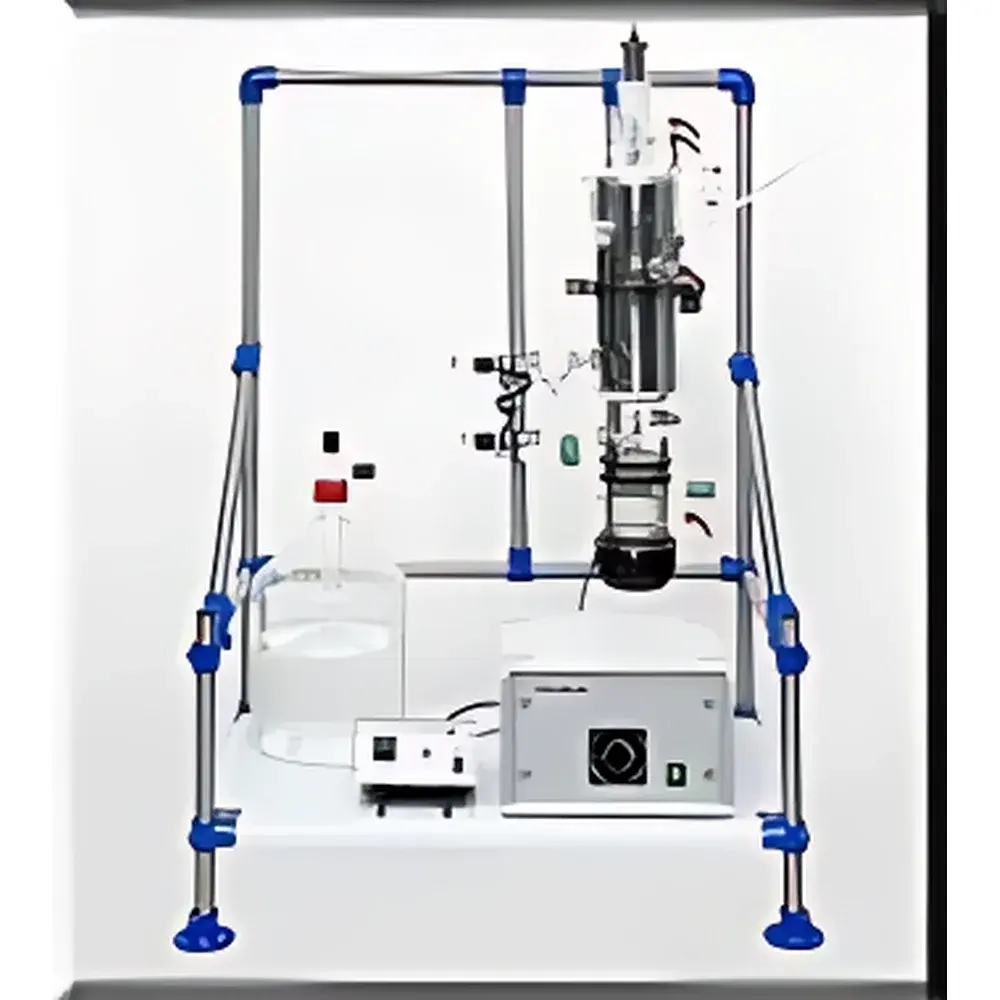
Normag Photoreactor System with Falling-Film Irradiation Geometry
| Brand | Normag |
|---|---|
| Origin | Germany |
| Type | Falling-Film Photoreactor |
| Construction | Double-Jacketed Tubular Reactor with Vacuum-Insulated Outer Sleeve |
| Light Source Configuration | Central Axial Lamp (UV/Visible) |
| Temperature Control | Dual-Zone — Inner Thermal Jacket (Oil Circulation) + Outer High-Vacuum Silvered Insulation Sleeve |
| Flow Mode | Forced-Circulation Falling Film |
| Compliance | Designed for GLP/GMP-aligned photoreaction workflows |
| Software Interface | Optional RS485/Modbus integration for external process controllers |
Overview
The Normag Photoreactor System with Falling-Film Irradiation Geometry is an engineered solution for scalable, temperature-controlled photochemical synthesis and degradation studies. Unlike conventional batch or stirred-tank photoreactors, this system operates on the principle of laminar falling-film irradiation—where liquid-phase reactants are pumped as a thin, uniform film over the inner surface of a vertically oriented, double-jacketed quartz tube. A centrally mounted, collimated light source (typically medium-pressure mercury or LED-based UV/Vis lamps) emits radiation radially inward, ensuring high photon flux density and near-uniform quantum yield across the entire illuminated path length. This geometry eliminates shadowing, minimizes thermal gradients, and decouples photon delivery from mixing efficiency—enabling precise control over residence time, irradiance, and local photon fluence rate (Ein, mol·m−2·s−1). The reactor is designed for applications requiring reproducible photochemical kinetics, including photocatalytic oxidation, pharmaceutical photostability testing, advanced oxidation process (AOP) development, and solar-simulated environmental degradation assays.
Key Features
- Double-jacketed tubular reactor architecture: inner thermal jacket for precise temperature regulation (–20 °C to +120 °C via external oil circulator), outer high-vacuum silvered sleeve for thermal isolation and UV containment
- Falling-film hydrodynamics: controlled film thickness (typically 0.1–0.5 mm) achieved via calibrated pump flow rates and optimized inlet distributor geometry
- Modular scalability: reaction volume adjusted via external reservoir size and circulation loop configuration—no modification to core irradiation zone required
- Integrated process instrumentation: PT100 temperature sensors at inlet/outlet and jacket ports, calibrated mass flow controllers for co-fed gaseous reagents (e.g., O2, O3, NO), and sampling valves compliant with ISO 8573-1 for sterile liquid withdrawal
- Quartz reaction tube (fused silica, ≥99.99% SiO2) with UV-transmittance >90% down to 185 nm; lamp housing equipped with interlocked safety shutters and UV-blocking viewport
Sample Compatibility & Compliance
The Normag Photoreactor accommodates a broad range of liquid-phase systems—including aqueous solutions, organic solvents (e.g., acetonitrile, methanol, dichloromethane), suspensions of heterogeneous photocatalysts (e.g., TiO2, g-C3N4), and microemulsions—without compromising film stability or optical path integrity. All wetted materials conform to USP Class VI and FDA 21 CFR 177.2600 standards. The system supports compliance with ASTM E2530 (standard practice for photostability testing of pharmaceuticals), ISO 10677 (photochemical degradation of organic pollutants), and ICH Q5C guidelines for light exposure during stability studies. Full audit trail capability is enabled when integrated with validated SCADA or LIMS platforms supporting 21 CFR Part 11 electronic signatures.
Software & Data Management
While the base system operates via analog/digital I/O with external controllers, optional firmware enables Modbus RTU or RS485 communication for real-time logging of temperature differentials (ΔTin–out), flow rate, lamp power output, and cumulative photon dose (measured via calibrated radiometric sensor). Data export formats include CSV and XML, compatible with MATLAB, Python (Pandas), and commercial kinetic modeling suites (e.g., Kinetics Toolkit, COPASI). All firmware revisions undergo traceable validation per GAMP 5 Annex 11 requirements, with version-controlled configuration files stored in secure network repositories.
Applications
- Photocatalytic water treatment: evaluation of TiO2-mediated mineralization kinetics under simulated solar irradiation
- Pharmaceutical photodegradation pathway mapping: forced degradation studies per ICH Q1B guidelines
- Synthesis of fine chemicals: [2+2] cycloadditions, Norrish-type cleavages, and photoinduced C–H functionalization under controlled λ and Ein
- Environmental fate assessment: direct photolysis quantum yield determination for pesticides and endocrine disruptors
- Material science: photo-polymerization of acrylate monomers with spatially resolved curing depth profiling
FAQ
Can the reactor be operated under inert atmosphere?
Yes—the system includes gas-tight fittings and a counter-current gas sparging module compatible with N2, Ar, or synthetic air purging.
What lamp types are supported?
Standard configurations accommodate 100–1000 W medium-pressure Hg, Xe, or tunable LED arrays (365, 385, 405, 450 nm); custom spectral profiles require optical coupling validation.
Is cleaning-in-place (CIP) feasible?
The quartz tube and stainless-steel manifolds support automated CIP cycles using aqueous NaOH or citric acid solutions at ≤80 °C; validation protocols follow ASME BPE-2022 section 6.3.
How is photon flux calibrated?
Each unit ships with a NIST-traceable radiometric calibration certificate; users may perform in situ verification using a calibrated silicon photodiode or chemical actinometer (e.g., potassium ferrioxalate).
Does the system meet explosion-proof requirements for solvent-based reactions?
The base configuration is rated for Zone 2/Class I Div 2 environments; ATEX/IECEx-certified variants with intrinsically safe instrumentation are available upon request.
Related Products



