
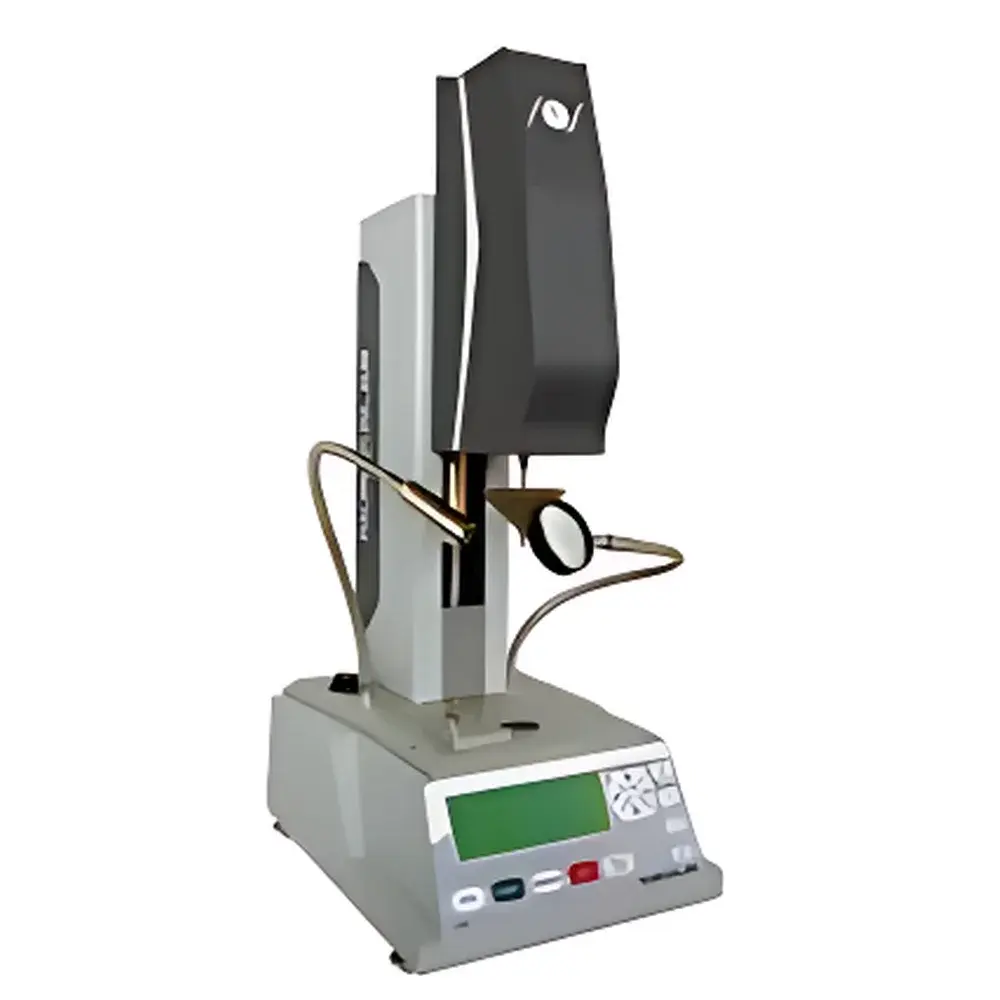
NORMALAB NPN Tech Automatic Penetration Tester
| Brand | NORMALAB |
|---|---|
| Origin | France |
| Manufacturer Type | Authorized Distributor |
| Origin Category | Imported |
| Model | NPN Tech |
| Price | Upon Request |
| Temperature Control Range | -10 to 150 °C |
| Temperature Control Accuracy | ±0.05 °C |
| Penetration Resolution | 0.01 mm |
| Maximum Penetration Depth | 75 mm |
Overview
The NORMALAB NPN Tech Automatic Penetration Tester is a precision-engineered instrument designed for standardized consistency and deformation testing of semi-solid and solid petroleum-based materials under controlled thermal conditions. It operates on the fundamental principle of measuring the vertical penetration depth of a standardized needle or cone into a sample under specified load, time, and temperature—fully compliant with internationally recognized test methods including ASTM D5 (bitumen), ASTM D217 (greases), ASTM D937 (petrolatum), ASTM D1321 (asphalt), ASTM D1403 (low-temperature grease), EN 1426 (bituminous binders), GB/T 4509 (Chinese standard for bitumen), and GB/T 269 (lubricating grease). The system integrates a high-stability temperature-controlled bath, servo-driven vertical actuation, optical displacement sensing, and programmable test sequencing to eliminate operator variability and ensure repeatable, auditable results in QC laboratories, R&D centers, and third-party testing facilities.
Key Features
- Micro-stepper motor with 0.01 mm positional resolution enables precise, reproducible penetration depth control across the full 0–75 mm range.
- Thermostatic bath with ±0.05 °C temperature stability over -10 °C to +150 °C, supporting both low-temperature asphalt and high-melting-point waxes and greases.
- Four programmable positions for needle/cone carrier assembly—optimized for rapid method switching between ASTM, EN, and GB standards without manual recalibration.
- Optical detection system for real-time, non-contact monitoring of needle contact and penetration termination—eliminating mechanical hysteresis and improving measurement fidelity.
- Integrated centering and leveling aids: fixed base alignment guide plus optional automatic horizontal position detection module for asphalt specimens per EN 1426 requirements.
- Dual USB interface: one dedicated to peripheral devices (printer/keyboard), the other for secure, driverless data export to Windows-based laboratory PCs.
- User-configurable penetration duration from 0 to 999 minutes—supporting extended creep measurements and time-dependent rheological profiling.
- On-device display shows the last three test results, their arithmetic mean, and pass/fail status against user-defined specification limits.
Sample Compatibility & Compliance
The NPN Tech tester accommodates a broad spectrum of thermorheologically complex materials—including paving and roofing bitumens, polymer-modified asphalts, NLGI-grade lubricating greases, pharmaceutical petrolatum, cosmetic waxes, and industrial paraffins. Its modular probe configuration supports interchangeable needles (e.g., 100 g / 2.5 mm diameter per ASTM D5) and cones (e.g., 15°/30°/60° per ASTM D1403), each traceable to NIST or PTB reference standards. All hardware and firmware are engineered to support GLP-compliant operation: audit trails, user access levels, electronic signatures, and timestamped raw data logs align with FDA 21 CFR Part 11 readiness when paired with validated laboratory information management systems (LIMS).
Software & Data Management
The embedded firmware includes a menu-driven, icon-assisted interface optimized for glove-compatible operation in controlled environments. Test parameters—including load, dwell time, temperature setpoint, and probe type—are stored in method templates conforming to ASTM/EN/GB numbering conventions. Raw penetration values (in 0.1 mm units) are recorded with 0.01 mm resolution and exported via USB as CSV or XML files containing metadata (operator ID, calibration date, ambient humidity, bath stability log). Optional PC software provides statistical process control (SPC) charts, trend analysis across batches, and automated report generation compliant with ISO/IEC 17025 documentation requirements.
Applications
- Quality control of asphalt binders during refinery production and pavement construction material certification.
- Routine evaluation of NLGI consistency grades in grease manufacturing and automotive OEM supply chains.
- Stability assessment of petrolatum-based ointments and topical formulations in pharmaceutical GMP environments.
- Research into temperature-dependent softening behavior of polymer-modified bitumens and bio-asphalts.
- Calibration verification of manual penetrometers using certified reference materials (CRMs) traceable to national metrology institutes.
FAQ
Does the NPN Tech comply with ASTM D5 and EN 1426 simultaneously?
Yes—the instrument’s programmable load, time, and temperature profiles can be independently configured to meet the exact procedural requirements of both standards, including specimen conditioning protocols and probe geometry selection.
Is external calibration required before first use?
The system ships with factory calibration certificates for temperature sensor (Pt100), displacement encoder (optical linear scale), and load cell. On-site verification using NIST-traceable penetrometer calibration blocks is recommended prior to routine use.
Can the device perform multi-cycle penetration tests on the same specimen?
Yes—users may define sequential penetration events at varying loads or temperatures, with automatic repositioning and thermal equilibration pauses between cycles.
What safety features prevent accidental probe impact during setup?
A dual-stage mechanical limit switch and software-enforced travel boundary prevent over-travel; the optical detection system also halts motion immediately upon initial surface contact detection.
Is remote monitoring or network integration supported?
While the unit does not include built-in Ethernet or Wi-Fi, its USB CDC-class interface allows integration into existing lab networks via USB-to-Ethernet adapters and compatible LIMS middleware.
Related Products






