
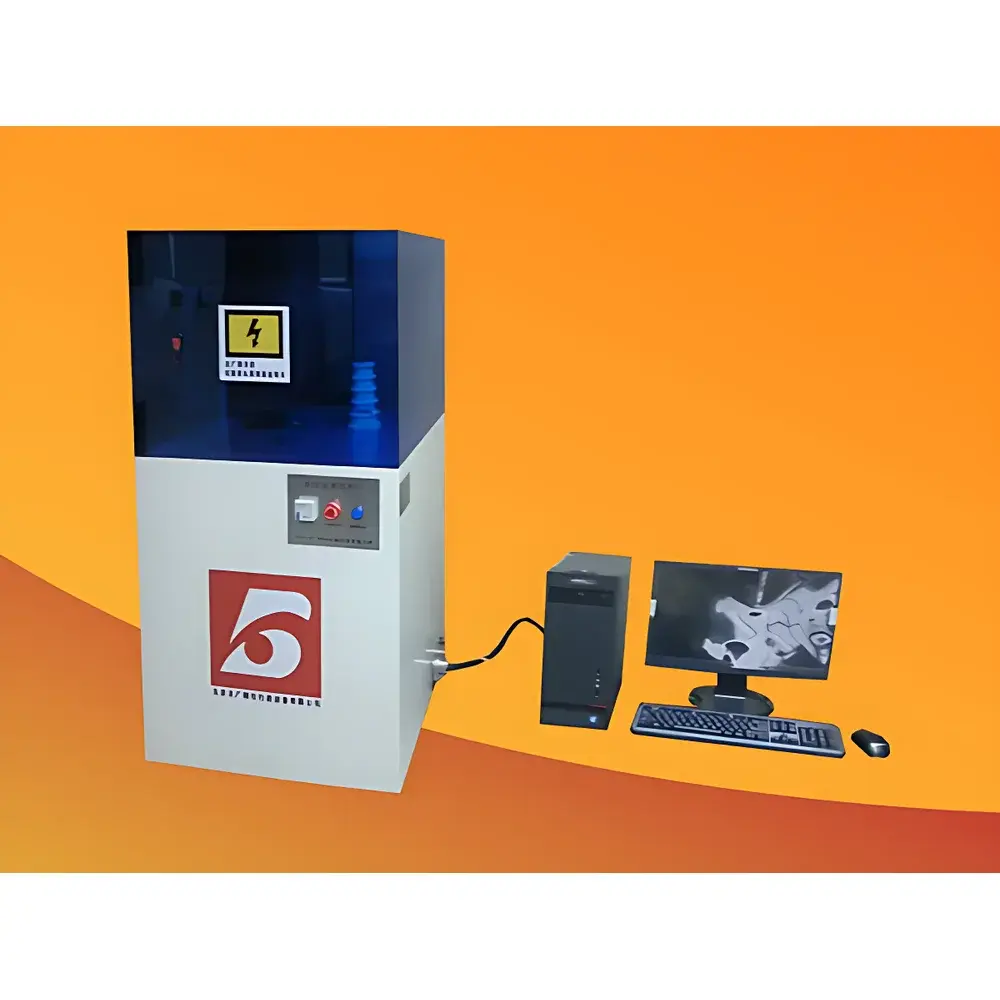
North Guangjingyi BDJ-C50KV Dielectric Breakdown Voltage Tester for Rubber and Insulating Materials
| Brand | North Guangjingyi / All Precision Instrument |
|---|---|
| Origin | Beijing, China |
| Manufacturer Type | Direct Manufacturer |
| Model | BDJ-C50KV |
| Maximum Output Voltage | 50 kV AC/DC |
| Voltage Accuracy | ≤ ±2% |
| Ramp Rates | 0.1–3.0 kV/s (selectable) |
| Test Current Limit | 1–100 mA (software-configurable) |
| Electrode Set | ASTM D149-compliant — two Φ25 mm × 25 mm disc electrodes, one Φ75 mm × 25 mm disc electrode |
| Test Chamber Dimensions | 1500 × 1200 × 1600 mm (L×W×H) |
| Weight | ~200 kg |
| Compliance | ASTM D149, IEC 60243-1, GB/T 1408.1–2006, UL 746A, ISO 60243-1 |
Overview
The North Guangjingyi BDJ-C50KV Dielectric Breakdown Voltage Tester is an engineered high-voltage test system designed for precise determination of dielectric strength and breakdown voltage in solid insulating materials—particularly elastomers such as natural rubber, SBR, EPDM, silicone, and fluoropolymers (e.g., PTFE), as well as thermoplastics, epoxy resins, and composite laminates. Operating on the principle of controlled voltage ramping under standardized electrode configurations, the instrument applies either AC (50/60 Hz) or DC potential across a conditioned specimen until electrical failure occurs—defined as a sudden, irreversible current surge indicating loss of insulating integrity. The system adheres to the fundamental physics of Townsend discharge initiation and avalanche breakdown in non-conductive bulk media, enabling quantification of intrinsic material resistance to electric stress under reproducible laboratory conditions.
Key Features
- True 50 kV AC/DC output capability with digitally regulated, contactless voltage control—eliminating mechanical variac wear and ensuring long-term calibration stability.
- Programmable ramp rates from 0.1 kV/s to 3.0 kV/s, fully compliant with ASTM D149 Method A (short-time test), Method B (step-by-step test), and Method C (slow-rate endurance test).
- Integrated overcurrent protection with sub-100 ms response time (<0.1 s cutoff upon breakdown), meeting IEC 61000-4-5 surge immunity requirements for lab safety systems.
- High-fidelity voltage measurement using precision resistive dividers and isolated ADC circuitry—guaranteeing ≤ ±2% full-scale accuracy traceable to NIST-equivalent national standards.
- Modular electrode assembly conforming to GB/T 1408.1–2006 and ASTM D149: includes two 25 mm diameter × 25 mm height brass electrodes and one 75 mm diameter × 25 mm height electrode for comparative thickness-dependent evaluation.
- Full software-driven operation via Windows-based platform supporting dual-mode testing (AC/DC), multi-sample sequencing (up to five specimens per session), and automated pass/fail logic based on user-defined voltage hold duration (0–6 hours).
Sample Compatibility & Compliance
The BDJ-C50KV accommodates rigid and flexible sheet, film, and molded specimens ranging from 0.1 mm to 10 mm thickness. It supports standard test geometries for rubber compounds per ISO 37, ASTM D412, and GB/T 528, while its electrode configuration satisfies mandatory requirements for dielectric strength assessment in cable insulation (UL 1581, ICEA T-28-520), automotive wiring harnesses (SAE J1127), and aerospace-grade elastomeric seals (AMS 3675). Regulatory alignment includes ASTM D149, IEC 60243-1, GB/T 1408.1–2006, and ISO 60243-1. For GLP/GMP environments, audit trails, electronic signatures, and 21 CFR Part 11–compliant data logging are enabled through optional software modules.
Software & Data Management
The embedded Windows application provides real-time voltage–time curve visualization, dynamic threshold triggering, and synchronized digital capture of breakdown event timestamps, peak current, and pre-failure leakage trends. All raw datasets export natively to CSV or Excel-compatible formats (.xlsx) without proprietary codec dependency. Reporting templates comply with ISO/IEC 17025 documentation structure—including operator ID, environmental conditions (temperature/humidity metadata), calibration certificate references, and electrode serial numbers. Role-based access control (RBAC) enforces separation of duties: administrator-level users configure hardware parameters and manage calibration logs; technician-level users execute tests within predefined SOP boundaries.
Applications
This system is routinely deployed in R&D laboratories evaluating polymer formulation robustness (e.g., filler dispersion effects on dielectric percolation thresholds), QC release testing of extruded rubber insulation for HVDC cables, qualification of potting compounds used in EV battery modules, and accelerated aging studies correlating thermal degradation (per ASTM D573) with progressive loss of dielectric withstand capability. It also supports comparative analysis of surface-treated vs. untreated elastomer interfaces, humidity-conditioned breakdown behavior (per IEC 60695-2-10), and partial discharge inception voltage mapping when coupled with external PD detectors.
FAQ
What standards does the BDJ-C50KV support out-of-the-box?
ASTM D149, IEC 60243-1, GB/T 1408.1–2006, UL 746A, and ISO 60243-1 — with additional test method templates available upon request.
Can the system perform both AC and DC breakdown tests?
Yes — dual-mode operation is standard, with independent ramp rate control, hold timing, and current limiting for each polarity.
Is electrode calibration required before each test?
No — electrodes are supplied pre-characterized and certified per ASTM E1048; however, periodic surface inspection and cleaning per IEC 60243 Annex B is recommended.
Does the software support automated reporting for ISO/IEC 17025 accreditation?
Yes — all reports include metadata fields required by Clause 7.8.2, including uncertainty statements, equipment traceability IDs, and environmental monitoring integration points.
What maintenance intervals are recommended for long-term reliability?
Biannual verification of voltage divider linearity and annual recalibration of current sensing circuits — documented in accordance with ISO/IEC 17025 Clause 6.4.10.



