
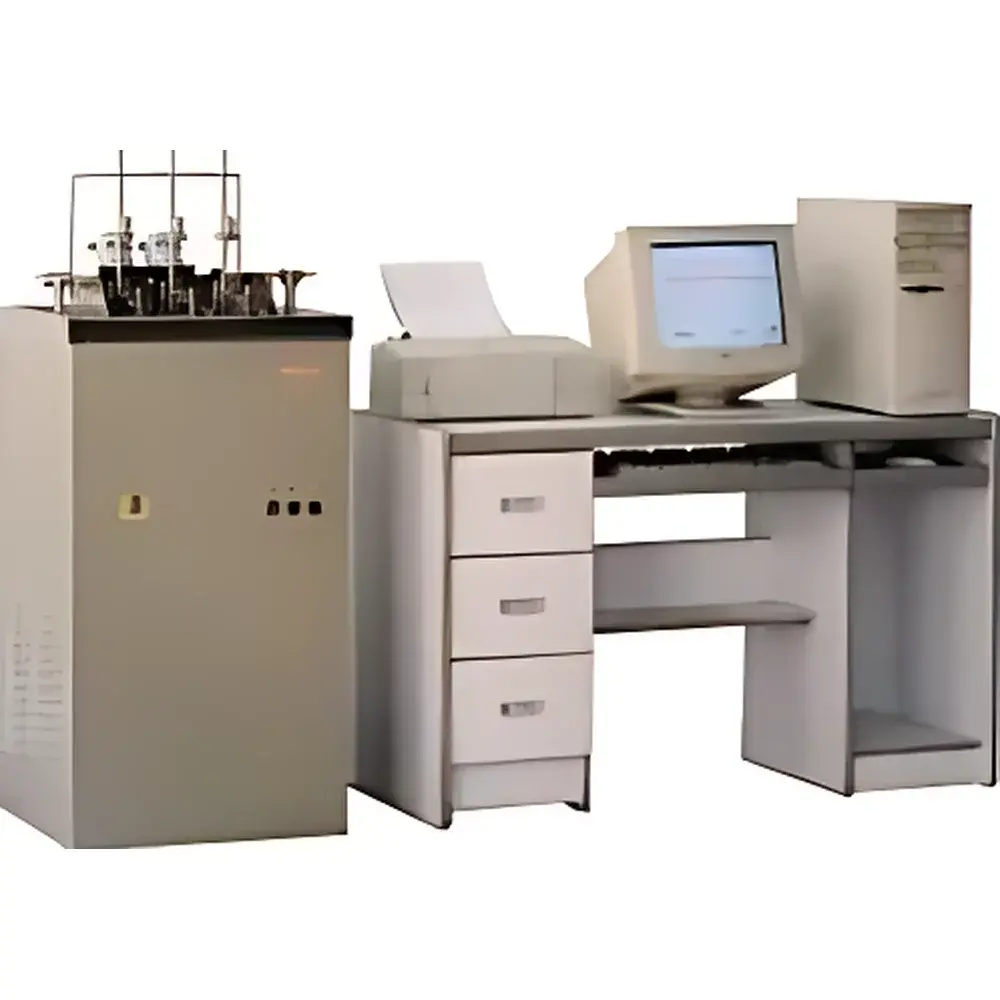
North Guangjingyi BWR Computer-Controlled Heat Deflection & Vicat Softening Point Tester
| Brand | All Precision Instrument |
|---|---|
| Origin | Beijing, China |
| Manufacturer Type | Direct Manufacturer |
| Country of Origin | China |
| Model | BWR |
| Power Supply | AC 220 V ±10%, 50 Hz, 30 A |
| Heating Power | 2.5 kW |
| Heating Medium | Methyl Silicone Oil (flash point ≥300 °C, kinematic viscosity 200 cSt, 20 L required) |
| Sample Stands | Three independent test stations per bath |
| Deformation Measurement | Linear encoder-based dial indicator (resolution 0.001 mm, accuracy ±0.01 mm) |
| Temperature Accuracy | ±0.5 °C |
| Temperature Resolution | 0.01 °C |
| Heating Rates | 120 ±5 °C/h (12 ±1 °C/6 min) or 50 ±3 °C/h (5 ±0.5 °C/6 min) |
| Deformation Range | −0.1 to 5.0 mm |
| Cooling Method | Natural convection above 150 °C |
| Maximum Settable Temperature | 300 °C with over-temperature cut-off |
| Load Rod + Indenter Mass | 88 g |
| Standard Loads | Vicat GA = 10.0 N ±0.2 N (1000 g), GB = 50.0 N ±1.0 N (5000 g) |
| HDT fiber stress options | 0.45 MPa (Method B), 1.80 MPa (Method A), 8.00 MPa (Method C) |
| Compliance | ASTM D1525, ASTM D648, ISO 306:2004, ISO 75-1:2013, GB/T 1633–2000, GB/T 1634.1–2004, GB 8802 |
Overview
The North Guangjingyi BWR Computer-Controlled Heat Deflection & Vicat Softening Point Tester is a dual-mode thermal analysis instrument engineered for precise determination of two critical thermomechanical properties in thermoplastic and thermosetting polymers: the Vicat Softening Temperature (VST) and the Heat Deflection Temperature (HDT). Based on standardized penetration and flexural deformation principles, the system operates under controlled heating ramp rates while applying calibrated mechanical loads—enabling quantitative assessment of polymer resistance to softening and dimensional instability under thermal stress. The instrument implements the fundamental physics of thermal expansion, viscoelastic creep, and elastic bending as defined in ISO 306, ISO 75, ASTM D1525, and ASTM D648. Its rigid bath architecture, triple-station design, and high-stability silicone oil medium ensure uniform thermal distribution and minimal convective disturbance—essential for reproducible results across regulatory-compliant testing environments.
Key Features
- Dual-test capability: Simultaneous or independent execution of Vicat softening point (VST) and heat deflection temperature (HDT) measurements per ASTM/ISO/GB standards
- Triple independent test stations: Enables parallel evaluation of three specimens under identical thermal conditions, improving throughput without cross-contamination or thermal lag
- Precision deformation sensing: Three optical linear encoders (grating-type dial indicators) with 1 µm resolution and ±10 µm absolute accuracy over 5 mm range
- Programmable heating profiles: Two certified ramp rates—120 ±5 °C/h (for rapid screening) and 50 ±3 °C/h (for high-accuracy compliance testing)—both traceable to NIST-calibrated reference thermometers
- Robust thermal control: Methyl silicone oil bath (20 L capacity, flash point ≥300 °C, 200 cSt at 25 °C) ensures stable convection-free heating up to 300 °C with ±0.5 °C uniformity across all stations
- Integrated safety architecture: Over-temperature cutoff at user-defined limits (up to 300 °C), automatic load disengagement upon thermal fault, and real-time monitoring of bath level and heater current
- Standardized load application: Pre-calibrated Vicat plungers (10 N ±0.2 N and 50 N ±1.0 N) and HDT loading assemblies compliant with ISO 75-2 geometric constraints (span length L = 100 mm)
Sample Compatibility & Compliance
The BWR tester accommodates standard rectangular test bars per ISO 75-2 (typically 80 × 10 × 4 mm) and cylindrical Vicat specimens per ISO 306 (diameter ≥10 mm, thickness ≥3 mm). It supports both unreinforced and fiber-reinforced thermoplastics—including PVC-U, ABS, PS, PP, PE, PC, and PEEK—as well as thermosets such as phenolics and epoxies. All measurement protocols adhere strictly to international regulatory frameworks: data acquisition satisfies FDA 21 CFR Part 11 requirements for electronic records when paired with validated software; test reports include full audit trails, operator ID, calibration timestamps, and raw sensor logs. The system is routinely deployed in GLP-compliant QC laboratories for raw material release, formulation validation, and batch-to-batch consistency verification against ASTM D1525 (VST), ASTM D648 (HDT), ISO 306:2004, ISO 75-1:2013, GB/T 1633–2000, GB/T 1634.1–2004, and GB 8802.
Software & Data Management
Control and analysis are executed via dedicated Windows-based software featuring real-time multi-channel plotting (temperature vs. time, deformation vs. time), automated endpoint detection per ISO criteria (e.g., 1 mm needle penetration for VST; 0.34 mm deflection for HDT), and customizable report generation in PDF or Excel format. Raw data files are stored in encrypted binary format with SHA-256 checksums, supporting version-controlled archiving and third-party LIMS integration via OPC UA or CSV export. Audit trail functionality logs all user actions—including method edits, parameter changes, and manual overrides—with timestamp, IP address, and digital signature. Calibration certificates for temperature sensors and load cells are managed within the software’s metrology module, with reminders for scheduled recalibration per ISO/IEC 17025 guidelines.
Applications
- Quality assurance of incoming polymer resins and compounded pellets in extrusion and injection molding facilities
- Thermal stability benchmarking during R&D of flame-retardant, high-heat, or automotive-grade plastics
- Regulatory submission support for medical device housings (ISO 10993-12), pipe systems (ASTM F2160), and electrical insulation components
- Failure analysis of thermally degraded parts exhibiting premature warpage or loss of mechanical integrity
- Evaluation of annealing effects on semi-crystalline polymers (e.g., post-mold heat treatment of PA66)
- Validation of additive impact—such as nucleating agents, plasticizers, or fillers—on thermal transition behavior
FAQ
What standards does the BWR tester fully support?
It complies with ASTM D1525, ASTM D648, ISO 306:2004, ISO 75-1:2013, GB/T 1633–2000, GB/T 1634.1–2004, and GB 8802—covering both Vicat and HDT test methodologies.
Is methyl silicone oil included with the system?
No. Users must supply 20 L of methyl silicone oil meeting specifications: flash point ≥300 °C and kinematic viscosity 200 cSt at 25 °C.
Can the instrument operate unattended overnight?
Yes—equipped with thermal cut-off, load disengagement logic, and auto-shutdown after test completion, it supports unmonitored operation within defined safety envelopes.
How is temperature uniformity verified across the three stations?
A three-point NIST-traceable PT100 probe array is used during factory qualification; users may perform periodic verification using calibrated reference thermometers inserted at each station location.
Does the system support GLP/GMP audit requirements?
When configured with validated software and documented calibration records, it meets core GLP/GMP data integrity requirements including ALCOA+ principles (Attributable, Legible, Contemporaneous, Original, Accurate, Complete, Consistent, Enduring, Available).







