
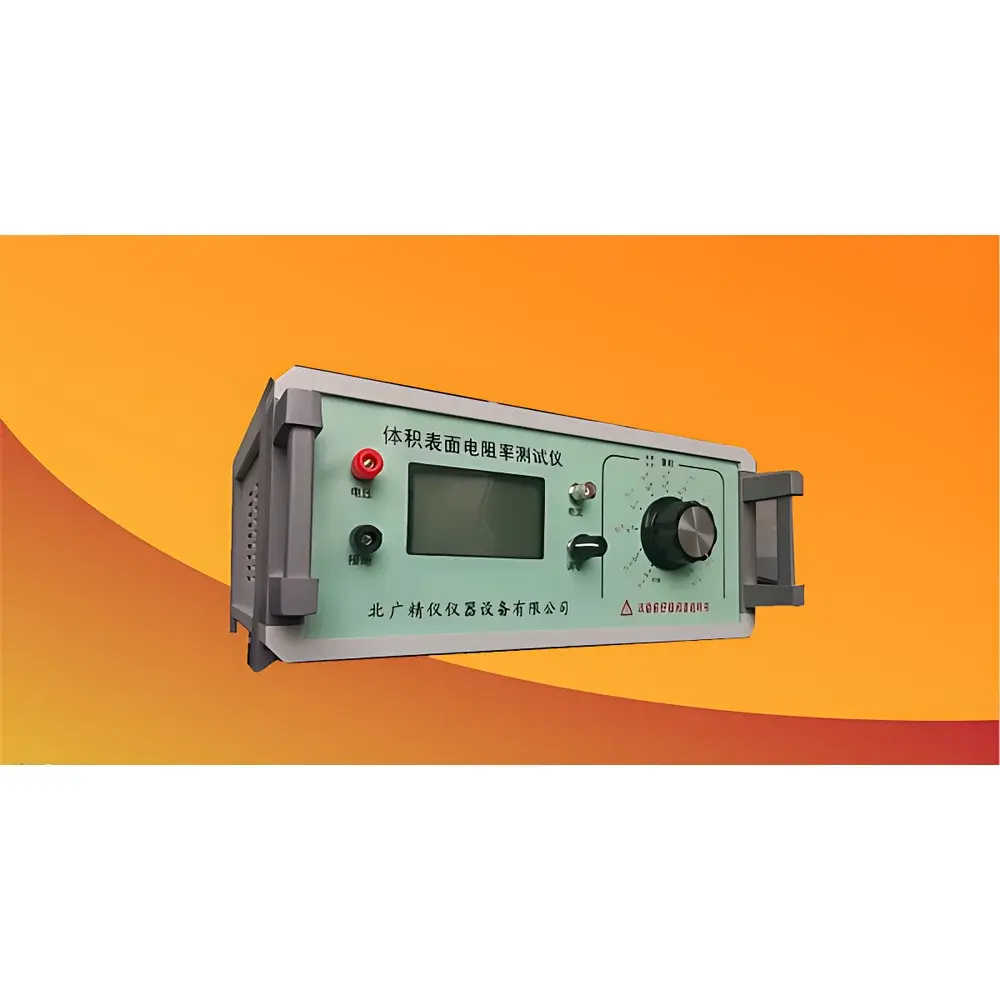
North Guangjingyi EST-121 Surface & Volume Resistivity Tester
| Brand | North Guangjingyi / All Precision Instrument |
|---|---|
| Origin | Beijing, China |
| Manufacturer Type | Manufacturer |
| Model | EST-121 |
| Resistance Measurement Range | 1×10⁴ Ω to 1×10¹⁸ Ω (10 decades) |
| Current Measurement Range | 2×10⁻⁴ A to 1×10⁻¹⁶ A |
| Test Voltages | DC 10 V, 50 V, 100 V, 250 V, 500 V, 1000 V (±10%) |
| Accuracy | ±1% to ±15% depending on range (see full spec table per decade) |
| Display | Full-digit LCD |
| Operating Temperature | −10 °C to +50 °C |
| Relative Humidity | <90% RH |
| Power Supply | AC 220 V, 50 Hz, ~10 W |
| Dimensions | 300 mm × 280 mm × 150 mm |
| Weight | ~3.0 kg |
| Compliance | Designed for ASTM D257, IEC 60093, GB/T 1410, ISO 3915 |
Overview
The North Guangjingyi EST-121 Surface & Volume Resistivity Tester is a precision electrometric instrument engineered for the quantitative characterization of electrical insulation properties in solid, liquid, and powdered dielectric materials. It operates on the principle of constant-voltage direct-current (DC) measurement, applying standardized test voltages across defined electrode configurations to determine surface resistivity (ρs, in Ω/sq) and volume resistivity (ρv, in Ω·m) according to Ohm’s law and geometric correction factors. The instrument implements guarded two-terminal or three-terminal measurement topology—compatible with standard shielded test cells and ASTM/IEC-compliant electrode fixtures—to minimize leakage current errors and ensure traceable, reproducible results across an ultra-wide resistance span from 10⁴ Ω to 10¹⁸ Ω. Its architecture integrates high-impedance input circuitry (<1 fA bias current), low-noise electrometer-grade amplification, and auto-ranging analog-to-digital conversion to maintain metrological integrity at sub-picoampere current levels.
Key Features
- Ultra-broad resistance measurement range: 1×10⁴ Ω to 1×10¹⁸ Ω, segmented into ten calibrated decades for optimal signal-to-noise ratio at each scale
- Simultaneous dual-parameter display: real-time readout of both measured resistance (Ω) and corresponding current (A), enabling immediate verification of Ohm’s law compliance and detection of non-ohmic behavior
- Six selectable DC test voltages (10 V, 50 V, 100 V, 250 V, 500 V, 1000 V) with ±10% tolerance—each independently calibrated and stable under load
- Integrated thickness input interface for automatic volume resistivity calculation (ρv = R × A / t), eliminating manual post-processing for solid specimens
- Front-panel toggle switch for rapid selection between surface resistance (Rs) and volume resistance (Rv) modes, synchronized with internal guard path reconfiguration
- Auto-zeroing function during open-circuit power-up; hardware-based offset compensation ensures baseline stability across environmental drift
- Compact benchtop form factor (300 × 280 × 150 mm) with EMI-shielded enclosure and grounded chassis—designed for integration into controlled laboratory environments or QC labs with limited footprint
Sample Compatibility & Compliance
The EST-121 supports standardized evaluation of insulating materials per major international test protocols. For solid samples—including polymers, elastomers, ceramics, composites, and coated substrates—it interfaces with concentric ring electrodes (ASTM D257 Type A), parallel plate electrodes (IEC 60093), or guarded two-probe fixtures. Liquid and powder measurements are enabled via optional conductive cell adapters meeting GB/T 1410 Annex B requirements. The instrument’s voltage sourcing and current sensing pathways are fully isolated and guarded to meet IEC 61000-4-8 immunity standards. Calibration traceability follows ISO/IEC 17025 guidelines, with factory certification against NIST-traceable reference resistors spanning 10⁴–10¹⁶ Ω. While not FDA 21 CFR Part 11–certified out-of-box, its deterministic measurement logic, non-volatile result logging, and absence of user-modifiable firmware support GLP/GMP-aligned documentation workflows when paired with external audit-ready LIMS systems.
Software & Data Management
The EST-121 operates as a standalone electrometer with no embedded operating system or network stack—ensuring deterministic timing, zero firmware vulnerabilities, and uninterrupted long-term stability. All measurements are displayed in real time on a high-contrast, full-digit LCD with fixed decimal resolution appropriate to the active decade. No proprietary software is required; however, RS-232 or optional USB-to-serial interface enables ASCII-formatted data streaming (e.g., “R=1.24E+15 Ω, I=8.32E-16 A, V=1000.0 V”) for integration with LabVIEW, MATLAB, or custom Python acquisition scripts. Each reading includes timestamp (via host PC), test voltage identifier, and range code—sufficient for compliant raw data archiving. Internal memory stores no measurement history; all data persistence occurs externally, aligning with ALCOA+ principles (Attributable, Legible, Contemporaneous, Original, Accurate) when captured via validated host applications.
Applications
- Quality control of polymer films, insulating tapes, and anti-static packaging per ASTM D257 and IPC-TM-650 2.6.3.1
- Development and validation of high-resistivity ceramic substrates used in semiconductor packaging and MEMS encapsulation
- Characterization of carbon-black-filled elastomers and conductive polymer blends for ESD-safe components
- Testing of transformer oils, silicone gels, and potting compounds per IEC 60296 and ASTM D924
- Research into novel dielectric nanocomposites, including graphene-epoxy and BN-filled thermoplastics
- Verification of cleanliness and ionic contamination on PCB surfaces prior to conformal coating
- Evaluation of humidity-induced surface conduction in hygroscopic materials (e.g., polyimide, PVA) using controlled RH chambers
FAQ
What standards does the EST-121 directly support?
It is configured and calibrated to meet the electrical measurement requirements of ASTM D257, IEC 60093, GB/T 1410, and ISO 3915. Electrode fixtures and sample preparation must comply with the respective standard’s geometric specifications.
Can the instrument measure resistivity of liquids and powders?
Yes—when used with optional liquid test cells or powder compression fixtures that maintain defined electrode separation and contact area, per GB/T 1410 Annexes B and C.
Why is guarding critical for measurements above 10¹² Ω?
Guarding diverts surface leakage currents away from the measurement path, preventing false low-resistance readings caused by contamination, humidity, or stray capacitance—essential for reliable 10¹⁵–10¹⁸ Ω characterization.
Is calibration certificate included with shipment?
Each unit ships with a factory calibration report listing as-tested accuracy against NIST-traceable standards at six voltage points and five resistance decades (10⁴, 10⁸, 10¹², 10¹⁵, 10¹⁸ Ω).
How is temperature dependence addressed in resistivity reporting?
The EST-121 does not include integrated temperature sensing. Users must record ambient temperature separately and apply material-specific ρ(T) correction models (e.g., ρ = ρ₀[1 + α(T − T₀)]) during data analysis.





