
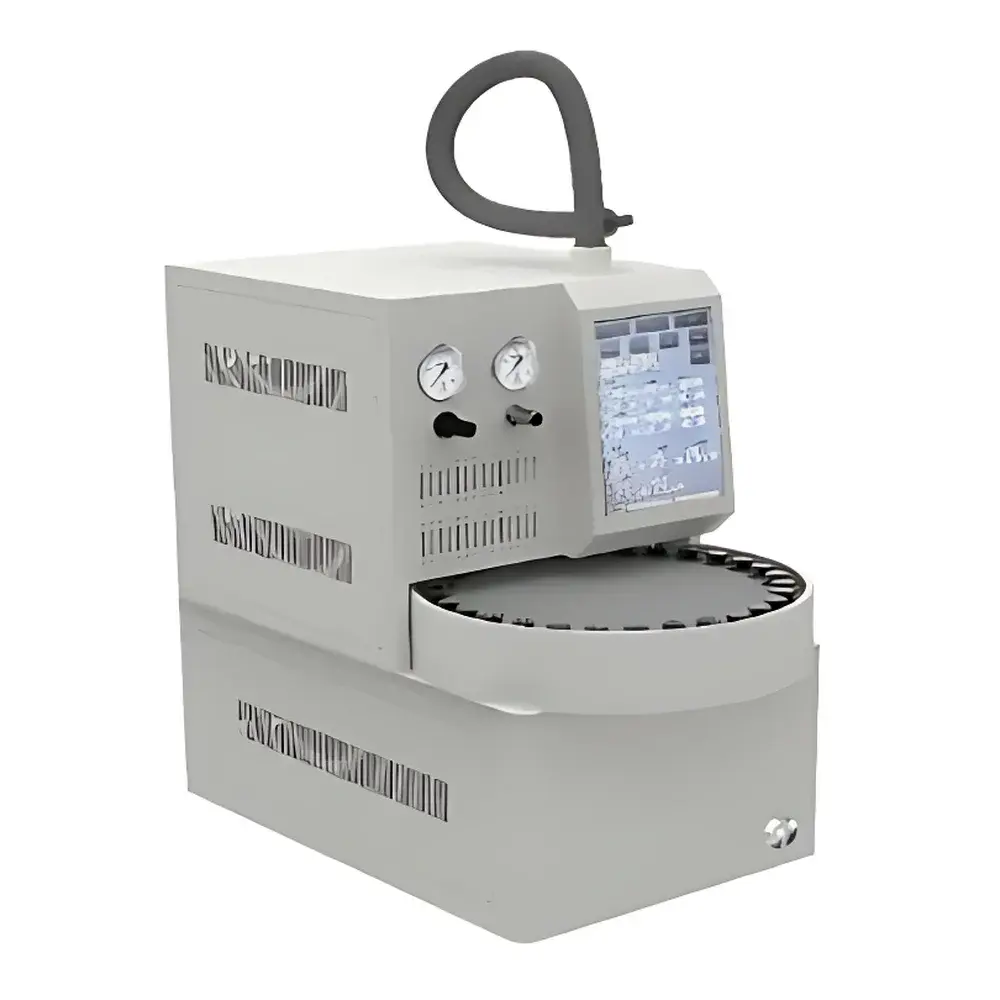
North Point NP-HS-A901 Fully Automated Static Headspace Sampler
| Brand | North Point |
|---|---|
| Origin | Zhejiang, China |
| Manufacturer Type | OEM Manufacturer |
| Instrument Type | Static Headspace Sampler |
| Automation Level | Fully Automated |
| Oven Temperature Range | Ambient to 200 °C (1 °C increment) |
| Valve & Transfer Line Temperature Range | Ambient to 200 °C (1 °C increment) |
| Sample Loop Volume | 1 mL |
| Temperature Control Accuracy | ±0.1 °C |
| Sample Tray Capacity | 12 / 24 / 30 positions |
| Vial Sizes Supported | 10 mL and 20 mL standard (custom sizes available) |
Overview
The North Point NP-HS-A901 Fully Automated Static Headspace Sampler is an engineered solution for precise, reproducible volatile compound analysis in compliance-critical environments. It operates on the principle of static headspace equilibration: sealed sample vials are heated to a user-defined temperature, allowing volatile analytes to partition between the solid/liquid matrix and the gas phase above it. Once thermodynamic equilibrium is achieved, a precisely metered volume of the equilibrated headspace gas is withdrawn via a high-stability six-port valve and introduced directly into a coupled gas chromatograph (GC). This methodology eliminates solvent interference, minimizes matrix effects, and ensures compatibility with flame ionization detection (FID), thermal conductivity detection (TCD), electron capture detection (ECD), and mass spectrometry (MS) systems. Designed for routine QC labs, environmental testing facilities, and pharmaceutical development laboratories, the NP-HS-A901 delivers robust performance under GLP and GMP-aligned workflows.
Key Features
- Fully automated operation with one-touch method execution and unattended batch processing—supports up to 30 samples per run without manual intervention
- Triple-zone independent temperature control: sample oven, valve manifold, and transfer line—all adjustable from ambient to 200 °C in 1 °C increments with ±0.1 °C stability
- Integrated 1 mL fixed-volume sampling loop with low-dead-volume six-port valve architecture, minimizing carryover and maximizing sensitivity
- Heated transfer pathway (including sampling needle and valve interface) eliminates cold spots and prevents condensation or adsorption losses
- Intelligent sample tray indexing with real-time position display on the 7-inch capacitive touchscreen interface
- On-the-fly sample addition capability: new vials can be inserted mid-sequence without resetting or interrupting ongoing analysis
- Automatic backflush function for both sampling needle and transfer line—activated after each injection to prevent cross-contamination
- Optional vial agitation module available to accelerate equilibration kinetics, improve RSD, and enhance detection of semi-volatiles
- Comprehensive self-diagnostic suite covering electronic board status, pressure integrity, thermal calibration, and valve actuation verification
- Modular hardware design enables field serviceability and long-term platform scalability
Sample Compatibility & Compliance
The NP-HS-A901 accommodates standard 10 mL and 20 mL crimp-top or screw-cap headspace vials; custom vial adapters are available upon request. Its pressure-controlled equilibration system supports adjustable pressurization from 0 to 0.4 MPa, enabling optimization for viscous matrices or low-volatility compounds. The instrument meets fundamental requirements for ISO/IEC 17025-accredited testing laboratories and aligns with ASTM D6866, USP <467>, and EP 2.4.24 methodologies for residual solvent analysis. While not inherently 21 CFR Part 11-compliant, its audit-trail-ready firmware architecture—featuring timestamped method logs, parameter change history, and user-access event records—facilitates validation in regulated environments when deployed with compliant LIMS or chromatography data systems (CDS).
Software & Data Management
The embedded control software features a responsive 7-inch graphical interface supporting up to 10 user-defined methods, each configurable with independent oven ramp profiles, equilibration time, agitator speed (if installed), pressurization setpoint, and injection timing. Methods include full parameter locking, version tagging, and exportable configuration files (.cfg). Synchronization with external GC systems is achieved via TTL-level start triggers or Ethernet-based protocol handshaking (Modbus TCP). All operational events—including vial position, temperature deviations, pressure readings, valve actuation timestamps, and error codes—are logged locally with microsecond resolution and exportable as CSV or XML for traceability. No proprietary cloud dependency: all data remains on-device unless explicitly transferred via USB or network share.
Applications
- Pharmaceutical residual solvent quantification (e.g., Class 1–3 solvents per ICH Q3C guidelines)
- Environmental analysis of volatile organic compounds (VOCs) in soil, water, and waste leachates
- Food and beverage quality control: ethanol content, off-flavor volatiles, packaging migration studies
- Polymer and coating formulation screening for monomer or catalyst residue
- Clinical toxicology: blood alcohol concentration (BAC) and volatile metabolite profiling
- Forensic chemistry: accelerant identification in arson investigations
FAQ
What vial formats does the NP-HS-A901 support?
Standard 10 mL and 20 mL headspace vials with crimp seals; custom adapters available for alternative formats.
Is the instrument compatible with third-party GC systems?
Yes—via hardware trigger (TTL) or software handshake (Modbus TCP); no vendor-specific drivers required.
Can the system perform multiple injections from a single vial?
Yes—method programming allows repeated sampling from the same vial at defined intervals, useful for kinetic studies.
How is carryover prevented between samples?
Through automated backflush of the sampling needle and transfer line post-injection, combined with heated zones eliminating condensation traps.
Does the NP-HS-A901 support method validation documentation?
It provides raw audit logs, parameter change history, and timestamped run reports—sufficient for IQ/OQ protocols when integrated into validated CDS environments.





