
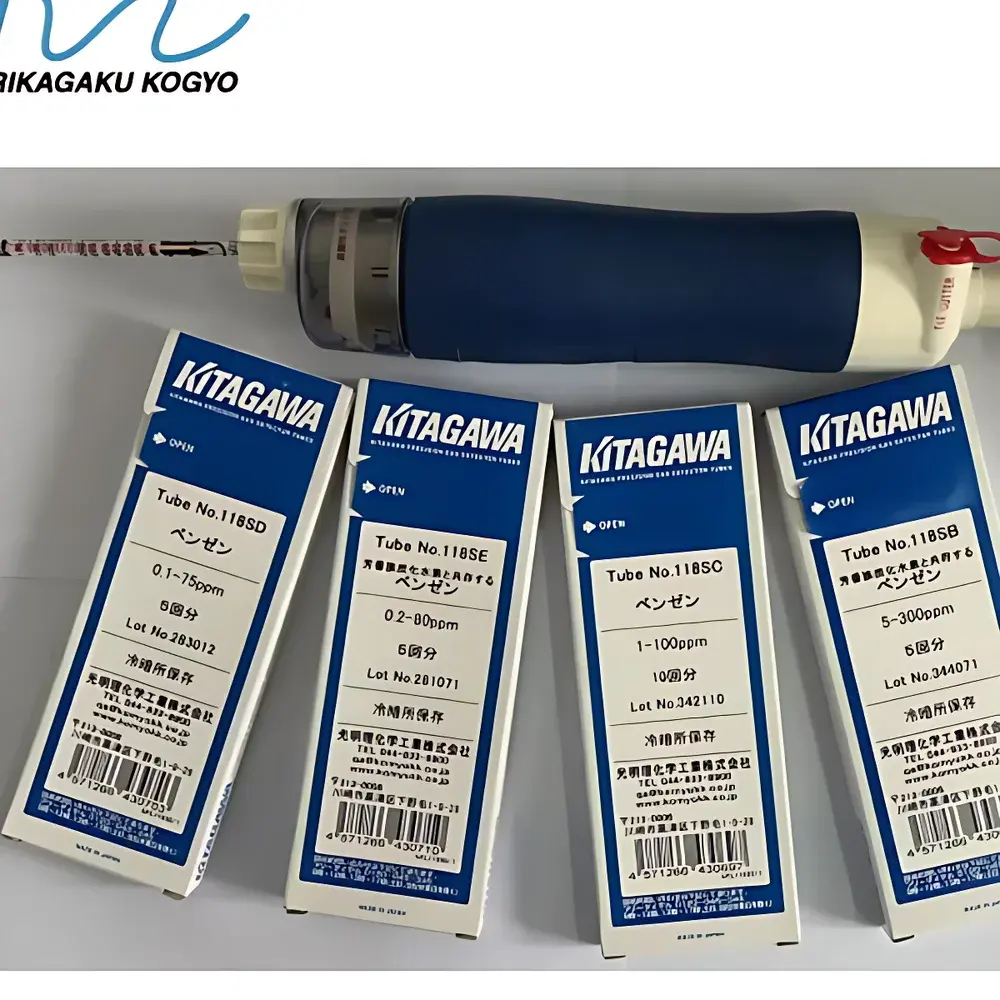
NorthKawakami Benzene Gas Detection Tube Model 118SC
| Brand | Meikai Rikagaku |
|---|---|
| Origin | Japan |
| Model | 118SC |
| Measurement Range | 4–100 ppm (primary scale), with secondary scales of 2–50 ppm and 1–25 ppm |
| Pack Size | 10 tubes per box |
| Detection Principle | Colorimetric reaction via impregnated reagent layer |
| Required Accessories | AP-20 manual air sampling pump |
| Compliance | Designed per JIS K 0321 (Japanese Industrial Standard for gas detection tubes) |
| Portability | Handheld, battery-free, ignition-free operation |
Overview
The NorthKawakami Benzene Gas Detection Tube Model 118SC is a calibrated, single-use colorimetric indicator tube engineered for rapid, on-site quantification of airborne benzene vapor concentrations in industrial, occupational, and emergency response environments. It operates on the principle of diffusion-controlled gas-phase reaction: when a defined volume of ambient air is drawn through the tube using the AP-20 manual piston pump, benzene molecules react stoichiometrically with a pre-impregnated solid-phase reagent (typically a sulfonated chromotropic acid or modified palladium-catalyzed oxidation system) sealed within the glass microbore tube. This reaction generates a discrete, sharp color front whose axial position—measured against a laser-etched linear scale—is directly proportional to the average benzene concentration (in parts per million, ppm) over the sampled volume. Unlike laboratory-based GC-FID or PID methods, the 118SC requires no power supply, calibration gases, or data logging hardware, making it suitable for immediate deployment in confined spaces, loading docks, solvent storage areas, or post-spill reconnaissance where intrinsic safety and operational immediacy are critical.
Key Features
- Three-tiered concentration scale: Primary range 4–100 ppm (full-scale), with high-sensitivity sub-ranges of 2–50 ppm and 1–25 ppm—enabling precise interpolation across variable exposure scenarios.
- Pre-calibrated at 23 °C and 50% RH per JIS K 0321 Annex B; lot-specific calibration certificates traceable to NMIJ (National Metrology Institute of Japan) reference standards.
- Chemically stabilized reagent matrix ensures shelf life of ≥24 months when stored unopened at ≤30 °C and protected from direct sunlight.
- Compatible exclusively with the AP-20 dual-stroke manual air sampler (100 mL nominal stroke volume), delivering consistent 100 ±3 mL draw volume per actuation—critical for measurement reproducibility.
- Breakage-resistant borosilicate glass construction with integrated dust filter and end-cap seals to prevent reagent degradation during transport and handling.
Sample Compatibility & Compliance
The 118SC is validated for use in ambient air matrices containing common co-volatiles found in petroleum refining, paint manufacturing, adhesive application, and printing operations—including toluene, xylene, ethylbenzene, and aliphatic hydrocarbons up to C8. Cross-sensitivity to non-aromatics (e.g., acetone, ethanol, methyl ethyl ketone) is <5% signal deviation at 200 ppm. Interference from hydrogen sulfide, chlorine, or nitrogen dioxide is mitigated by an upstream activated charcoal pre-filter (optional accessory). The tube meets requirements for workplace atmospheric monitoring under OSHA 1910.1200 (Hazard Communication) and EU Directive 2017/2398 (benzene exposure limit values). While not intended for regulatory compliance reporting per ISO 16000-23 or EN 13528-1, it serves as a Tier 1 screening tool aligned with NIOSH Manual of Analytical Methods (NMAM) Method 1501 validation criteria.
Software & Data Management
As a passive, analog field measurement device, the 118SC does not interface with digital systems or require firmware. However, quantitative results may be documented manually into enterprise EHS platforms (e.g., Intelex, ETQ Reliance) or exported via standardized paper-based field logs compliant with ISO 45001:2018 clause 7.5.2 (documented information control). Each tube batch includes a QR-coded certificate of analysis enabling traceability to production lot, expiration date, and certified calibration curve parameters. For audit readiness, users are advised to retain used tubes for minimum 30 days alongside dated, signed sampling records indicating location, time, operator ID, and environmental conditions.
Applications
- Real-time verification of local exhaust ventilation (LEV) effectiveness near benzene-handling workstations.
- Routine perimeter monitoring during tank cleaning, railcar unloading, or drum transfer operations.
- First-responder triage during chemical incident response to assess immediate inhalation hazard zones.
- Verification of respirator fit-test challenge concentrations prior to qualitative fit testing (OSHA Appendix A).
- Supplemental spot-checking between scheduled GC-based air monitoring campaigns to detect process excursions or seal failures.
FAQ
What is the recommended sampling volume for the 118SC?
A single 100 mL draw using the AP-20 pump is required. Two full strokes (200 mL) are not recommended, as reagent saturation may distort front sharpness and reduce accuracy.
Can the 118SC be reused after partial development?
No. The tube is designed for single-use only. Reuse introduces uncertainty due to irreversible reagent consumption and potential moisture ingress.
Does temperature affect the reading?
Yes. Readings taken below 15 °C or above 35 °C require correction per the temperature compensation chart provided in the instruction leaflet (JIS K 0321 Table 4).
How should expired tubes be disposed?
Expired or unused tubes must be treated as hazardous chemical waste per local regulations (e.g., EPA 40 CFR Part 261), due to residual reactive reagents and heavy metal catalysts.
Is the 118SC compatible with other hand pumps?
Only the AP-20 is validated. Use of alternative pumps may result in inconsistent flow rates, leading to under- or over-development and non-compliant measurements.
Related Products







