
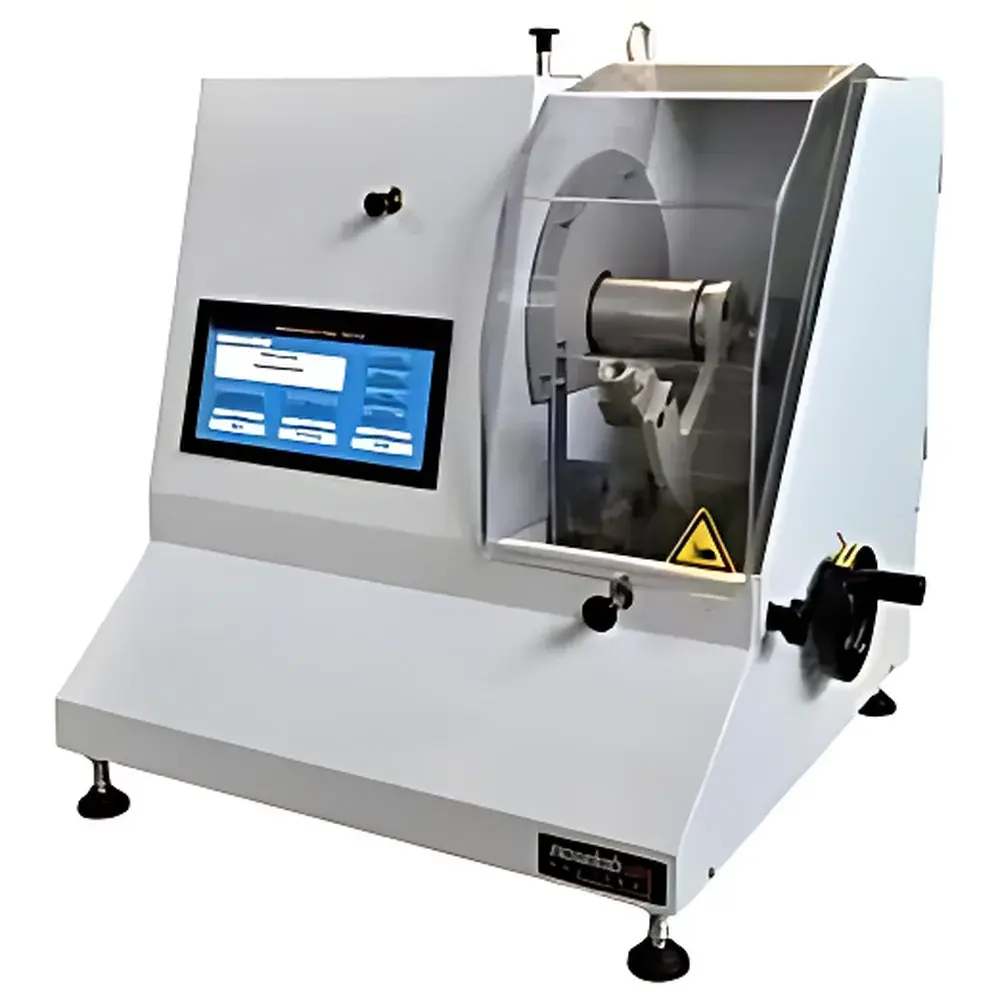
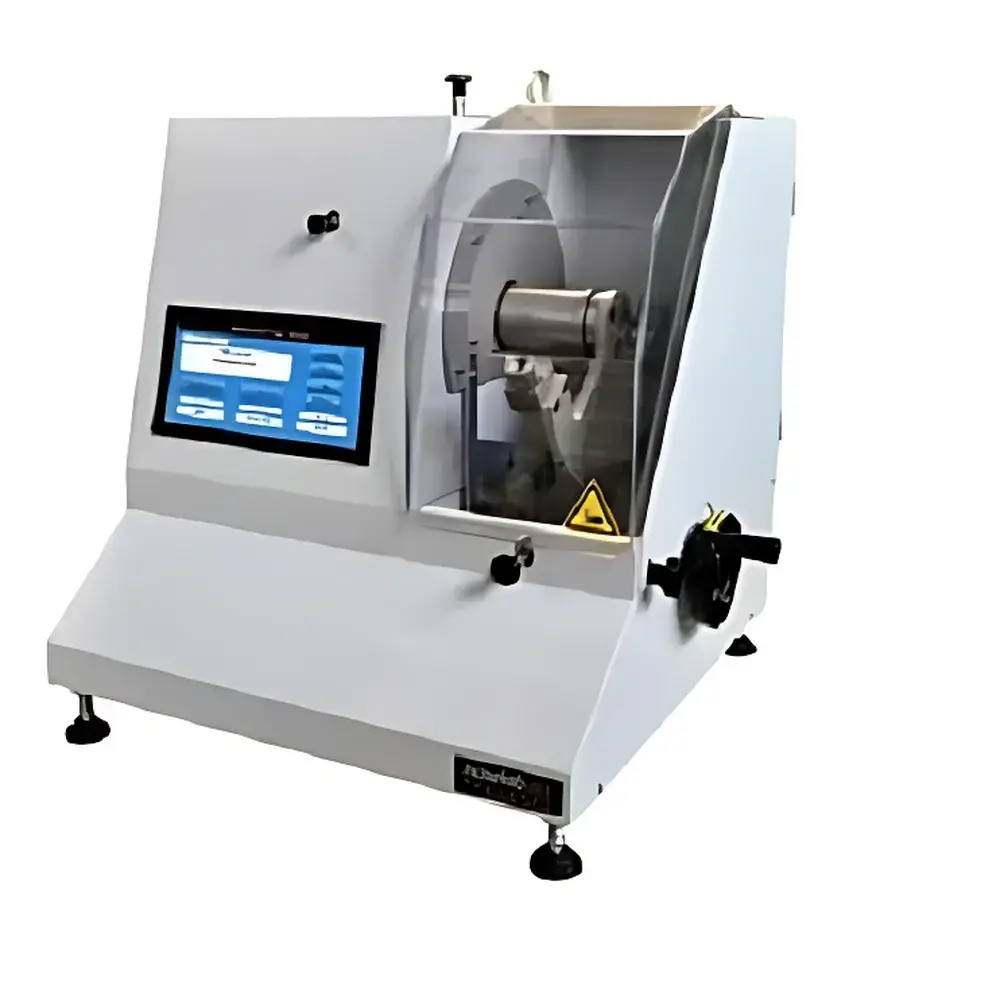
NOSELAB ATS TearATS-200 Universal Pendulum Tear Resistance Tester
| Brand | NOSELAB ATS |
|---|---|
| Origin | Italy |
| Model | TearATS-200 |
| Maximum Force | 100 N |
| Force Resolution | 0.1 mN |
| Accuracy | ±1% of full scale |
| Measurement Units | mN, N |
| Display | 7-inch color touchscreen interface |
| Data Output | USB 2.0, RS-232 |
| Sample Clamping System | Integrated notch-and-grip fixture |
| Pendulum System | Triple-mass calibrated pendulum with motorized lift mechanism |
| Calibration | Built-in calibration control system |
| Data Storage | Up to 20 test results with parameter tagging |
| Compliance | ASTM D1922, ASTM D1938, ISO 6383-1, ISO 6383-2, TAPPI T414, GB/T 455 |
Overview
The NOSELAB ATS TearATS-200 is a precision-engineered universal pendulum tear resistance tester designed for reliable, repeatable evaluation of tear propagation resistance in flexible sheet materials. Based on the fundamental principle of pendulum impact energy absorption—where a notched specimen is torn by a falling weighted pendulum—the instrument quantifies the average force required to propagate a tear across a defined length. This method conforms to internationally recognized mechanical testing paradigms used extensively in quality assurance laboratories across packaging, paper, film, and nonwoven manufacturing sectors. The TearATS-200 implements a robust dual-mode force transduction architecture: primary measurement via high-stability load cell integrated into the pendulum arm, supplemented by real-time angular displacement tracking for dynamic correction. Its modular pendulum mass configuration (three interchangeable calibrated weights) enables seamless adaptation across low-force (e.g., tissue paper) and high-force (e.g., laminated barrier films) applications without recalibration.
Key Features
- Motor-driven pendulum lift mechanism ensures consistent release height and eliminates operator-induced variability in drop initiation.
- 7-inch capacitive color touchscreen interface with intuitive icon-based navigation supports multilingual operation (English, German, French, Spanish, Chinese) and provides real-time graphical feedback of tear force profiles.
- Built-in microprocessor control unit manages test sequencing, automatic zeroing, overload protection, and error diagnostics—including misalignment alerts, incomplete tear detection, and specimen slippage warnings.
- Dual-unit display capability allows concurrent or toggle-view of results in millinewtons (mN) and newtons (N), facilitating direct comparison with legacy data or regulatory submissions requiring SI-unit compliance.
- Integrated notch-cutting and clamping station ensures standardized 20 mm slit length and uniform jaw pressure (adjustable 0.5–2.0 MPa), minimizing inter-test geometric variance per ISO 6383-1 Annex A requirements.
- Onboard memory stores up to 20 complete test records—including date/time stamp, operator ID, sample ID, pendulum mass used, and raw force curve data—with timestamped audit trail exportable via USB.
Sample Compatibility & Compliance
The TearATS-200 accommodates specimens ranging from 63 mm × 76 mm (standard TAPPI format) to custom widths up to 100 mm, supporting single-layer and multi-layer substrates including polyethylene (PE), polypropylene (PP), polyester (PET), cellulose acetate, kraft paper, coated board, metallized films, and biodegradable polymers. All mechanical and software functions are validated against ASTM D1922 (graves-type tear for plastic film), ASTM D1938 (trouser tear for thin plastics), ISO 6383-1 (pendulum tear for paper and board), ISO 6383-2 (trouser tear for plastics), TAPPI T414 (internal tear resistance of paper), and GB/T 455 (Chinese national standard for paper tear). Instrument firmware includes configurable test templates preloaded with standard-compliant parameters—such as pendulum arm angle (175° ± 0.5°), knife clearance (0.2–0.5 mm), and jaw separation (2.8 mm)—to ensure out-of-the-box conformance during GLP/GMP audits.
Software & Data Management
While the standalone instrument operates fully autonomously, optional PC-based software (TearSoft v3.2, sold separately) extends functionality for regulated environments. TearSoft supports 21 CFR Part 11-compliant user authentication, electronic signatures, and immutable audit trails with time-stamped action logs. It enables batch reporting per ISO/IEC 17025 requirements, statistical process control (SPC) charting (X-bar/R, Cpk), and automated generation of PDF test certificates containing instrument ID, calibration status, environmental conditions (temperature/humidity metadata), and raw force-vs-time curves. Data export formats include CSV, XML, and .tdf (Tear Data Format), compatible with LIMS integration and enterprise QMS platforms.
Applications
This instrument serves critical roles in incoming raw material inspection (e.g., verifying film supplier tear specifications), in-process QC during extrusion or coating lines, R&D formulation screening (e.g., evaluating filler or plasticizer effects on tear propagation), and regulatory dossier preparation for FDA-submitted packaging dossiers (e.g., USP <661.2> polymer characterization). Common use cases include validating seal integrity in medical pouches, assessing delamination resistance in aluminum-laminated pharmaceutical blisters, benchmarking compostable film performance under EN 13432, and monitoring aging-related embrittlement in archival-grade document storage envelopes.
FAQ
Does the TearATS-200 require annual third-party calibration?
Yes—while the built-in calibration control system verifies sensor linearity and zero stability daily, ISO/IEC 17025-accredited laboratories must perform traceable calibration annually using NIST-traceable deadweight standards and documented uncertainty budgets.
Can the instrument test specimens thicker than 1 mm?
It is optimized for flexible sheets ≤ 0.5 mm thick per ISO 6383; specimens > 0.8 mm may yield non-linear tear propagation and require validation per ASTM D6287 (instrument-specific verification protocol).
Is the USB interface compatible with Windows 11 and macOS Ventura?
Yes—the USB 2.0 port implements CDC ACM class enumeration and requires no proprietary drivers; data appears as a virtual COM port accessible via standard terminal emulators or TearSoft.
What safety certifications does the instrument carry?
CE marked per Machinery Directive 2006/42/EC and EMC Directive 2014/30/EU; electrical safety compliant with IEC 61010-1:2010 Ed.3 for laboratory equipment.
How is pendulum energy loss compensated during high-cycle testing?
The firmware applies dynamic friction compensation derived from periodic air-drag characterization tests, updating the energy correction factor in real time based on ambient temperature and relative humidity inputs.




