
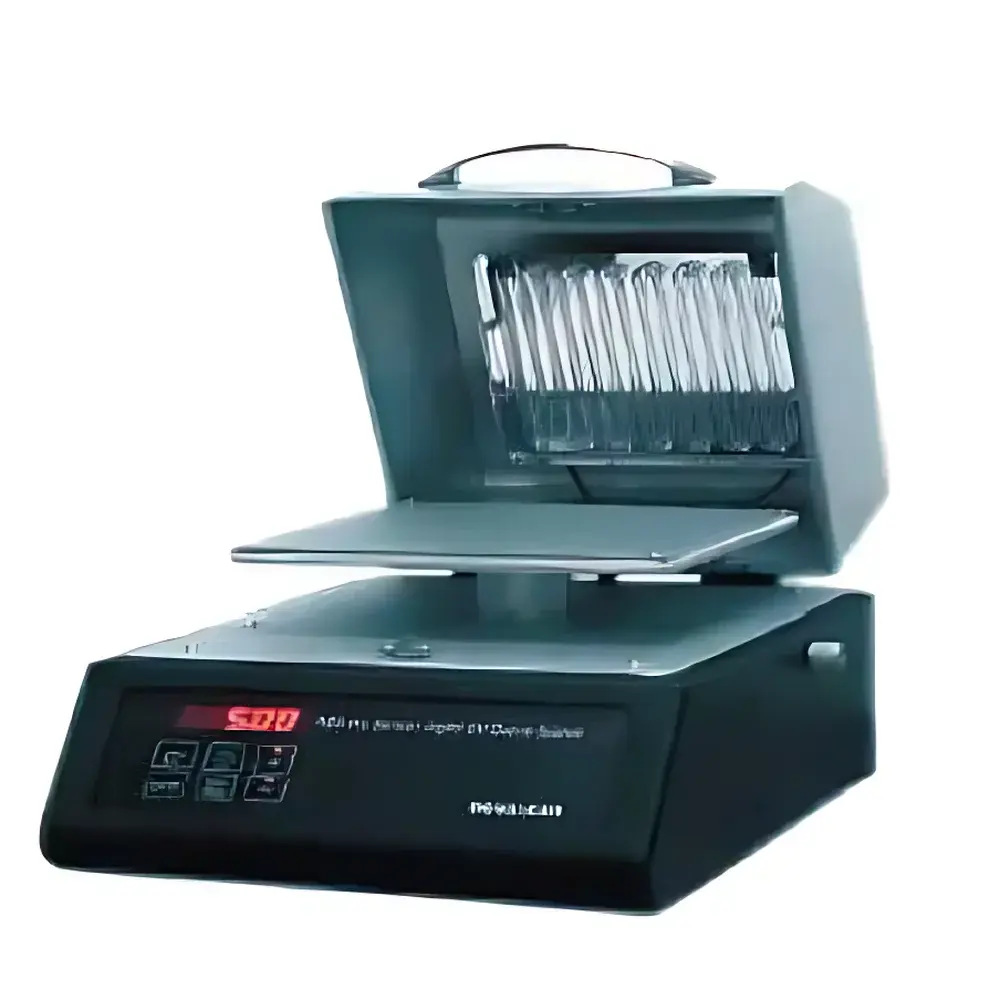
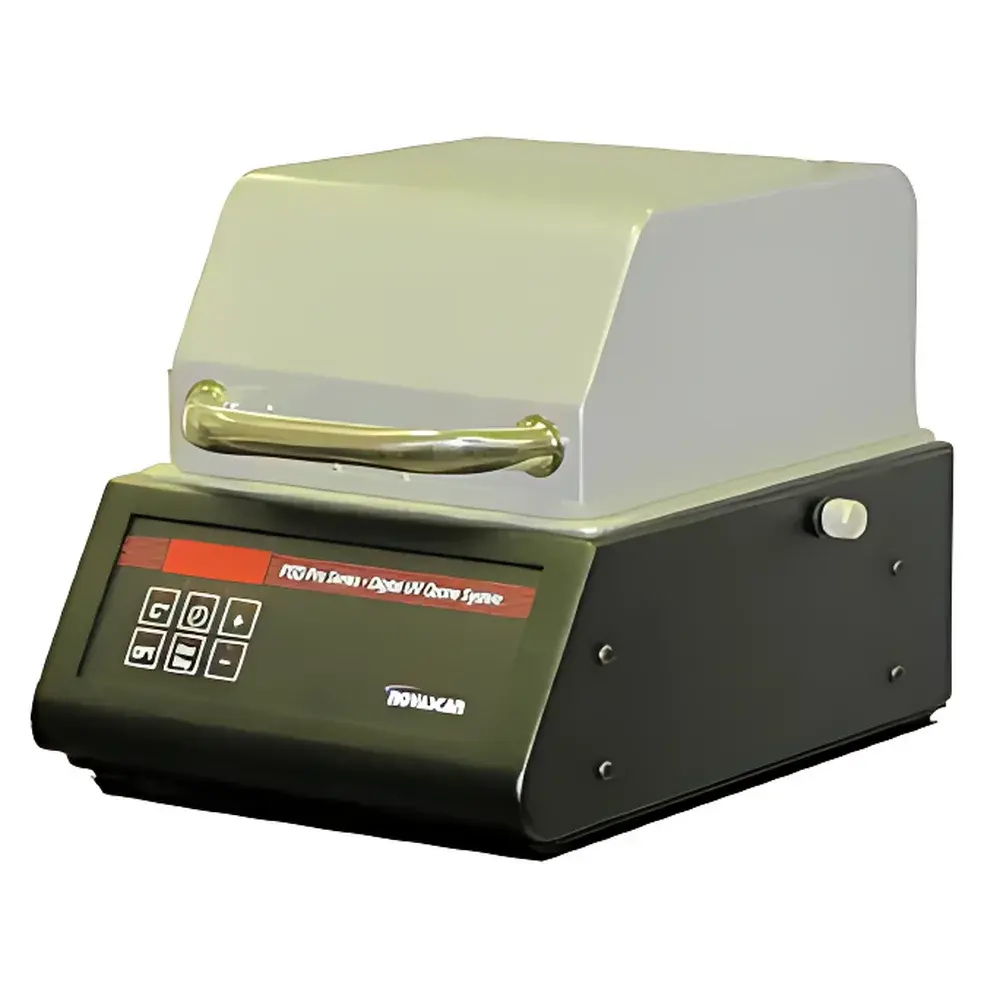
Novascan PSD & PSDP Series UV-Ozone Cleaners
| Brand | Novascan |
|---|---|
| Origin | USA |
| Model Series | PSD & PSDP |
| Control Type | Digital (PSD) / Programmable Digital (PSDP) |
| UV Wavelengths | 185 nm and 254 nm |
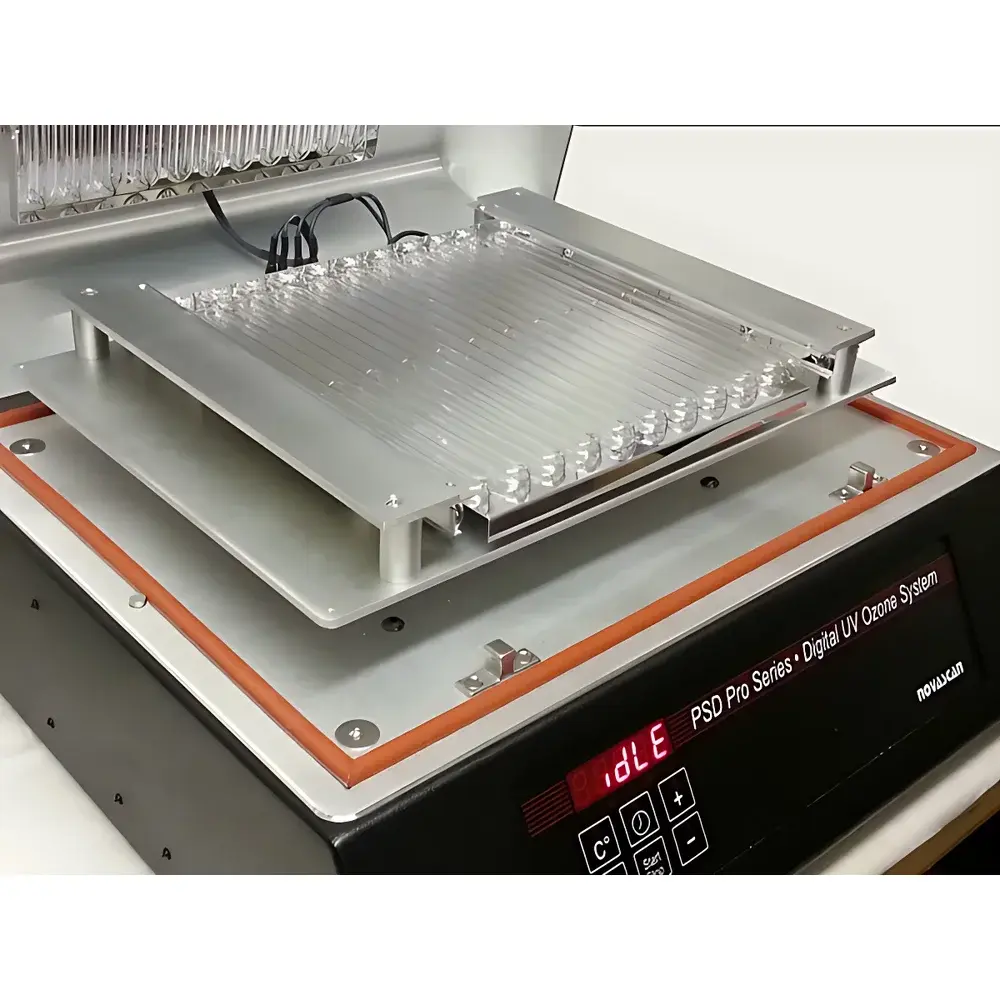
| Lamp Type | Low-pressure mercury grid lamp with aluminum reflector |
| Lamp Lifetime | ~5,000 hours |
| Sample Stage | Height-adjustable with position lock |
| Chamber Access | Top-hinged lid for 360° sample loading |
| Safety Interlock | Automatic UV shutoff when chamber is open |
| Gas Options | Ambient air or optional O₂ feed via inlet ports |
| Exhaust Options | Integrated ozone destruct unit with pump (optional) |
| Temperature Capability | Up to 150 °C (200 °C or 300 °C heating plate available as option) |
| Vacuum Chamber | Customizable (aluminum or quartz) |
| Compliance | Designed for GLP-compliant environments |
Overview
The Novascan PSD and PSDP Series UV-Ozone Cleaners are precision-engineered benchtop systems for non-destructive, solvent-free surface preparation of substrates used in microfabrication, thin-film deposition, surface science, and analytical sample handling. These instruments operate on the principle of photochemical oxidation: dual-wavelength ultraviolet irradiation (185 nm and 254 nm) initiates molecular dissociation of atmospheric oxygen (O₂) into atomic oxygen and subsequently ozone (O₃), while simultaneously exciting organic contaminants adsorbed on material surfaces. The reactive oxygen species—including atomic oxygen, ozone, and hydroxyl radicals—oxidize hydrocarbon-based residues into volatile byproducts (CO₂ and H₂O vapor), leaving atomically clean, hydrophilic surfaces without mechanical abrasion or chemical residue. This dry cleaning mechanism is particularly critical prior to photolithography, metal sputtering, AFM/STM tip functionalization, or adhesion promotion in polymer bonding applications.
Key Features
- Dual-band UV source: High-intensity low-pressure mercury grid lamps emitting at 185 nm (ozone generation) and 254 nm (organic excitation and ozone photolysis), optimized for balanced radical yield and surface residence time.
- Height-adjustable sample stage with mechanical lock: Enables precise optimization of UV fluence and ozone concentration at the substrate surface across all model sizes (3″×3″ to 12″×16″).
- Integrated aluminum reflector housing: Increases effective UV irradiance by >40% compared to bare-lamp configurations; reflector dimensions exceed lamp footprint by 1 inch per side for uniform field coverage.
- Top-access chamber design: Facilitates unobstructed 360-degree sample placement and accommodates irregularly shaped or tall specimens (e.g., probe cards, MEMS wafers, optical mounts).
- Fail-safe interlock system: UV emission terminates immediately upon lid opening, meeting IEC 60825-1 Class 1 laser safety equivalence requirements for UV radiation containment.
- Modular gas handling: Standard dual-port gas interface supports ambient-air operation or controlled O₂ enrichment (up to 99.999% purity) to accelerate contaminant removal kinetics on inert or low-reactivity surfaces.
Sample Compatibility & Compliance
The PSD/PSDP platforms demonstrate broad compatibility with rigid and semi-rigid substrates including silicon, SiO₂, GaAs, Si₃N₄, mica, fused quartz, sapphire, borosilicate glass, alumina ceramics, PMMA, PET, and PDMS. Surface-sensitive materials such as graphene monolayers, MoS₂ flakes, and self-assembled monolayers (SAMs) retain structural integrity under optimized exposure durations (typically 5–30 min). All systems are constructed from anodized aluminum and stainless-steel hardware compliant with ISO 14644-1 Class 5 cleanroom assembly standards. Optional ozone destruct modules meet OSHA PEL (0.1 ppm) and NIOSH REL (0.05 ppm) occupational exposure limits when vented externally. For regulated laboratories, the PSDP’s programmable controller supports configurable logging intervals and exportable timestamped session records—enabling alignment with FDA 21 CFR Part 11 electronic record requirements when paired with validated third-party data acquisition software.
Software & Data Management
While the base PSD model employs a fixed-timer digital controller (15/30/60/120 min presets), the PSDP series integrates a microprocessor-based programmable interface with real-time countdown display, pause/resume functionality, and non-volatile memory storing up to 10 prior cleaning protocols. Each protocol includes user-defined parameters: exposure duration, lamp intensity mode (if equipped with dimmable ballast), gas environment selection (air/O₂), and optional thermal ramp profiles (when heated stage is installed). Session logs—comprising start/stop timestamps, total UV-on time, and selected configuration ID—are exportable via USB-C or RS-232 to CSV format for integration into LIMS or ELN systems. Firmware updates are delivered via secure authenticated channels, supporting version-controlled validation for GMP/GLP audits.
Applications
- Prior to electron-beam lithography: Removal of airborne hydrocarbons that cause resist scumming or charging artifacts.
- Pre-deposition surface activation: Increasing surface energy of polymers (e.g., PDMS, PC) for improved metal adhesion in evaporation or sputtering processes.
- AFM/STM tip cleaning: Restoring nanoscale resolution by eliminating organic adsorbates that induce tip convolution errors.
- Optical component preparation: Eliminating sub-monolayer contamination from lenses, prisms, and laser mirrors without risk of solvent-induced coating damage.
- Biomedical device pre-sterilization: Inactivating residual proteins and lipids on stainless-steel surgical tools or microfluidic chips prior to autoclaving or ethylene oxide treatment.
- Materials aging studies: Controlled oxidative conditioning of carbon-based nanomaterials under reproducible UV/ozone flux for structure–property correlation analysis.
FAQ
What is the difference between PSD and PSDP models?
The PSD series features fixed-duration digital timing and manual operation, whereas the PSDP series adds full programmability, session logging, pause/resume capability, and optional thermal control integration.
Can these systems operate under vacuum?
Yes—custom vacuum-compatible chambers (aluminum or quartz) are available as factory-installed options, rated for ≤10⁻³ Torr base pressure and compatible with standard KF-25 or CF-35 flanges.
Is ozone exhaust management included?
A catalytic ozone destruct module with integrated vacuum pump is offered as an accessory; it reduces outlet ozone concentration to <0.01 ppm, satisfying local environmental health and safety regulations.
How often must the UV lamps be replaced?
Lamp lifetime is rated at 5,000 hours of cumulative operation under nominal conditions; output degradation is monitored via integrated photodiode feedback in PSDP units with advanced firmware.
Are calibration certificates available?
NIST-traceable UV irradiance calibration reports (measured at 185 nm and 254 nm using calibrated radiometers) can be provided upon request for IQ/OQ validation packages.



