
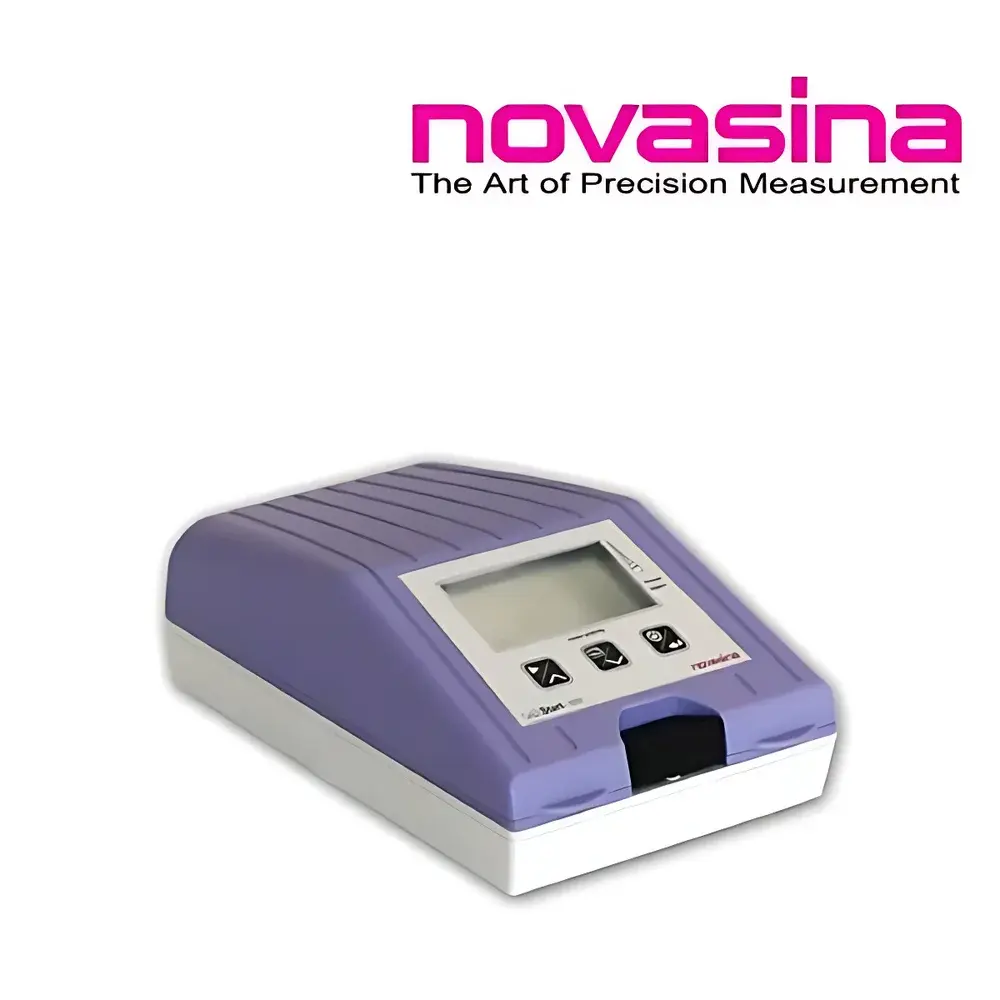
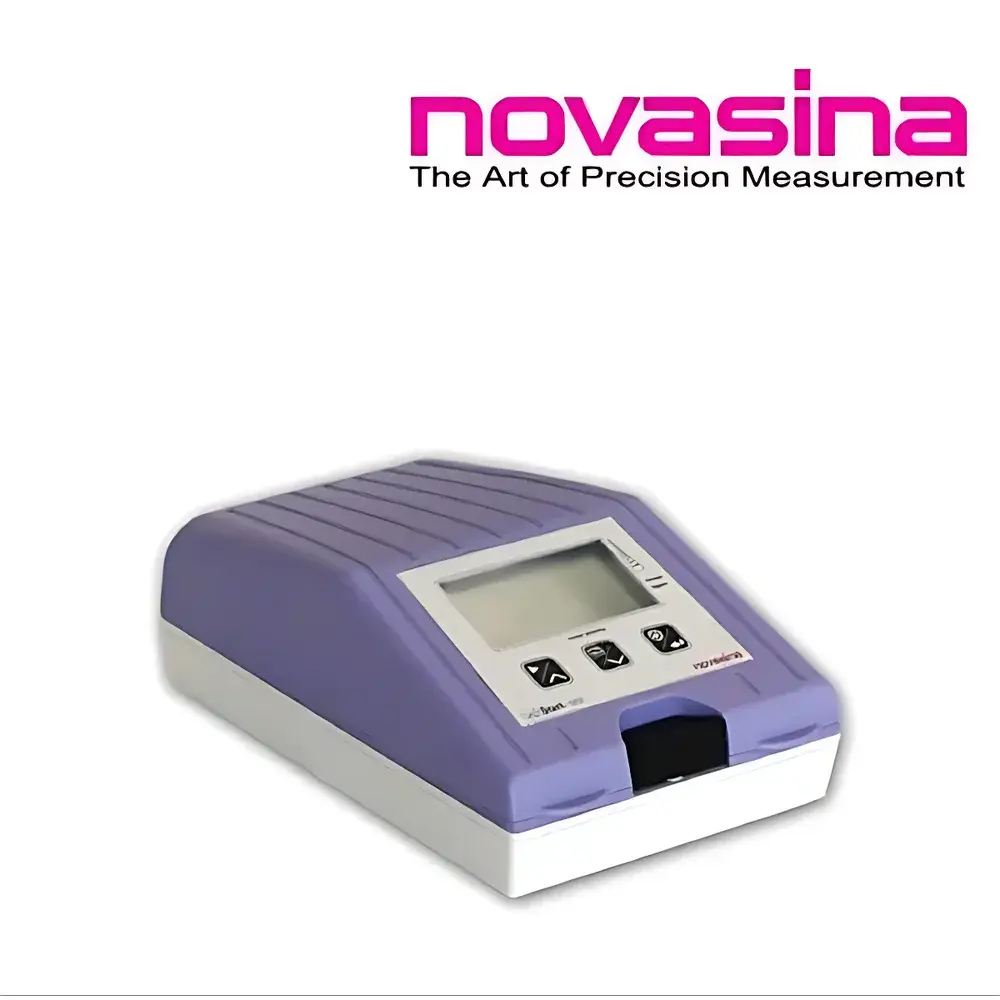
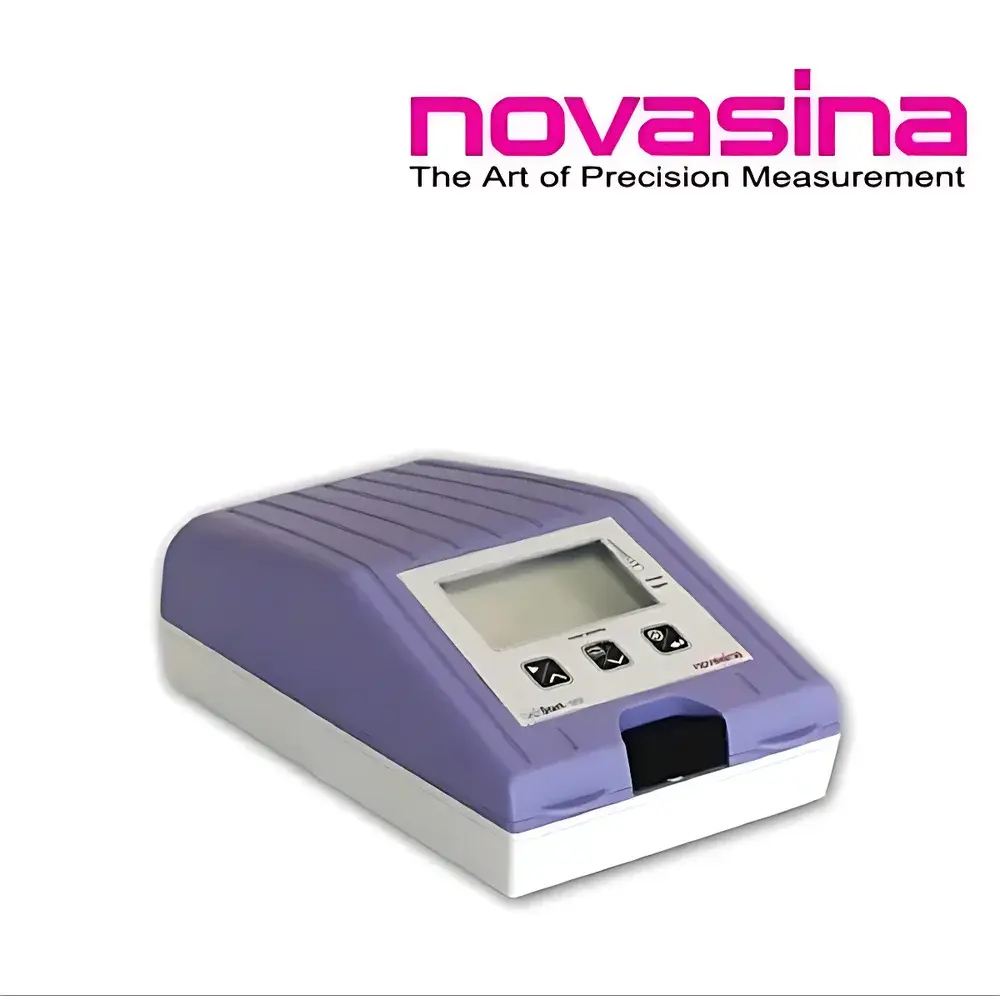
Novasina LabStart-aw Portable Water Activity Analyzer
| Brand | Novasina |
|---|---|
| Origin | Switzerland |
| Model | LabStart-aw |
| Measurement Range | 0.030–1.000 aw |
| Operating Environment | 5–40 °C, ≤85% RH (non-condensing) |
| Sensor Type | CM-4 Capacitive Electrolyte Sensor |
| Temperature Control | None (ambient measurement only) |
| Temperature Range for Measurement | 15–30 °C |
| Temperature Accuracy | ±0.3 K |
| Resolution | 0.01 aw |
| Accuracy | ±0.03 aw |
| Display | Backlit LCD (aw, °C, %RH) |
| Sample Cups | 20 reusable stainless-steel cups included |
| Data Storage | None (real-time readout only) |
| Power Supply | 90–264 VAC, 50–60 Hz |
| Dimensions (H×W×D) | 85 × 140 × 225 mm |
| Weight | 1.2 kg |
Overview
The Novasina LabStart-aw is a portable, benchtop water activity (aw) analyzer engineered for rapid, traceable, and metrologically sound assessment of equilibrium relative humidity in solid and semi-solid samples. It operates on the principle of capacitive electrolyte sensing—Novasina’s proprietary CM-4 sensor technology—which directly measures the equilibrium vapor pressure above a sample at ambient temperature, converting it to water activity (aw) via thermodynamic calibration against saturated salt standards. Unlike indirect methods such as Karl Fischer titration or loss-on-drying, the LabStart-aw delivers aw as a thermodynamic parameter reflecting the energy status of unbound water molecules—critical for predicting microbial proliferation limits, enzymatic reaction kinetics, and physical stability (e.g., caking, crystallization, lipid oxidation). Designed for routine QC labs and R&D environments where portability, simplicity, and regulatory alignment are essential, the LabStart-aw meets foundational requirements for food safety validation under Codex Alimentarius, FDA Food Safety Modernization Act (FSMA), and EU Regulation (EC) No 2073/2005 on microbiological criteria.
Key Features
- Capacitive CM-4 electrolyte sensor with NIST-traceable calibration—no consumables, no recalibration required during normal operation
- Measurement completed in ≤2 minutes per sample, with automatic endpoint detection based on dynamic RH stabilization
- High reproducibility (±0.03 aw accuracy, 0.01 aw resolution) validated across ISO 21807:2021 and AOAC Official Method 978.18
- Compact, lightweight design (1.2 kg) with integrated backlit LCD displaying aw, sample temperature (°C), and relative humidity (%RH) simultaneously
- No active temperature control—optimized for ambient-equilibrated measurements within 15–30 °C; eliminates thermal lag and condensation artifacts common in heated-chamber systems
- Robust mechanical architecture: IP20-rated enclosure, stainless-steel sample cup set (20 pcs), and chemically resistant sensor housing suitable for food-grade cleaning protocols
Sample Compatibility & Compliance
The LabStart-aw accommodates a broad spectrum of food matrices—including powders (milk, spices, flour), pastes (jams, nut butters), gels (gelatin desserts), dried fruits, baked goods, and intermediate-moisture products—without requiring grinding, dilution, or pre-conditioning. Its sealed measurement chamber ensures full vapor-phase equilibration in <60 seconds for low-viscosity samples and <120 seconds for high-viscosity or low-permeability materials. The instrument complies with key international standards governing water activity testing: ISO 21807:2021 (food and feed), ASTM F1718-22 (pharmaceutical excipients), and USP <1151> (pharmaceutical dosage forms). While not equipped with audit trail or electronic signature functionality, its analog measurement pathway and fixed calibration architecture support GLP-compliant documentation when paired with laboratory-controlled SOPs and manual logbook entries. All Novasina sensors are manufactured in Switzerland under ISO 9001-certified processes and certified per EN ISO/IEC 17025 for metrological competence.
Software & Data Management
The LabStart-aw operates as a standalone, firmware-driven instrument with no embedded software stack, USB interface, or data logging capability. This architecture eliminates cybersecurity vulnerabilities, software validation overhead, and compatibility dependencies—making it ideal for regulated environments where change control rigor outweighs digital convenience. All measurements are displayed in real time on the integrated LCD; users record results manually or integrate readings into LIMS via external barcode scanners or secondary data capture tools. For laboratories requiring digital traceability, Novasina recommends pairing the LabStart-aw with its optional LabLink companion software (used with higher-tier models) for method transfer and trend analysis—though raw LabStart-aw output remains fully compatible with CSV-based QA reporting workflows. Calibration verification is performed using certified reference standards (e.g., saturated NaCl, MgCl₂, KCl solutions), traceable to NIST SRM 2370 and PTB humidity standards.
Applications
- Food safety validation: Confirming aw ≤0.85 to inhibit growth of Staphylococcus aureus and pathogenic molds per FDA/USDA guidelines
- Shelf-life modeling: Correlating aw with Arrhenius-based degradation rates for Maillard browning, rancidity, and texture loss
- Process optimization: Monitoring aw shifts during drying, roasting, extrusion, and packaging to define critical control points (CCPs)
- Raw material qualification: Verifying incoming ingredients (e.g., starches, hydrocolloids, dairy powders) meet specification limits before batch release
- Pharmaceutical excipient screening: Assessing hygroscopicity impact on tablet compression behavior and dissolution profile consistency
- Research applications: Supporting studies on glass transition (Tg), amorphous content, and moisture sorption isotherms (BET, GAB modeling)
FAQ
What is the difference between water activity (aw) and moisture content?
Water activity quantifies the thermodynamic availability of unbound water—the fraction of vapor pressure exerted by a sample relative to pure water at the same temperature—whereas moisture content expresses total water mass per unit dry mass. aw predicts microbial and chemical stability more reliably than % moisture alone.
Does the LabStart-aw require daily calibration?
No. The CM-4 sensor is factory-calibrated against primary humidity standards and requires only periodic verification (e.g., quarterly) using NIST-traceable saturated salt standards.
Can it measure samples below 0.20 aw?
Yes—the specified range is 0.030–1.000 aw, validated per ISO 21807 Annex B for low-aw matrices including freeze-dried foods and anhydrous powders.
Is temperature control available on this model?
No. The LabStart-aw performs ambient-temperature measurements only (15–30 °C); temperature-controlled variants (e.g., LabSwift-aw, LabMaster-aw) are available for isothermal or dynamic T–aw profiling.
How is compliance with 21 CFR Part 11 addressed?
As a non-networked, non-data-logging instrument, the LabStart-aw falls outside the scope of Part 11 requirements; however, its deterministic measurement pathway supports ALCOA+ principles (Attributable, Legible, Contemporaneous, Original, Accurate) when used with controlled procedural documentation.




