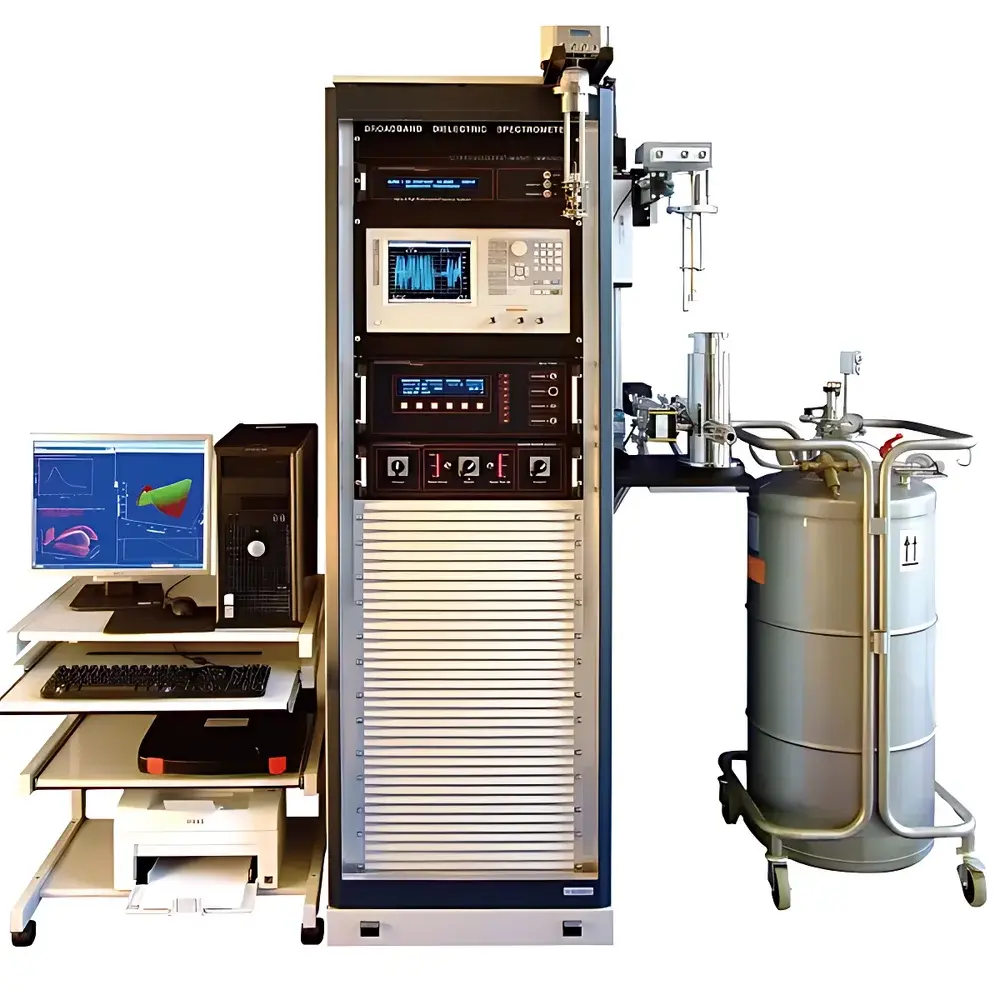
Novocontrol GmbH Novocontrol Alpha-A High-Performance Broadband Dielectric Impedance Spectrometer
| Brand | Novocontrol Technologies |
|---|---|
| Origin | Germany |
| Model | Alpha-A |
| Frequency Range | 3 µHz – 40 MHz (up to 3 GHz with Keysight E4991B RF Impedance Analyzer) |
| Temperature Range | −160 °C to +1600 °C |
| Impedance Range | 10 mΩ to 100 TΩ |
| AC Voltage Range | 10⁻⁶ V to 3 V RMS |
| DC Bias Voltage | ±40 V |
| Compliance | ASTM D150, ISO 257-1/2, IEC 60250, USP <1058>, FDA 21 CFR Part 11 (software-enabled audit trail) |
Overview
The Novocontrol GmbH Alpha-A Broadband Dielectric Impedance Spectrometer is an engineered platform for precision dielectric spectroscopy and impedance analysis across ultra-low to radio frequencies. Based on the principles of broadband frequency-domain dielectric relaxation spectroscopy (DRS), the system measures complex permittivity (ε* = ε′ − jε″) and complex conductivity (σ* = σ′ + jσ″) as functions of frequency, temperature, and bias voltage. Its modular architecture integrates a high-stability low-frequency analyzer (3 µHz–40 MHz) with optional RF extension modules—such as the Keysight E4991B impedance analyzer—to extend measurement capability up to 3 GHz. This enables characterization of dipolar relaxations, interfacial polarization (Maxwell–Wagner–Sillars effects), ionic conduction, and electrode polarization phenomena in heterogeneous, lossy, or highly resistive materials. Designed for fundamental research and industrial process development, the Alpha-A delivers reproducible, traceable measurements under rigorously controlled thermal and electrical conditions.
Key Features
- Ultra-broad frequency coverage: 3 µHz–40 MHz standard; scalable to 3 GHz via certified RF module integration
- Wide dynamic impedance range: 10 mΩ to 100 TΩ (10¹⁴ Ω), supporting both conductive and insulating materials
- Precision temperature control: Three cryogenic-to-ultrahigh-temperature options: (i) liquid nitrogen-cooled cryostat (−160 °C to +200 °C), (ii) Peltier-based chamber (−40 °C to +200 °C), and (iii) custom high-temperature furnace (up to +1600 °C with SiC heating elements and optical pyrometry)
- Low-noise signal generation and detection: AC excitation voltage programmable from 1 µV to 3 V RMS; DC bias up to ±40 V with galvanic isolation
- Modular sample interface: Interchangeable electrodes and holders for solids (discs, pellets), thin films (interdigitated, parallel-plate), liquids (guarded cell), powders (dielectric cell with pressure compensation), and semiconductor wafers
- Real-time multi-parameter acquisition: Simultaneous recording of |Z|, θ, C′, C″, ε′, ε″, σ′, σ″, tan δ, and M″ (electric modulus) at user-defined sweep rates
Sample Compatibility & Compliance
The Alpha-A accommodates diverse material forms without requiring destructive sample preparation. Solid dielectrics—including polymer blends, ferroelectric ceramics, ion-conducting glasses, and battery separator membranes—are measured using guarded three-terminal configurations to eliminate stray capacitance. Liquid electrolytes, colloidal suspensions, and biological gels are analyzed in thermostatted, shielded coaxial cells with calibrated electrode geometry. Powdered samples are evaluated in compression cells equipped with pneumatic loading to ensure reproducible packing density and contact resistance. All hardware and software comply with international standards for dielectric testing: ASTM D150 (dielectric constant and dissipation factor), ISO 257-1/2 (measurement methods for permittivity), and IEC 60250 (determination of relative permittivity). The integrated software supports GLP/GMP workflows, including electronic signatures, version-controlled method templates, and full 21 CFR Part 11–compliant audit trails.
Software & Data Management
The proprietary NOVOCONTROL WinDETA software provides unified instrument control, real-time visualization, and advanced post-processing. It supports automated frequency sweeps, isothermal time sweeps, temperature ramps (dT/dt ≤ 0.1 K/min), and bias-voltage stepping—all fully programmable via intuitive graphical workflow editors. Raw data are stored in HDF5 format with embedded metadata (instrument configuration, calibration history, environmental logs). Built-in analytical modules include Cole–Cole, Havriliak–Negami, and Kohlrausch–Williams–Watts fitting; Arrhenius and Vogel–Fulcher–Tammann activation analysis; and distribution-of-relaxation-times (DRT) deconvolution. Export options include CSV, MATLAB .mat, and ASCII-compatible formats compatible with third-party modeling tools (e.g., COMSOL Multiphysics®, Python SciPy). Remote access and batch processing are supported via secure TLS-encrypted client-server architecture.
Applications
The Alpha-A serves as a primary tool in academic and industrial laboratories engaged in functional material development. In polymer science, it quantifies segmental dynamics, crosslink density, and moisture diffusion kinetics. In solid-state electrochemistry, it resolves bulk vs. grain-boundary conduction in Li-ion battery electrolytes and SOFC electrolytes. In pharmaceutical formulation, it characterizes amorphous content, hydration state, and polymorphic transitions in lyophilized proteins and excipients. In semiconductor manufacturing, it evaluates gate dielectric integrity, interlayer dielectric losses, and plasma-induced damage. Additional application domains include corrosion science (coating dielectric breakdown), geophysics (rock core permittivity mapping), and food science (water activity and phase separation monitoring).
FAQ
What frequency resolution and accuracy does the Alpha-A achieve at sub-Hz frequencies?
At frequencies below 1 Hz, the system achieves 0.1% amplitude accuracy and phase resolution of ±0.05°, enabled by 24-bit delta-sigma ADCs and adaptive digital lock-in detection.
Can the system perform simultaneous dielectric and DC conductivity measurements?
Yes—the integrated DC bias source and high-impedance electrometer allow concurrent AC impedance spectroscopy and DC current–voltage (I–V) sweeps, enabling direct correlation between relaxation behavior and charge transport mechanisms.
Is calibration traceable to national metrology institutes?
All factory calibrations are NIST-traceable; customers receive full calibration certificates with uncertainty budgets per ISO/IEC 17025 requirements.
How is electrode polarization mitigated during low-frequency measurements?
Through automatic electrode correction algorithms, geometrically defined guard electrodes, and optional four-terminal sensing configurations that decouple interfacial contributions from bulk response.
Does the software support automated compliance checking against regulatory test protocols?
Yes—preconfigured test sequences for ASTM D150, ISO 257, and USP <1058> include pass/fail thresholds, statistical process control (SPC) charts, and PDF report generation with digital signatures.