
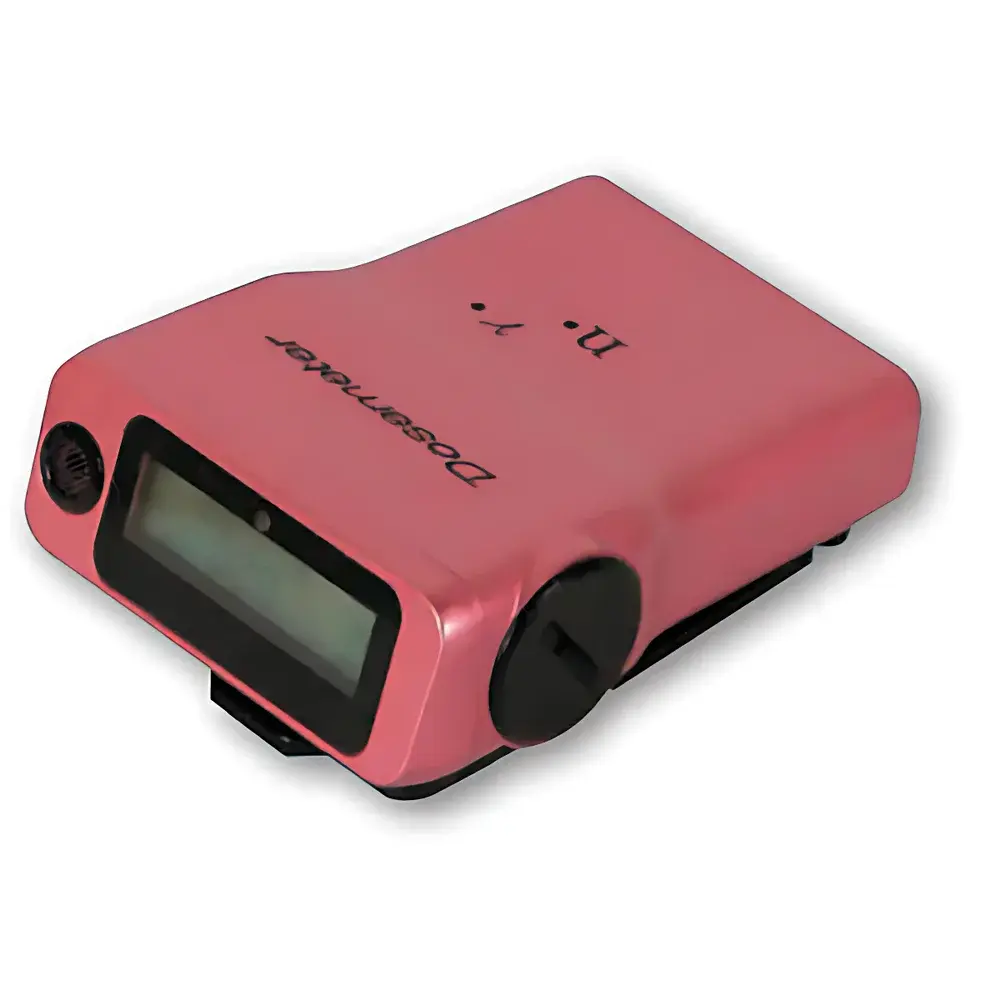
NRF31 Electronic Personal Dosimeter
| Origin | Japan |
|---|---|
| Manufacturer Type | Authorized Distributor |
| Origin Category | Imported |
| Model | NRF31 |
| Pricing | Available Upon Request |
| Detection Radiation Types | Gamma (γ) and X-rays, Neutrons |
| Detector Technology | Silicon Semiconductor |
| Dose Equivalent Range | 1 μSv – 9.999 Sv (0.1 mrem – 999.9 rem) |
| Accuracy | ±10% for γ/X-rays (0.1 mSv – 9.999 Sv, ¹³⁷Cs) |
| Energy Range | γ/X-rays: 35 keV – 6 MeV |
| Neutrons | 0.025 eV – 15 MeV |
| Energy Dependence | ±20% (γ/X), ±50% (neutrons) |
| Angular Dependence | ±20% (γ/X), ±30% (neutrons) |
| Battery Life | >1 year (8 h/day usage) or >4 months (continuous operation) |
| Dimensions | 60 W × 78 H × 33 D mm |
| Mass | ~125 g |
Overview
The NRF31 Electronic Personal Dosimeter is a compact, dual-radiation detection instrument engineered for real-time monitoring of occupational exposure to ionizing radiation in nuclear facilities, medical radiology departments, research laboratories, and emergency response environments. Designed and manufactured in Japan, the device employs solid-state silicon semiconductor detector technology to simultaneously measure dose equivalent from both photon (gamma and X-ray) and neutron radiation fields—enabling comprehensive personal dosimetry where mixed-field exposure is a recognized hazard. Its operational principle relies on charge collection from radiation-induced electron-hole pairs within the silicon diode, with signal processing calibrated against traceable standards (¹³⁷Cs for photons; ²⁵²Cf for neutrons) to deliver dose equivalent values in sieverts (Sv) per ICRP-60 and ICRU-57 definitions. The NRF31 complies with fundamental performance criteria outlined in IEC 61526:2010 (Radiation protection instrumentation — Measurement of personal dose equivalents Hp(10) and Hp(0.07)) and supports regulatory alignment with national frameworks implementing EURATOM Directive 2013/59 and US NRC Part 20 requirements.
Key Features
- Dual-mode detection architecture optimized for simultaneous γ/X-ray and neutron dose equivalent measurement using a single integrated silicon semiconductor sensor
- Wide dynamic dose range spanning six orders of magnitude—from 1 µSv to 9.999 Sv—suitable for routine monitoring and high-dose incident response scenarios
- Energy response characterized across clinically and industrially relevant bands: 35 keV–6 MeV for photons and thermal (0.025 eV) to fast (15 MeV) neutrons
- Low-power electronics enabling extended field deployment: battery life exceeds 1 year under standard 8-hour daily use (typical alkaline cell configuration)
- Compact ergonomic form factor (60 × 78 × 33 mm, ~125 g) designed for clip-on wear at the torso position per ISO 4037-3 recommendations for Hp(10) estimation
- Real-time digital display with auto-ranging and unit switching (µSv/mSv/Sv or mrem/rem), supporting immediate visual feedback without external readout devices
Sample Compatibility & Compliance
The NRF31 is not a sample-based analyzer but a direct-reading personal dosimeter intended for human-worn deployment. It does not require sample preparation, calibration sources, or consumables during normal operation. Its performance verification follows standardized irradiation protocols defined in IEC 61526 Annex B, including angular and energy dependence testing using reference beams traceable to national metrology institutes (e.g., NMIJ/AIST in Japan). Device firmware and hardware design support audit-ready documentation for GLP and ALARA program implementation. While not certified to FDA 21 CFR Part 11, its data logging capability (when paired with optional docking station and software) can be configured to meet basic electronic record integrity requirements for internal radiation safety programs.
Software & Data Management
When interfaced via USB with the proprietary NRF-DATA Manager software (Windows-compatible), the NRF31 supports secure download of time-stamped dose logs, event markers, and alarm history. Each recorded entry includes UTC timestamp, accumulated Hp(10) and Hp(0.07) values, dose rate, and radiation type flag. Software features include customizable dose thresholds, group reporting by badge ID, export to CSV/PDF, and integration with enterprise radiation safety information systems (RSIS) via standard XML schema. All stored data retains immutable audit trails, and software installation packages include full validation documentation suitable for internal QA review.
Applications
- Continuous monitoring of personnel working in nuclear power plant maintenance zones, fuel handling areas, and decommissioning sites
- Dose tracking for interventional radiologists, radiotherapy physicists, and nuclear medicine technologists exposed to mixed photon–neutron fields near PET cyclotrons or LINAC bunkers
- Emergency responder dosimetry during radiological dispersal device (RDD) or improvised nuclear device (IND) incidents
- Research reactor operations where neutron fluence contributes significantly to effective dose
- Regulatory compliance reporting for licensees subject to annual dose limits under IAEA Safety Standards Series No. GSR Part 3
FAQ
Does the NRF31 require periodic recalibration?
Yes—annual calibration against accredited reference sources is recommended per IEC 61526 Clause 8. Calibration certificates are issued with traceability to JCSS (Japan Calibration Service System) or equivalent NMIs.
Can the NRF31 distinguish between gamma and neutron contributions in real time?
It provides separate Hp(10) and Hp(0.07) dose equivalent readings for each radiation type based on pulse shape discrimination and spectral response modeling—but does not output raw spectra or particle identification.
Is the device waterproof or intrinsically safe for hazardous locations?
The NRF31 carries IP54 ingress protection rating (dust-protected, splash-resistant) and is not rated for Class I Division 1 environments; it is intended for general indoor/outdoor occupational use.
What battery type is used, and is replacement user-serviceable?
Standard AA alkaline batteries are employed; battery compartment access requires a small screwdriver, and replacement is field-permissible following manufacturer’s torque specifications.
Does the NRF31 support wireless data transfer (e.g., Bluetooth or Wi-Fi)?
No—data exchange is conducted exclusively via physical USB connection to ensure electromagnetic immunity and data integrity in high-radiation or RF-noisy environments.







