
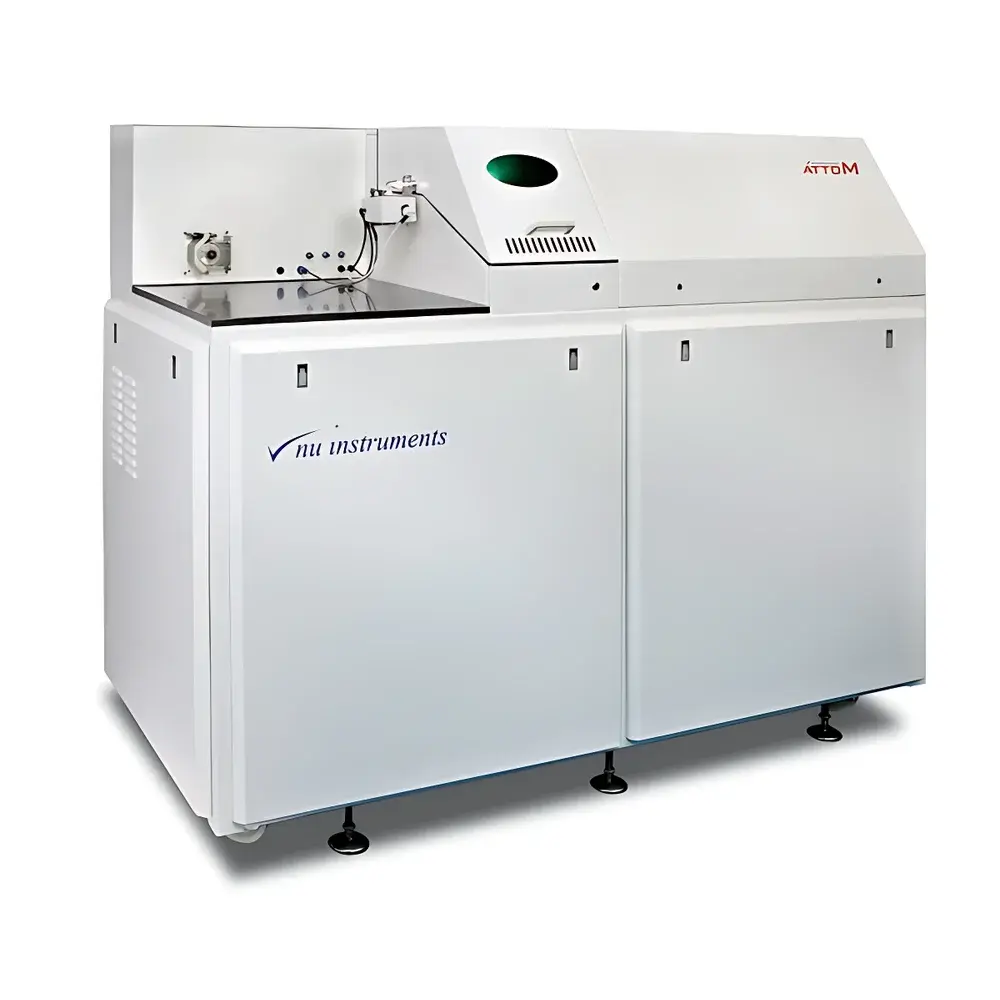
Nu Instruments AttoM ES High-Resolution Multi-Collector ICP-MS
| Brand | Nu Instruments |
|---|---|
| Origin | United Kingdom |
| Model | Nu AttoM ES |
| Type | Double-Focusing Magnetic Sector ICP-MS |
| Detector System | Wide Dynamic Range Faraday + Secondary Electron Multiplier (SEM) |
| Resolution Mode | Adjustable High-Resolution Slit (Fixed Width, Vertically Movable) |
| Primary Application | Isotope Ratio Analysis & Ultra-Trace Elemental Quantification in Geochemical and Environmental Matrices |
Overview
The Nu Instruments AttoM ES is a high-performance, double-focusing magnetic sector inductively coupled plasma mass spectrometer (ICP-MS) engineered for ultra-precise isotope ratio measurements and sub-attogram-level elemental quantification. Operating on the principle of magnetic sector mass separation—where ions are accelerated through a fixed energy analyzer and dispersed by magnetic field strength—the AttoM ES achieves mass-resolving power exceeding 10,000 (M/ΔM, 10% valley definition), enabling baseline separation of isobaric interferences critical in geochemical and environmental isotope systems (e.g., 87Rb/87Sr, 204Pb/204Hg, 176Lu/176Hf). Its design centers on analytical robustness across complex, high-dissolved-solid matrices—supporting direct analysis of acid-digested rock leachates, seawater, aerosol filters, and biological digests without compromising reproducibility or long-term stability.
Key Features
- Double-Focusing Magnetic Sector Architecture: Combines electrostatic and magnetic analyzers to deliver high mass resolution, excellent mass accuracy (<±0.001 u), and superior signal-to-noise ratios—essential for low-abundance isotope detection in natural abundance and radiogenic systems.
- Adjustable High-Resolution Slit System: Features a fixed-width, vertically movable entrance slit that enables real-time optimization between sensitivity and mass resolution—allowing users to select appropriate settings for either high-precision ratio work (e.g., Sr-Nd-Pb-Hf isotopic systems) or trace element screening at sub-pg/g levels.
- Wide Dynamic Range Detection: Integrated dual-detector configuration includes high-stability Faraday cups for major isotope signals and a low-noise secondary electron multiplier (SEM) with analog/digital switching, supporting linear dynamic range >12 orders of magnitude without gain calibration drift.
- Fast Scanning Capability: Optimized ion optics and detector electronics facilitate rapid peak-jumping and multi-collection sequences—enabling full multi-isotope acquisition within sub-second dwell times while maintaining counting statistics required for <0.002% (2SE) internal precision on 87Sr/86Sr.
- Robust Plasma Interface: Designed for stable operation with variable sample introduction systems—including desolvating nebulizers (Aridus, Apex), high-efficiency PFA microflow nebulizers, and laser ablation cells—ensuring consistent signal transmission across matrix-loaded solutions and solid samples.
Sample Compatibility & Compliance
The AttoM ES supports a broad spectrum of sample types relevant to Earth sciences, environmental monitoring, nuclear forensics, and metallurgical research. It routinely handles aqueous standards, HF/HNO3-digested silicates, seawater (pre-concentrated or matrix-matched), airborne particulate extracts, and laser-ablated mineral domains. Instrumental protocols align with ISO/IEC 17025 requirements for testing laboratories; data acquisition workflows support audit-ready metadata tagging per GLP and GMP frameworks. While not FDA-cleared as a medical device, its measurement traceability is maintained via NIST-traceable isotopic reference materials (e.g., NIST SRM 981, BHVO-2, AGV-2) and conforms to ASTM D5673 (trace elements in water) and ASTM D7573 (isotopic analysis of geological materials).
Software & Data Management
Controlled via Nu’s proprietary NuScript software platform, the AttoM ES provides integrated method development, real-time data visualization, and automated interference correction (e.g., polyatomic subtraction using on-mass or off-mass monitors). All raw transient and continuous signals are stored in vendor-neutral .raw binary format with embedded instrument parameters, timestamped acquisition logs, and user-defined metadata fields. Export options include CSV, Excel, and ASCII formats compatible with third-party statistical packages (e.g., IsoplotR, VizualAge). Full compliance with 21 CFR Part 11 is achieved through electronic signature validation, role-based access control, and immutable audit trails for all acquisition, processing, and reporting actions.
Applications
- High-precision radiogenic isotope geochronology (U–Pb, Sm–Nd, Rb–Sr, Lu–Hf) in zircon, apatite, and whole-rock digests
- Stable isotope ratio analysis (e.g., Fe, Cu, Zn, Mg) in biogeochemical cycling studies
- Ultra-trace metal quantification (ppt–sub-ppt) in seawater, polar ice cores, and atmospheric deposition samples
- Nuclear safeguards and isotopic fingerprinting of uranium and plutonium materials
- Multi-elemental and isotopic characterization of ore deposits, mine tailings, and remediation site soils
FAQ
What distinguishes the AttoM ES from quadrupole or time-of-flight ICP-MS platforms?
The AttoM ES employs magnetic sector mass separation—delivering higher mass resolution, better mass accuracy, and lower background noise than quadrupole or TOF systems—making it uniquely suited for isobaric interference removal and high-precision isotope ratio metrology.
Can the AttoM ES be used for laser ablation analysis?
Yes—the instrument is fully compatible with commercial LA systems (e.g., CETAC LSX, UP213) and features optimized transient signal integration routines for spatially resolved isotopic mapping of minerals.
Is remote operation supported?
NuScript enables secure remote access via VPN-configured network environments, allowing method execution, real-time monitoring, and preliminary data reduction from off-site locations while preserving full audit trail integrity.
What maintenance intervals are recommended for optimal performance?
Routine maintenance includes quarterly ion optic cleaning, biannual magnet calibration, and annual detector gain verification using certified isotopic standards—procedures documented in the Nu Service Manual and tracked via built-in service log functionality.






