
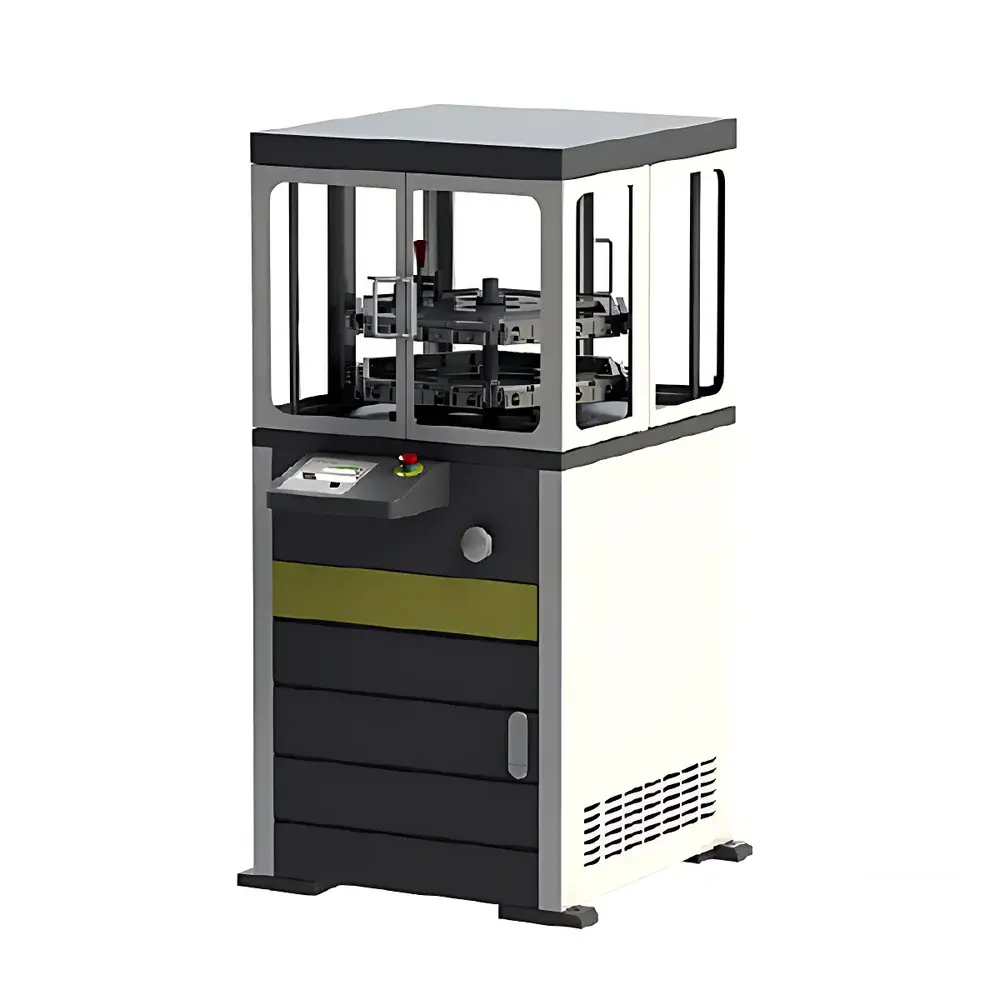
NYX HY-760BX De Mattia Flexing Fatigue Tester
| Brand | NYX |
|---|---|
| Origin | Tianjin, China |
| Manufacturer Type | Manufacturer |
| Country of Origin | China |
| Model | HY-760BX |
| Pricing | Upon Request |
| Control System | PLC-based Touchscreen Interface |
| Test Stations | 12 independent channels |
| Max. Sample Capacity | 12 specimens (standard configuration) |
| Specimen Type | Dumbbell-shaped or square cross-section rubber/plastic strips |
| Clamping Method | Four-sided mechanical clamping |
| Stroke Adjustment Range | 0–100 mm (continuously adjustable) |
| Test Speed | 60–300 rpm ±10 rpm |
| Drive Mechanism | Motor-driven eccentric cam + precision linkage system with linear guide columns |
| Failure Detection | Real-time individual channel break detection with autonomous counter halt |
| Safety Features | Interlocked transparent safety guard enclosure |
| Compliance Standards | GB/T 1688–2021, ISO 6943:1985, ASTM D430–18, DIN 53509-1:2006 |
Overview
The NYX HY-760BX De Mattia Flexing Fatigue Tester is an engineered solution for evaluating the dynamic fatigue resistance of vulcanized rubber and thermoplastic elastomers under repeated flexural deformation. Based on the classical De Mattia principle—where a rectangular or dumbbell-shaped specimen undergoes controlled cyclic bending over a cylindrical mandrel—the instrument quantifies material durability by measuring the number of cycles to crack initiation and propagation until complete rupture. This mode of mechanical stress simulates real-world service conditions encountered in automotive boots, conveyor belts, seals, and dynamic sealing components subjected to repeated flexure. The tester operates under standardized kinematic constraints defined in GB/T 1688–2021 (equivalent to ISO 6943:1985), ensuring traceable, reproducible results suitable for quality control, formulation development, and regulatory documentation.
Key Features
- Twelve independently monitored test stations with synchronized yet isolated cycle counting—each channel halts its counter upon specimen failure without affecting concurrent testing on other stations.
- PLC-controlled touchscreen interface enabling precise setup of target cycle count, stroke amplitude (0–100 mm), rotational speed (60–300 rpm ±10 rpm), and dwell time parameters.
- Mechanically robust drive architecture: AC motor coupled to a hardened eccentric cam and precision-machined linkage system, delivering consistent vertical displacement along linear guide columns for high repeatability.
- Four-point clamping mechanism ensures uniform stress distribution across square or dumbbell-shaped specimens (per ISO 6943 geometry requirements), minimizing slippage and edge-induced premature failure.
- Interlocked polycarbonate safety guard with door-position sensing—immediate motion cessation upon access door opening, with full test state retention and seamless resumption post-recovery.
- Real-time display of cumulative cycles per station, elapsed test time, and active status indicators; data export via USB to CSV-compatible formats for downstream statistical analysis.
Sample Compatibility & Compliance
The HY-760BX accommodates standard test specimens as specified in GB/T 1688–2021 (Type A dumbbell, 25 mm × 6 mm × 2 mm) and ISO 6943:1985 (rectangular strip, 100 mm × 10 mm × 2 mm). Optional fixture kits support alternate geometries including notched variants for accelerated crack growth studies. The system meets functional equivalence to ASTM D430–18 (Standard Test Method for Rubber Deterioration—Flex Cracking) and DIN 53509-1:2006, and supports audit-ready operation under GLP-compliant environments when paired with validated software logging protocols.
Software & Data Management
While the base unit employs embedded PLC logic for deterministic real-time control, optional firmware upgrades enable timestamped event logging—including start/stop commands, door interlock triggers, and per-channel failure timestamps—with metadata export compliant with ISO/IEC 17025 documentation requirements. All cycle data are stored in non-volatile memory; power interruption does not erase counters. For laboratories operating under FDA 21 CFR Part 11 or EU Annex 11 frameworks, third-party validation packages—including IQ/OQ documentation templates and electronic signature modules—are available upon request.
Applications
- Quality assurance of raw compound batches in tire cord adhesion layers, brake hose linings, and anti-vibration mounts.
- Comparative fatigue screening during polymer blend optimization (e.g., EPDM/NBR/SBR formulations).
- Accelerated life modeling for dynamic sealing applications where hinge-type flexure dominates failure modes.
- Supporting ISO 22858-compliant service life prediction of elastomeric expansion joints in civil infrastructure.
- Academic research into crack nucleation kinetics in filled and unfilled elastomer systems under constrained bending.
FAQ
What standards does the HY-760BX comply with?
It conforms to GB/T 1688–2021, ISO 6943:1985, ASTM D430–18, and DIN 53509-1:2006 for flex fatigue testing of vulcanized rubber.
Can the stroke length be adjusted during a test?
No—stroke is set prior to test initiation and remains fixed throughout a given run to ensure compliance with standard-defined deformation amplitudes.
Is multi-specimen data exported as a single file or per-channel files?
Data export generates one consolidated CSV file containing all 12 channels’ cycle counts, timestamps, and failure flags in aligned columnar format.
Does the system support external trigger inputs for integration into automated lab networks?
Yes—dry-contact I/O ports (24 V DC) are provided for START/STOP signaling and pass/fail status output to SCADA or MES platforms.
What maintenance intervals are recommended for the cam and linkage assembly?
Lubrication of cam surfaces and linear guides is advised every 500 operational hours; wear inspection of clamping jaws is recommended after every 2,000 test cycles.





