
Occhio FC200 Series Flow Cell Particle Size and Shape Analyzer
| Brand | Occhio |
|---|---|
| Origin | Belgium |
| Model | FC200 Series |
| Particle Size Range | 0.2 µm – 3 mm |
| Imaging Resolution | Down to 0.17 µm/pixel |
| Number of Morphological Parameters | 50–80 |
| Sample Volume Range | Microliter to >1 L |
| Maximum Undiluted Sample Concentration | 5% (v/v) |
| Light Source | 440–450 nm Collimated Blue LED |
| Camera Options | 5–12 MP CMOS/CCD |
| Software Platform | Callisto 2D/3D |
| Regulatory Compliance | 21 CFR Part 11, IQ/OQ/PQ (3Q) Validation Support |
| Pump Types | Peristaltic, Diaphragm, Syringe, or Integrated Injection Pumps |
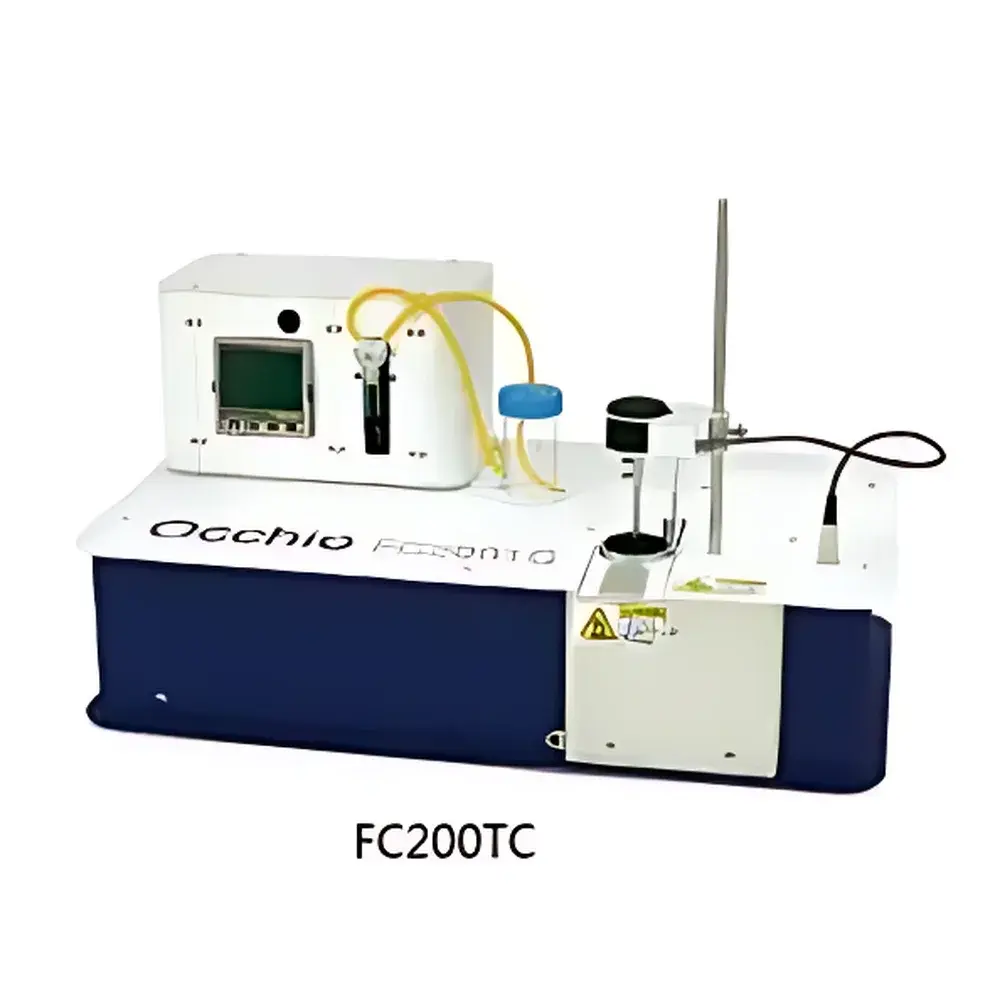
| Temperature Control (FC200TC) | Ambient to 140 °C |
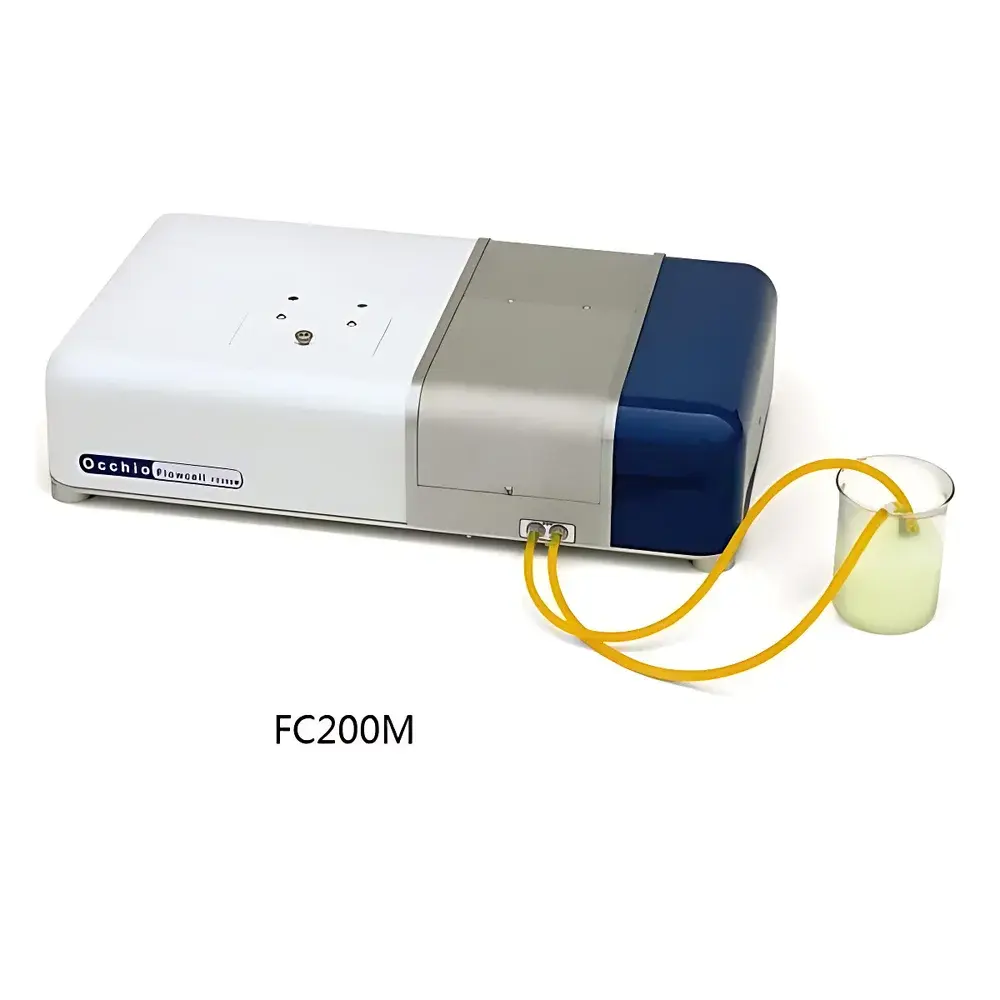
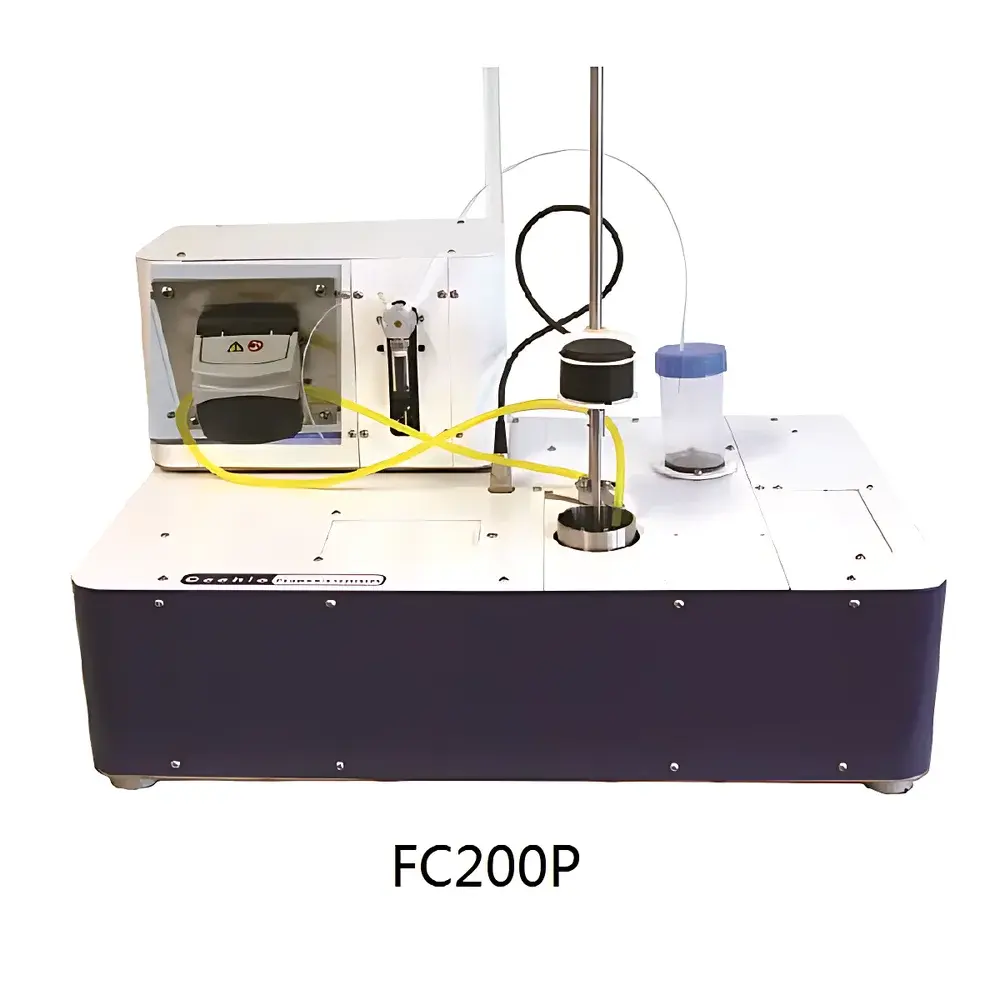
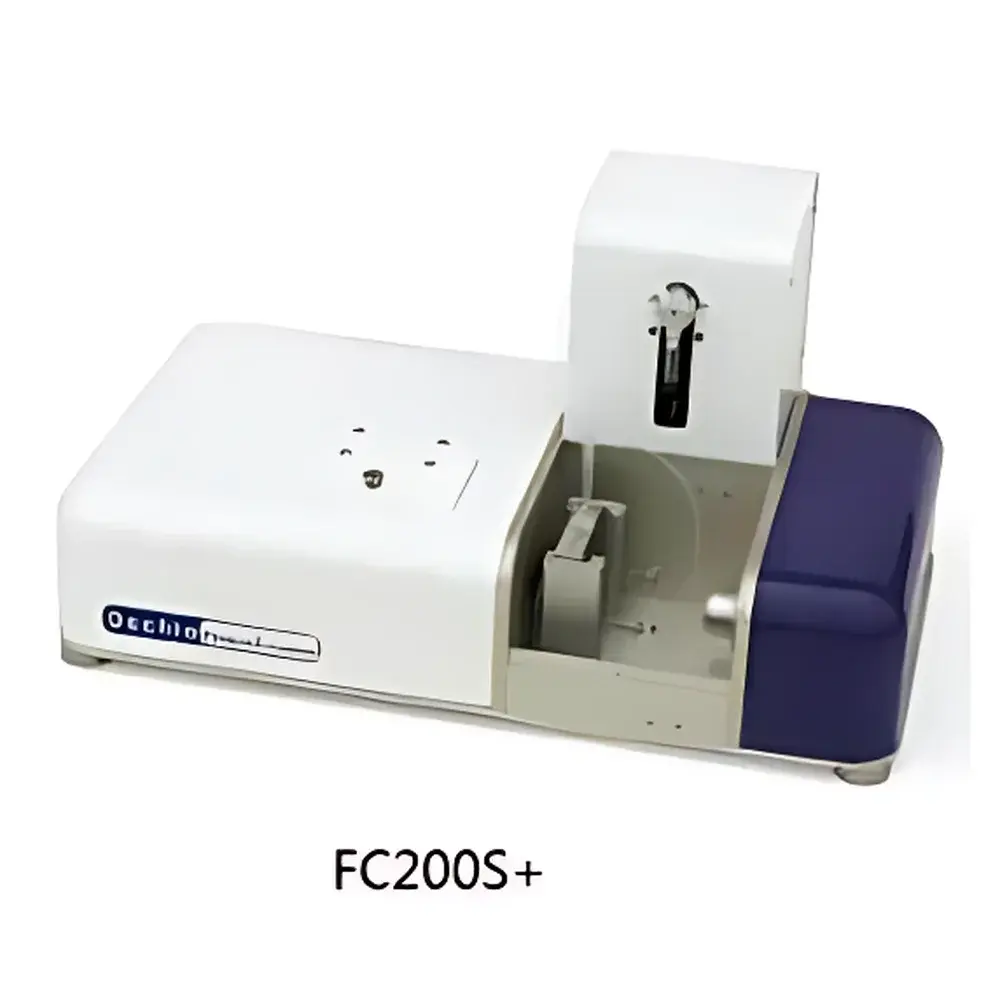
| Specialized Configurations | FC200M+(HR), FC200S+(HR), FC200TC, FC200P, FC200BAG, IPAC 1, IPAC 2 CMP |
Overview
The Occhio FC200 Series Flow Cell Particle Analyzer is a high-precision, image-based instrumentation platform engineered for real-time, in-flow characterization of particulate systems in liquid suspension. Operating on the principle of dynamic digital microscopy—where particles pass through a precisely defined optical flow cell and are imaged under collimated blue-light illumination—the system delivers simultaneous measurement of particle size distribution (PSD), morphological descriptors (e.g., circularity, aspect ratio, convexity, solidity, Feret diameters), and absolute particle concentration (particles/mL). Unlike ensemble techniques such as laser diffraction or light obscuration, the FC200 captures individual particle silhouettes at frame rates up to 60 fps, enabling statistically robust analysis without reliance on scattering models or Mie theory assumptions. Its design accommodates both dilute and highly concentrated dispersions—including undiluted emulsions up to 5% v/v—by leveraging proprietary flow control architecture and background-dynamic subtraction algorithms that discriminate moving particles from static debris or cell-wall artifacts.
Key Features
- Multi-configurable flow cell architecture supporting interchangeable optical paths, pump modules, and thermal units across application-specific variants (FC200M, FC200S+, FC200TC, FC200P, FC200BAG, IPAC 1, IPAC 2 CMP).
- High-resolution imaging subsystems: CMOS sensors ranging from 5 MP to 12 MP; pixel resolutions down to 0.17 µm/pixel (IPAC 2 CMP); telecentric zoom lenses with diffraction-limited optical performance.
- Dedicated illumination: 440–450 nm collimated monochromatic blue LEDs eliminate chromatic aberration and minimize diffraction halo effects—critical for accurate edge detection of transparent or low-contrast particles (e.g., protein aggregates, silicone oil droplets, polymer microspheres).
- Intelligent flow management: Integrated peristaltic, diaphragm, or syringe pumps deliver stable, pulse-free laminar flow with programmable shear profiles—ensuring reproducible dispersion state and minimizing aggregation artifacts during transit.
- Regulatory-ready software: Callisto 2D and Callisto 3D platforms include full audit trail logging, electronic signatures, user role management, and 21 CFR Part 11 compliance modules for GxP environments.
- Validation support: Factory-installed IQ/OQ/PQ protocols aligned with ASTM E2412, ISO 13322-2, and USP and guidance for subvisible particle analysis.
Sample Compatibility & Compliance
The FC200 Series accepts a broad spectrum of sample types—including aqueous and non-aqueous suspensions, oil-in-water and water-in-oil emulsions, foams, crystalline slurries, radiopharmaceutical colloids, and biopharmaceutical formulations—without requiring electrolyte addition or centrifugal pre-treatment. Its non-invasive optical design enables direct analysis of fragile or reactive particles (e.g., liposomes, viral vectors, precipitated APIs) that degrade under sonication or surfactant exposure. The FC200TC variant integrates dual-zone digital temperature control (ambient to 140 °C) for kinetic crystallization studies, while FC200BAG isolates radiation-handling electronics from the optical module for nuclear material applications. All configurations comply with ISO/IEC 17025 traceability requirements and support GLP/GMP documentation workflows, including raw image archiving, method versioning, and report generation with embedded metadata (timestamp, operator ID, instrument calibration status).
Software & Data Management
Callisto software provides a modular, scriptable environment for method development, acquisition control, and post-processing analytics. Each acquisition session generates a timestamped .ocd project file containing original TIFF images, particle ROI masks, extracted morphometric data tables (CSV/Excel export), and histogram overlays. Advanced features include batch processing pipelines, SOP-driven automation (e.g., auto-dispersion, rinse cycles, reporting), trajectory tracking for Brownian motion analysis (IPAC 1), and 3D surface reconstruction via multi-angle shadow projection (FC200TC, Callisto 3D). Data integrity is enforced via cryptographic hash verification of raw image files and immutable audit logs compliant with FDA 21 CFR Part 11 Annex 11 requirements. Optional integration with LIMS or MES systems is supported via RESTful API and OPC UA interfaces.
Applications
- Pharmaceutical development: Quantitative assessment of protein aggregate morphology, subvisible particle burden in mAb formulations, and crystallinity evolution during lyophilization cycle optimization.
- Chemical process monitoring: Real-time tracking of crystal nucleation, growth, and attrition in continuous crystallizers (FC200TC), with trend analysis of median size, shape anisotropy, and population balance models.
- Materials science: Characterization of CMP slurry abrasives (IPAC 2 CMP), ceramic nanoparticle dispersions, and battery electrode slurries—where aspect ratio and surface roughness correlate directly with coating uniformity.
- Food & cosmetics: Emulsion stability profiling (droplet coalescence, Ostwald ripening), foam bubble size distribution, and starch granule morphology in thermal gelatinization studies.
- Nuclear safety: Radioactive particle sizing and shape classification in fuel reprocessing effluents (FC200BAG), meeting IAEA TRS-461 reporting standards for alpha-emitting actinide colloids.
FAQ
Does the FC200 require sample dilution for accurate counting?
No—its dynamic background subtraction algorithm and high-contrast blue-light imaging allow direct analysis of undiluted samples up to 5% v/v concentration, eliminating dilution-induced bias and preserving native aggregation states.
Can the system differentiate between solid particles, liquid droplets, and gas bubbles?
Yes—FC200S+ and FC200S+(HR) models employ Occhio’s proprietary phase-aware pattern recognition engine trained on labeled datasets of emulsions, foams, and suspensions, enabling classification by refractive index contrast and edge gradient signature.
Is temperature-controlled analysis possible?
Yes—the FC200TC configuration includes dual-zone Peltier heating/cooling with ±0.1 °C stability over 0–140 °C, enabling isothermal crystallization kinetics and polymorph transition studies.
What validation documentation is provided?
Each instrument ships with factory-executed Installation Qualification (IQ), Operational Qualification (OQ), and Performance Qualification (PQ) protocols, plus reference standard certificates traceable to NIST SRM 1980 and EURAMET CG-18 guidelines.
How is data security ensured in regulated environments?
Callisto implements role-based access control, encrypted database storage, electronic signature workflows, and immutable audit trails—all independently verified for 21 CFR Part 11 and EU Annex 11 compliance.



