
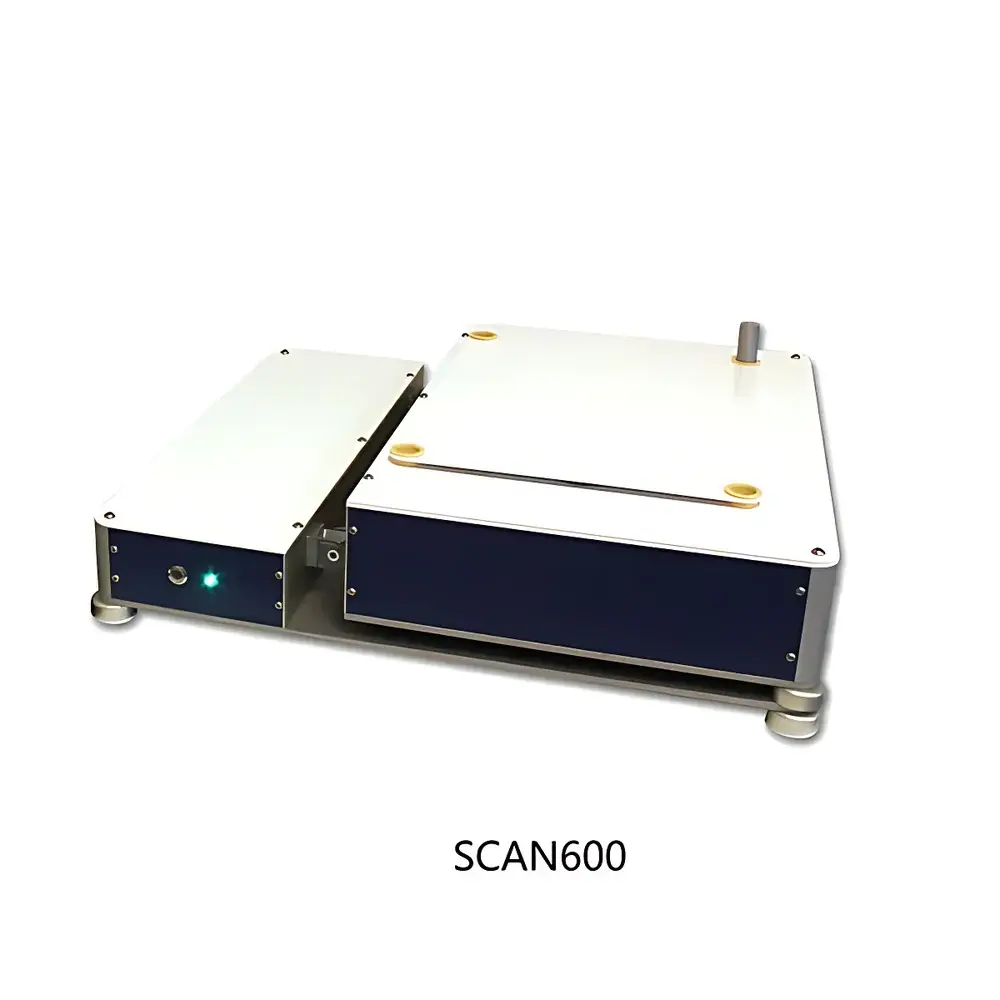
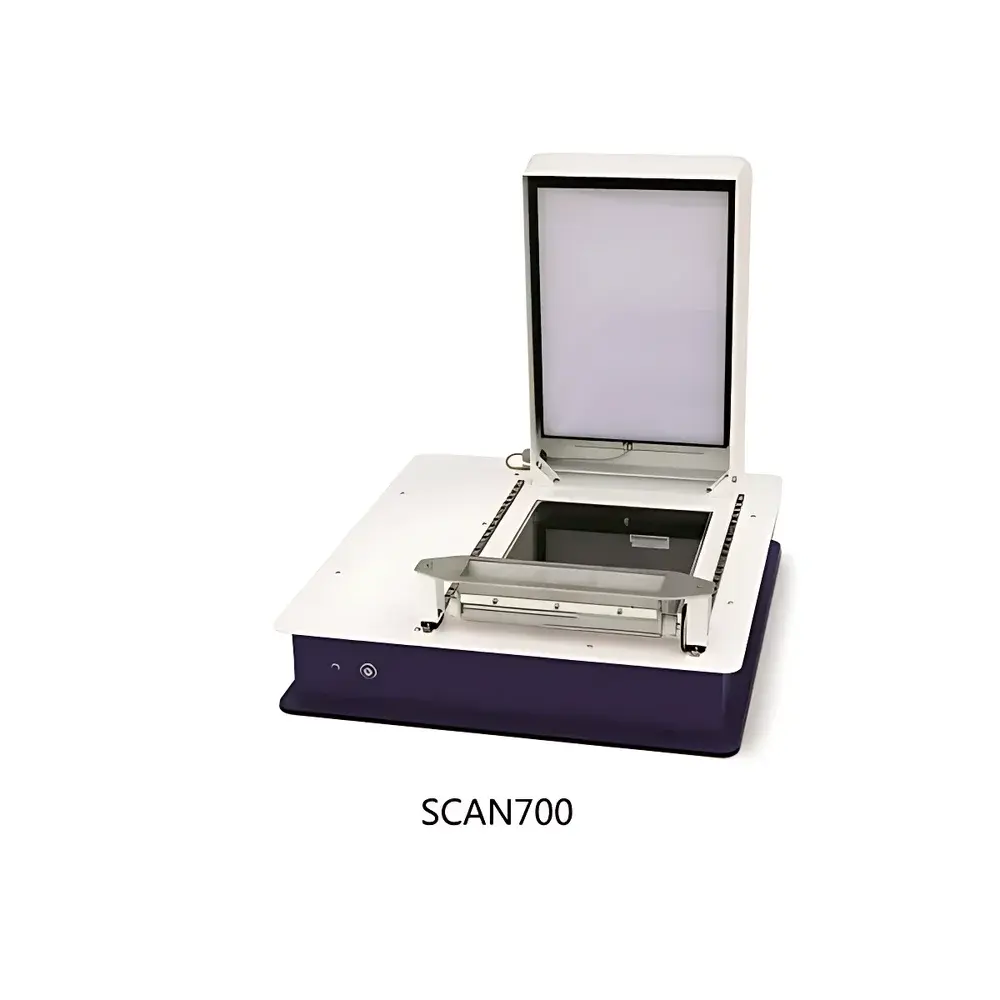
Occhio SCAN Series Static Particle Size and Shape Analyzer
| Brand | Occhio |
|---|---|
| Origin | Belgium |
| Model | SCAN Series |
| Particle Size Range | 10 µm – 50 mm (extendable to 2 µm – 20 cm) |
| Optical Resolution | Up to 600 Mpx (Scan 700) |
| Illumination | Broadband white light (350–640 nm), transmission + reflection modes |
| Imaging Sensor | High-speed CCD linear array |
| Software | Callisto 2D/3D |
| Dispersion | Dry-mode linear disperser with anti-adhesion metal coating |
| Sample Stage | 242 × 320 mm (Scan 700) |
| Compliance | ASTM D7927, ISO 9276-6, USP <1788>, GLP-ready audit trail in Callisto |
Overview
The Occhio SCAN Series is a high-precision static image analysis system engineered for comprehensive morphological characterization of particulate and planar materials. Unlike dynamic or laser-diffraction-based instruments, the SCAN platform relies on calibrated, high-resolution macro- and micro-scale digital imaging under controlled illumination—enabling true two-dimensional (2D) and optional three-dimensional (3D) particle representation. Its core measurement principle combines geometric segmentation algorithms with sub-pixel edge detection to extract over 30 shape descriptors (e.g., aspect ratio, convexity, circularity, solidity, Feret diameters) alongside size distribution histograms. Designed specifically for heterogeneous, non-spherical, or fragile samples—including soil aggregates, construction aggregates, fertilizer granules, plant fibers, cereal seeds, bakery slices, concrete thin sections, and polymeric foams—the SCAN Series bridges the gap between traditional sieving and electron microscopy by delivering statistically robust, traceable, and operator-independent results without sample destruction or suspension.
Key Features
- Modular optical architecture supporting both transmission and reflection illumination across 350–640 nm spectrum, ensuring optimal contrast for transparent, opaque, colored, or semi-crystalline specimens.
- Dual-stage dispersion capability: integrated dry-mode linear disperser with low-adhesion metal-coated rails and programmable slide velocity, plus optional VDD 270 vacuum disperser (≤100 mbar ultimate vacuum, ≥27.9 N/min flow rate) enabling direct dispersion onto the optical stage without transfer artifacts.
- High-fidelity imaging: Scan 600 employs a 100 Mpx (10,000 × 10,000) surface resolution sensor; Scan 700 supports up to 600 Mpx (20,000 × 30,000) via optional ultra-high-resolution CCD linear array, paired with telecentric zoom lenses for distortion-free magnification across full field-of-view.
- Multi-modal analysis engine: simultaneous quantification of particle count, size distribution (by equivalent circle diameter, minimum bounding rectangle, or Martin length), shape parameters, color intensity mapping (RGB/HSL), pore geometry (area, perimeter, elongation), and foam coalescence kinetics via time-lapse acquisition.
- GLP-compliant software architecture: Callisto 3D includes electronic signatures, version-controlled method templates, raw image archiving, and full audit trail per FDA 21 CFR Part 11 requirements—ensuring data integrity during regulatory submissions.
Sample Compatibility & Compliance
The SCAN Series accommodates rigid and semi-rigid planar substrates up to 240 × 240 mm (Scan 600) or 242 × 320 mm (Scan 700), including filter membranes, asphalt cores, mineral thin sections, extruded catalyst pellets, tobacco ribbons, textile fibers, and aerated food matrices. Wet dispersion modules enable aqueous or organic suspension analysis with recirculation control, while foam analysis kits support real-time bubble tracking at frame rates up to 30 fps. Method validation aligns with ISO 9276-6 (representation of particle shape and morphology), ASTM D7927 (standard test method for determination of particle size distribution of soil using image analysis), and USP (subvisible particle characterization in parenterals). All hardware and firmware revisions are documented per ICH Q5A and GMP Annex 11 guidelines.
Software & Data Management
Callisto software provides an integrated environment for acquisition, segmentation, classification, statistical reporting, and export. Its modular design supports both 2D batch analysis (Callisto 2D) and stereoscopic reconstruction from dual-angle acquisitions (Callisto 3D). Built-in calibration routines use NIST-traceable stage micrometers and certified glass standards. Data exports include CSV (for Excel/Python integration), PDF reports with embedded metadata, and structured XML files compatible with LIMS platforms. Batch processing workflows allow automated re-analysis of legacy datasets following updated thresholding or classification rules—critical for retrospective quality investigations.
Applications
- Construction materials: quantifying aggregate gradation, flakiness index, and void structure in asphalt or concrete thin sections per EN 13242 and ASTM C136.
- Agricultural science: morphometric profiling of seed viability, fertilizer dissolution patterns, and soil aggregate stability indices.
- Pharmaceutical development: characterizing extruded matrix pellets, lyophilized cake pore networks, and inhalation powder fiber aerodynamics.
- Food & beverage R&D: measuring crumb grain uniformity in baked goods, starch granule swelling kinetics, and foam collapse dynamics in dairy or plant-based alternatives.
- Materials engineering: analyzing catalyst pellet fragmentation, carbon black dispersion homogeneity, and polymer foam cell size distribution per ISO 4590.
FAQ
What is the smallest detectable particle size with the SCAN Series?
The base configuration resolves particles down to 10 µm; with optional high-magnification optics and 600 Mpx imaging, effective resolution extends to ~2 µm under optimal contrast conditions.
Can the SCAN analyze wet suspensions?
Yes—via the optional wet dispersion module, which integrates syringe pump control, flow-cell illumination, and refractive-index compensation algorithms.
Is calibration traceable to international standards?
All optical and mechanical calibrations are performed using NIST-traceable reference standards, with certificates issued per ISO/IEC 17025 requirements.
How does the system handle overlapping or agglomerated particles?
Callisto employs watershed-based separation heuristics combined with user-definable touch-counting logic, validated against manual counting per ISO 13322-2.
Does the software support automated pass/fail decision-making against specification limits?
Yes—customizable acceptance criteria can be embedded into method templates, triggering visual alerts and auto-flagging of out-of-spec results in generated reports.



