
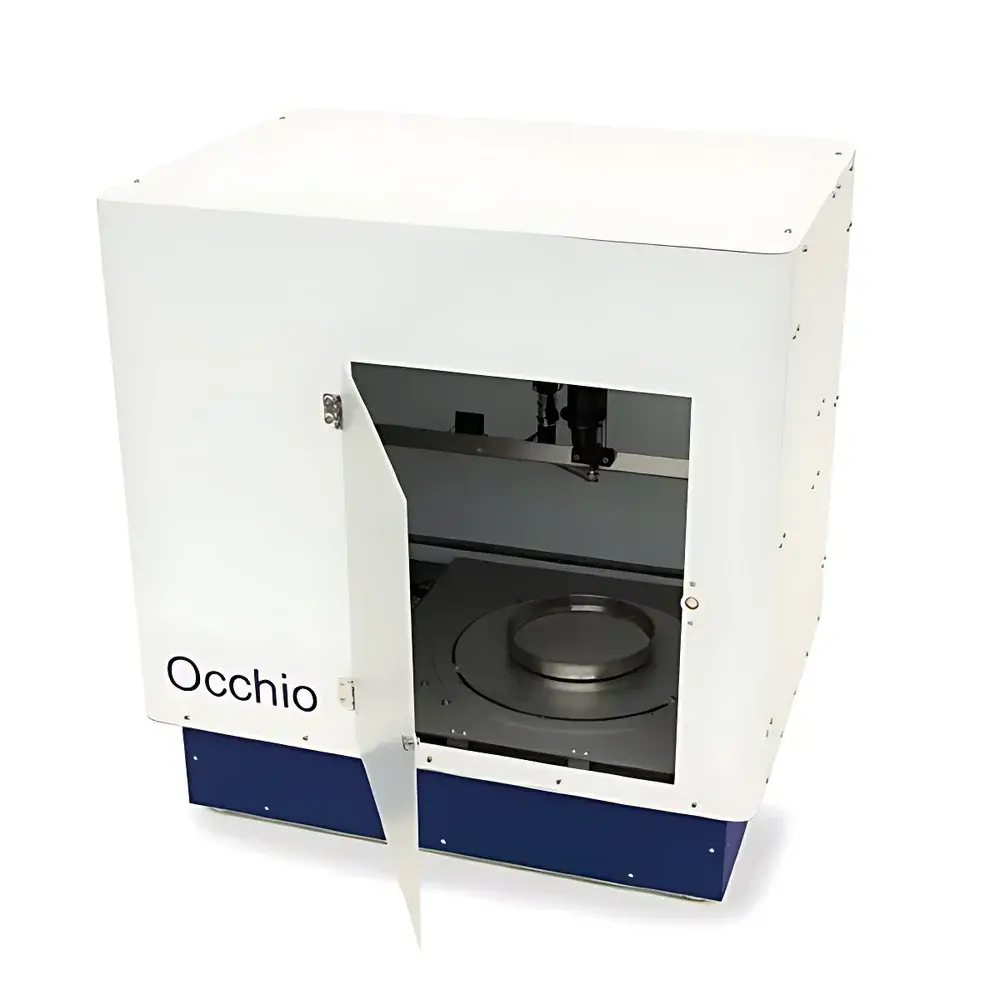
Occhio SIEVECAL Sieve Calibration & Analysis System
| Brand | Occhio |
|---|---|
| Origin | Belgium |
| Model | SIEVECAL |
| Application | Automated optical calibration and metrological analysis of test sieves per ASTM E11, ISO 3310-1, and DIN EN ISO 3310-1 |
| Imaging Resolution | 1.2 µm (pixel-limited) |
| Sieve Diameter Support | 200–300 mm (8–12 inch) |
| Aperture Size Range | 20 µm – 12.5 mm |
| Measurement Parameters | Feret X/Y diameters, maximum inscribed circle diameter, wire thickness (X/Y), aperture area, blockage ratio, statistical distribution (mean, min, max, σ) |
| Compliance Standards | ASTM E11-13, ISO 3310-1:2016, DIN EN ISO 3310-1 |
| Analysis Time | ≤120 s per sieve |
| Optical System | Collimated 450 nm blue LED backlight + telecentric zoom lens + USB3 monochrome camera (1.3 MP) |
| Automation Level | Fully motorized XY translation + 360° continuous rotation stage |
| Software | Occhio SIEVECAL Suite with audit-trail-capable reporting, GLP-compliant data storage, and CFR 21 Part 11–ready configuration options |
Overview
The Occhio SIEVECAL is a fully automated, metrology-grade optical calibration system engineered for traceable, non-contact dimensional verification of woven-wire and perforated test sieves. It operates on the principle of high-contrast silhouette imaging under collimated 450 nm blue illumination, enabling sub-micron resolution measurement of aperture geometry and wire cross-sections without physical contact or mechanical stress. Unlike traditional manual caliper or microscope-based methods—prone to operator bias and sampling error—the SIEVECAL acquires and analyzes >99.8% of the active sieve surface in a single, unattended run. Its core function is to generate objective, auditable compliance evidence against internationally recognized standards including ASTM E11-13, ISO 3310-1:2016, and DIN EN ISO 3310-1. Designed specifically for QC laboratories, accredited calibration facilities, and sieve manufacturing QA departments, the system delivers repeatable, NIST-traceable results required for ISO/IEC 17025 accreditation and FDA-regulated environments.
Key Features
- Fully motorized XY translation and continuous 360° rotation stage ensures complete coverage of standard sieve diameters (200–300 mm), eliminating blind zones and edge artifacts.
- Telecentric zoom lens coupled with a 1.3 MP USB3 monochrome camera achieves a calibrated pixel resolution of 1.2 µm—sufficient to resolve apertures down to 20 µm while maintaining geometric fidelity across field-of-view.
- Collimated 450 nm blue LED backlight provides uniform, shadow-free illumination critical for accurate Feret diameter and inscribed circle computation—minimizing diffraction-induced edge uncertainty.
- Real-time image acquisition and on-the-fly aperture segmentation allow immediate visual feedback during scanning; each detected aperture receives a unique ID for traceability.
- Statistical engine computes full distribution metrics per measurement axis: mean, minimum, maximum, and standard deviation for both aperture dimensions (Feret X/Y, diagonal, max inscribed circle) and wire thickness (X/Y).
- Blockage detection algorithm identifies occluded or partially obstructed apertures and reports their relative frequency—essential for assessing sieve service life and cleaning efficacy.
Sample Compatibility & Compliance
The SIEVECAL accommodates all standard test sieves conforming to ASTM E11, ISO 3310-1, and DIN EN ISO 3310-1—including stainless steel, brass, and nylon meshes—across nominal diameters from 200 mm (8″) to 300 mm (12″). It supports both woven-wire and electroformed perforated plates. The system’s measurement uncertainty budget has been validated against certified reference sieves and aligns with the repeatability requirements specified in Clause 7.3 of ASTM E11-13. All generated reports include embedded metadata (timestamp, operator ID, instrument serial number, calibration certificate ID) and are structured to satisfy ISO/IEC 17025 clause 7.8.2 (reporting of results) and FDA 21 CFR Part 11 requirements when deployed with electronic signature and audit trail modules enabled.
Software & Data Management
The Occhio SIEVECAL Suite is a Windows-based application built on a relational database architecture supporting concurrent multi-user access and role-based permissions. It features configurable pass/fail thresholds aligned with ASTM E11 Table 1 (tolerances for nominal aperture size and wire diameter), automatic generation of PDF/CSV reports with embedded histograms and scatter plots, and optional integration with LIMS via ODBC or REST API. All raw images, intermediate masks, and measurement logs are stored with SHA-256 checksums and immutable timestamps. Audit trails record every user action—including parameter edits, report exports, and calibration events—with full WHO/WHEN/WHERE attribution. The software is validated per GAMP5 guidelines and includes IQ/OQ documentation templates for regulated laboratories.
Applications
- Accredited calibration of laboratory test sieves prior to use in particle size distribution analysis (e.g., USP <786>, Ph. Eur. 2.9.31).
- Incoming inspection of new sieves from manufacturers to verify conformance to purchase specifications.
- Periodic in-service verification of sieves used in pharmaceutical granulation, catalyst screening, or mineral processing QC workflows.
- Root-cause investigation of sieve-related outliers in sieve analysis data—e.g., identifying localized wear, plugging, or manufacturing defects.
- Supporting ISO 9001 and IATF 16949 process validation by providing documented evidence of measurement system capability (MSA) for sieve-based testing.
FAQ
Does the SIEVECAL require periodic recalibration with traceable standards?
Yes. Annual calibration using NIST-traceable aperture reference standards is recommended and supported by Occhio’s certified service network.
Can the system analyze damaged or bent sieves?
It can detect local deformations (e.g., dents, warping) via focus-map analysis and exclude affected regions from final statistics—but severely distorted sieves may fail full-surface registration and require manual region-of-interest definition.
Is the software compliant with 21 CFR Part 11?
Out-of-the-box, it meets technical prerequisites; full Part 11 compliance requires deployment with validated electronic signatures, audit trail logging, and system access controls—configured during IQ/OQ.
What file formats does the system export?
PDF (print-ready reports), CSV (raw measurements), TIFF (lossless image stacks), and XML (structured metadata for LIMS ingestion).
How is measurement uncertainty quantified for each reported parameter?
Uncertainty is derived from combined Type A (repeatability SD across ≥1000 apertures) and Type B (lens MTF, pixel pitch, backlight collimation error) components per GUM (JCGM 100:2008); full uncertainty budgets are included in advanced reporting mode.



