
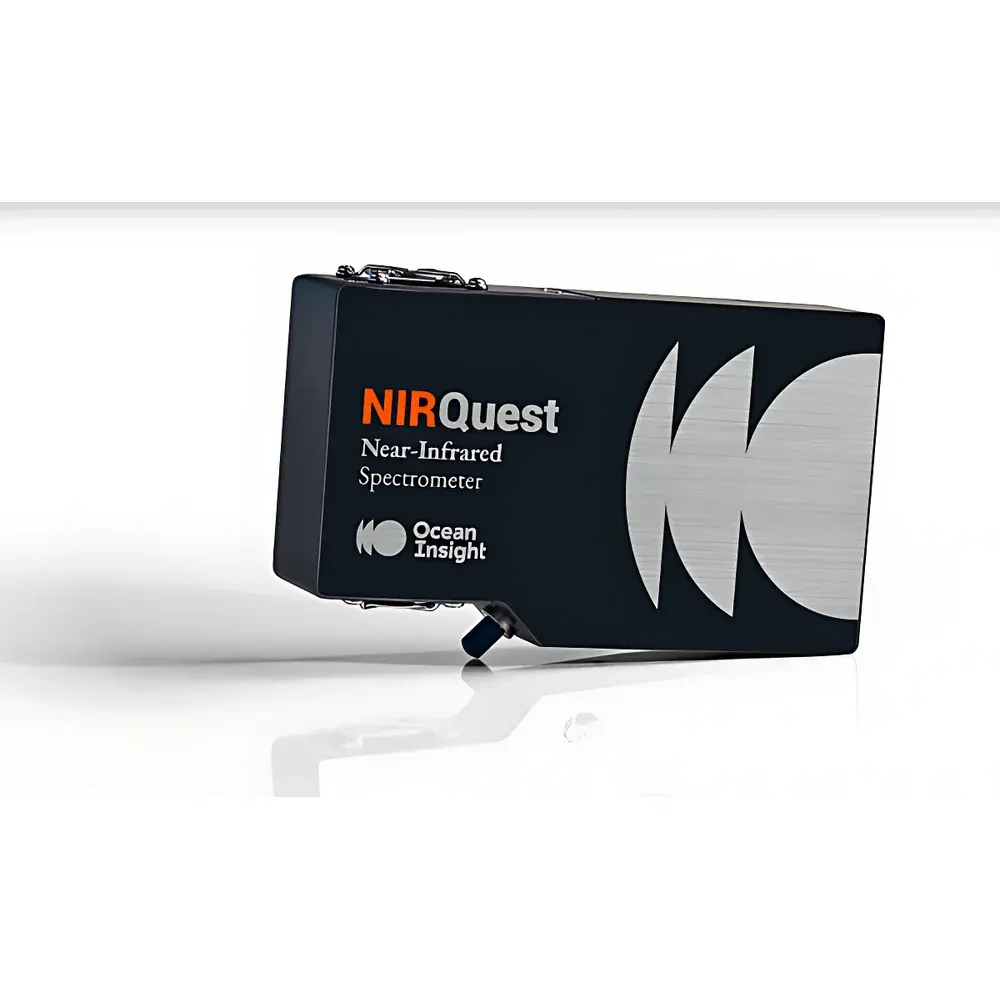
Ocean Insight NIRQuest+ Near-Infrared Spectrometer
| Brand | Ocean Insight |
|---|---|
| Model | NIRQuest+ |
| Type | Portable Grating-Based Spectrometer |
| Wavelength Range | 900 nm – 2500 nm |
| Detector Cooling | Thermoelectric (TEC) to –20 °C |
| Dark Current | Low |
| Signal-to-Noise Ratio | High |
| Integration Time | Short (ms-scale typical) |
| Optical Compatibility | Fully compatible with Ocean Insight light sources, optical fibers, and sampling accessories |
| Configurations | NIRQuest+1.7 (900–1700 nm), NIRQuest+2.2 (900–2200 nm), NIRQuest+2.5 (900–2500 nm) |
| Compliance | Designed for GLP/GMP-aligned workflows |
Overview
The Ocean Insight NIRQuest+ is a high-performance, portable near-infrared (NIR) spectrometer engineered for precision quantitative and qualitative analysis in demanding field and laboratory environments. Based on a robust Czerny-Turner optical architecture with optimized grating dispersion and enhanced throughput optics, the NIRQuest+ employs an InGaAs linear array detector with thermoelectric cooling (–20 °C) to minimize dark current and maximize signal fidelity across the 900–2500 nm spectral range. Unlike scanning monochromator-based systems, the NIRQuest+ operates on a fixed-grating, multi-channel detection principle—enabling full-spectrum acquisition in a single integration cycle without mechanical wavelength scanning. This design delivers inherent stability, repeatability, and immunity to moving-part drift, making it particularly suitable for process monitoring, quality control, and field-deployable chemometric applications where measurement consistency and environmental resilience are critical.
Key Features
- Three preconfigured spectral ranges: NIRQuest+1.7 (900–1700 nm), NIRQuest+2.2 (900–2200 nm), and NIRQuest+2.5 (900–2500 nm)—each optimized for specific absorption band coverage in organic functional group analysis.
- Enhanced optical throughput via improved entrance slit geometry, collimating mirror efficiency, and anti-reflection coated optics—yielding up to 2.5× higher system sensitivity compared to prior-generation NIR spectrometers of comparable form factor.
- Thermoelectrically cooled InGaAs detector maintained at –20 °C, ensuring low dark current (10,000:1), and stable baseline performance over extended integration periods.
- Short minimum integration time (down to 1 ms), enabling rapid spectral capture for kinetic studies, conveyor-belt inline measurements, or handheld field surveys.
- Modular mechanical and electrical interface—standard SMA 905 fiber coupling, USB 3.0 or Ethernet (optional) connectivity, and industry-standard 5 V DC power input—facilitating seamless integration into OEM instrumentation, automated sampling stations, or mobile analytical platforms.
Sample Compatibility & Compliance
The NIRQuest+ is compatible with a broad range of sample types—including solids (granules, tablets, fruits, soil), liquids (solutions, suspensions, fuels), and semi-solids (creams, pastes, biological tissues)—when used with appropriate Ocean Insight sampling accessories such as integrating spheres, contact probes, transflectance cuvettes, or fiber-optic reflectance probes. Its optical design conforms to ISO 14785:2022 (optical methods for liquid analysis) and supports method development aligned with ASTM E1655 (standard practices for NIR quantitative analysis) and USP (near-infrared spectroscopy). When deployed with validated software and documented calibration protocols, the system meets foundational requirements for GLP and GMP environments, including traceable wavelength and photometric calibration, electronic record integrity, and configurable user access controls.
Software & Data Management
The NIRQuest+ operates natively with Ocean Insight’s OceanView spectroscopy platform—a cross-platform application supporting real-time spectral acquisition, baseline correction, smoothing, derivative processing, and multivariate calibration (PLS, PCR, PCA). OceanView exports data in vendor-neutral formats (CSV, HDF5, JCAMP-DX) and integrates with third-party chemometrics tools including MATLAB, Python (via seabreeze and numpy/scikit-learn), and commercial packages such as Unscrambler X and CAMO Analytics. For regulated environments, Ocean Insight offers optional validation documentation packages and supports 21 CFR Part 11-compliant configurations through integration with enterprise LIMS or ELN systems—enabling electronic signatures, audit trails, and change control for calibration files, measurement methods, and result archives.
Applications
- Agriculture & Food: Non-destructive quantification of moisture, protein, oil, and starch content in grains, legumes, and dairy powders; ripeness assessment in fruits via water and sugar absorption bands.
- Pharmaceuticals: Raw material identification (RMI), blend uniformity monitoring, tablet coating thickness analysis, and counterfeit detection using spectral fingerprinting and PLS-DA classification models.
- Recycling & Polymer Sorting: Rapid differentiation of PET, HDPE, PP, and PVC plastics based on overtone and combination band signatures between 1600–2400 nm.
- Environmental Monitoring: Soil organic carbon estimation, vegetation water content mapping, and nutrient profiling (N, P, K) from field-collected spectra calibrated against reference laboratory assays.
- Energy & Materials: Solar simulator spectral irradiance characterization, thin-film thickness verification via interference fringe analysis, and catalyst surface hydration state tracking.
FAQ
What spectral resolution can be expected from the NIRQuest+ series?
Spectral resolution (FWHM) varies by configuration and slit width; typical values range from 2.5 nm (NIRQuest+1.7, 25 µm slit) to 6.5 nm (NIRQuest+2.5, 50 µm slit). Resolution is specified at 1550 nm and scales approximately linearly across the range.
Is the NIRQuest+ suitable for use in regulated pharmaceutical QC labs?
Yes—when deployed with validated calibration procedures, controlled software versions, and documented change management, the NIRQuest+ supports compliance with ICH Q2(R2), USP , and FDA guidance for PAT implementation.
Can the NIRQuest+ be integrated into custom OEM instruments?
Yes—Ocean Insight provides SDKs (C/C++, Python, LabVIEW), hardware design support, and optical subsystem customization services through Ocean Lab Services for embedded and industrial integration.
Does the spectrometer require external cooling or vacuum systems?
No—the integrated thermoelectric cooler (TEC) maintains detector temperature at –20 °C without external chillers, dry ice, or vacuum enclosures.
How is wavelength calibration performed and maintained?
Factory-calibrated using NIST-traceable rare-earth oxide emission lines; users may perform periodic verification using optional tungsten-halogen or mercury-argon calibration sources, with calibration coefficients stored per-device in non-volatile memory.






