
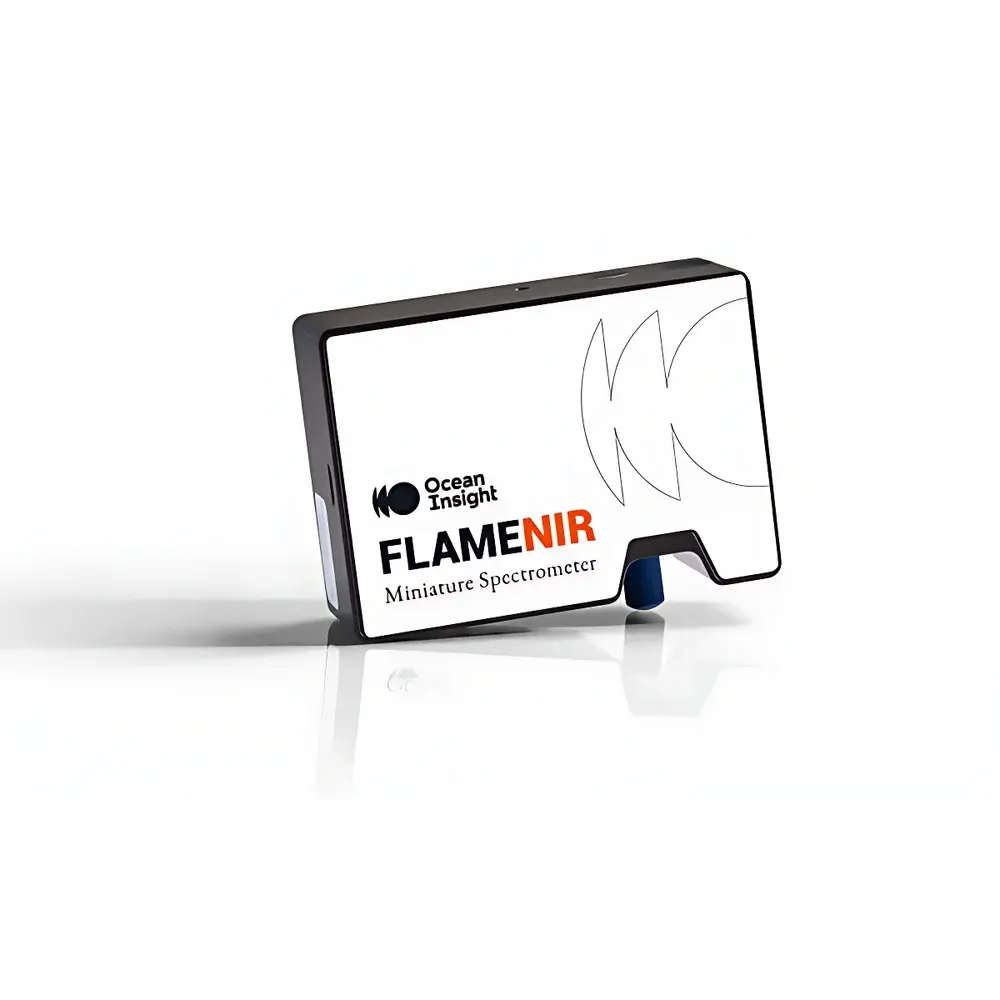
Ocean Optics Flame-NIR+ Miniature Near-Infrared Spectrometer
| Brand | Ocean Optics |
|---|---|
| Model | Flame-NIR+ |
| Type | Portable Spectrometer |
| Principle | Grating-based Scanning Spectroscopy |
| Wavelength Range | 970–1700 nm |
| Optical Resolution | ~10 nm FWHM (25 µm slit) |
| Signal-to-Noise Ratio | 6000:1 (full signal) |
| Dynamic Range | 6000:1 (single acquisition) |
| Thermal Drift | 0.08 nm/°C |
| Maximum Scan Rate | ~400 Hz |
| Integration Time | 1 ms – 45 s |
| Detector | Uncooled InGaAs linear array (128 pixels) |
| Dimensions | 89.1 × 63.3 × 31.9 mm (34.4 mm including feet) |
| Weight | 265 g |
| Interface | Micro-USB |
| Compliance | CE, RoHS, FCC Class B |
Overview
The Ocean Optics Flame-NIR+ is a compact, high-performance miniature near-infrared (NIR) spectrometer engineered for field-deployable and benchtop quantitative and qualitative analysis in regulated and research environments. Based on grating-scanning optical architecture with an uncooled InGaAs linear detector array, it delivers stable spectral acquisition across the critical 970–1700 nm range—covering first-overtone C–H, N–H, and O–H vibrational absorptions essential for organic compound identification and quantification. Its thermally robust design (0.08 nm/°C wavelength drift) and high dynamic range (6000:1, single-scan) enable reproducible measurements under variable ambient conditions—making it suitable for use in production floors, mobile labs, and quality control stations where space, power, and portability are constrained.
Key Features
- Compact form factor (89.1 × 63.3 × 31.9 mm; 265 g) optimized for integration into handheld probes, process analyzers, and OEM instrumentation platforms.
- Uncooled InGaAs detector with 128-pixel resolution ensures low power consumption (<500 mW), eliminating need for thermoelectric cooling and associated thermal stabilization delays.
- Configurable 25 µm entrance slit yielding ~10 nm FWHM optical resolution—balanced for sufficient spectral discrimination while maintaining high light throughput.
- Micro-USB interface enables direct connection to Windows, Linux, or macOS hosts without external power supplies; supports USB 2.0 high-speed data transfer up to ~400 spectra per second.
- Field-replaceable slits and customizable firmware allow adaptation to specific application requirements—including integration with fiber-optic sampling accessories (e.g., reflection probes, integrating spheres, transmission cells).
- Low inter-unit variability (<±0.5 nm wavelength calibration deviation across production lot) ensures measurement consistency across multi-instrument deployments.
Sample Compatibility & Compliance
The Flame-NIR+ supports reflectance, transmittance, and radiance measurements via standardized fiber-optic coupling (SMA 905). It is routinely deployed in solid, semi-solid, and liquid sample analysis—including powders, tablets, slurries, and packaged foods—without destructive preparation. While the spectrometer itself does not include embedded chemometric software, its spectral output (ASCII or binary format) is fully compatible with industry-standard chemometrics platforms such as Unscrambler®, MATLAB® PLS Toolbox, and open-source libraries (e.g., scikit-learn, PyChem). Data acquisition workflows may be configured to comply with GLP/GMP documentation requirements when paired with validated host software supporting audit trails, electronic signatures, and 21 CFR Part 11–compliant metadata logging.
Software & Data Management
Ocean Insight’s OceanView spectroscopy software provides intuitive instrument control, real-time spectral visualization, and basic processing (baseline correction, smoothing, peak detection). For advanced modeling, raw spectral data (intensity vs. wavelength, 128 points) is exportable in CSV, TXT, or HDF5 formats. The device supports scripting via Python (through the oceanopticsusb SDK), LabVIEW™ drivers, and .NET APIs—enabling seamless incorporation into automated QA/QC systems, LIMS interfaces, or custom HMI dashboards. All firmware updates and calibration files are digitally signed and version-controlled, supporting traceable instrument maintenance records per ISO/IEC 17025 and ASTM E178 guidelines.
Applications
- Pharmaceutical Manufacturing: Raw material identification (RMI), blend uniformity monitoring, and tablet coating thickness assessment using NIR diffuse reflectance.
- Food & Agriculture: Moisture, fat, protein, and sugar content prediction in grains, dairy products, and processed meats via partial least squares (PLS) regression models.
- Polymer Sorting & Recycling: Rapid classification of PET, HDPE, PP, and PVC plastics based on characteristic C–H combination bands between 1100–1350 nm.
- Environmental Monitoring: Soil organic carbon estimation and hydrocarbon contamination screening in field-deployed sensor nodes.
- Biotechnology: Real-time monitoring of bioreactor nutrient concentrations (e.g., glucose, lactate) through flow-cell transmission measurements.
FAQ
Does the Flame-NIR+ require external cooling or temperature stabilization?
No. It uses an uncooled InGaAs detector, eliminating thermoelectric coolers and enabling operation from 5 °C to 40 °C without active thermal management.
Can I perform quantitative analysis directly on the device?
The Flame-NIR+ is a spectral acquisition engine—not a standalone analyzer. Quantitative results require external chemometric modeling using reference datasets and calibration transfer protocols.
Is the wavelength calibration NIST-traceable?
Yes. Each unit ships with factory calibration using NIST-traceable tungsten-halogen and rare-earth oxide sources; users may perform recalibration using optional calibration kits (e.g., HG-1 Mercury-Argon lamp).
What is the typical lifetime of the InGaAs detector under continuous operation?
Based on accelerated life testing per IEC 60747-14, the detector maintains >95% responsivity after 50,000 hours of operation at 25 °C ambient.
How is spectral data synchronized with external triggers (e.g., conveyor belt encoders)?
Hardware trigger input (TTL-compatible) supports external start/stop synchronization, enabling gated acquisition aligned with process events or mechanical motion.






