
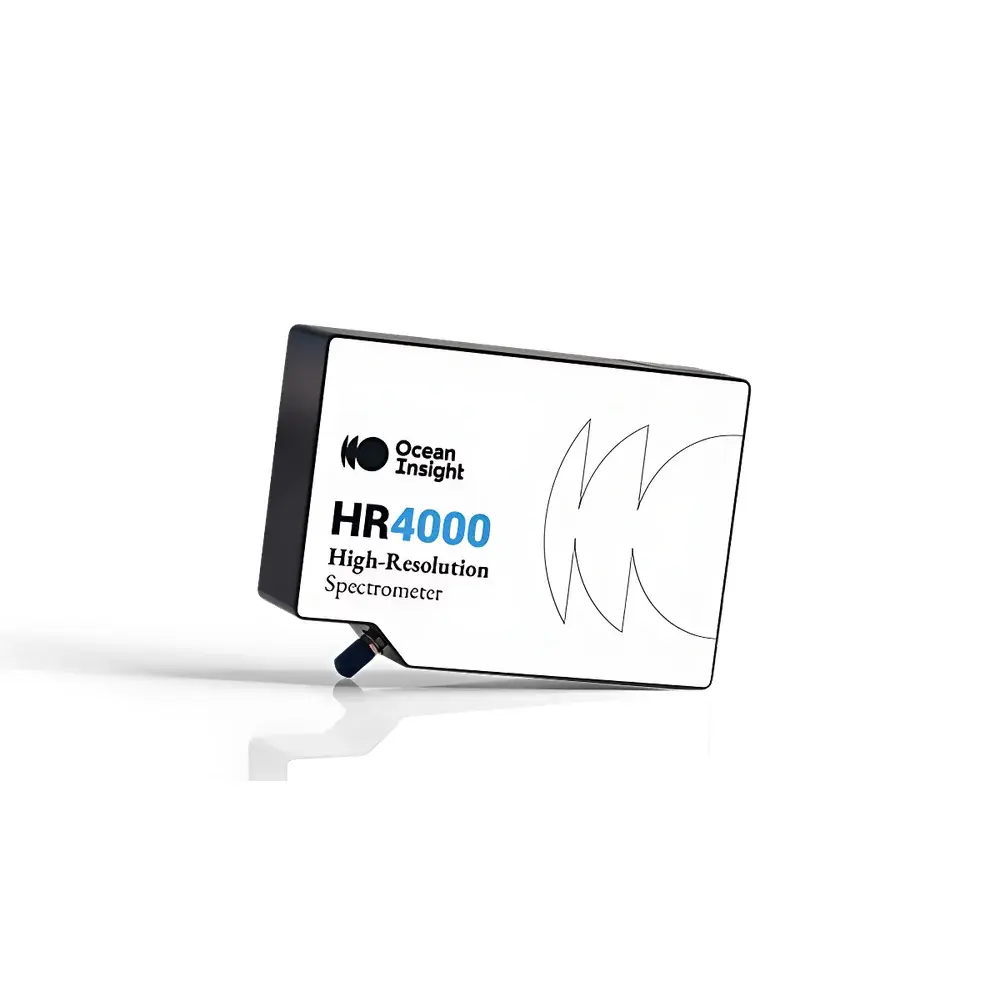
Ocean Optics HR4000CG-UV-NIR High-Resolution Compact Spectrometer
| Brand | Ocean Optics |
|---|---|
| Origin | USA |
| Model | HR4000CG-UV-NIR |
| Optical Architecture | Single-beam |
| Detector Type | Toshiba TCD1304AP CCD |
| Wavelength Range | 190–1100 nm |
| Grating | HC-1, 300 lines/mm |
| Slit Width | 5 µm |
| Optical Resolution (FWHM) | 0.75 nm |
| Stray Light | <0.05% at 600 nm |
| Integration Time | 4 ms–20 s (continuous) |
| Signal-to-Noise Ratio | 300:1 (full signal) |
| Dynamic Range (system) | 2×10⁹ |
| Interface | USB 2.0 (480 Mbps), RS-232 (2-wire), I²C |
| Operating Temperature | –10°C to +50°C |
| Storage Temperature | –30°C to +70°C |
| Humidity | 0–90% RH (non-condensing) |
| Dimensions | 148.6 × 104.8 × 45.1 mm |
| Weight | 0.57 kg |
| Fiber Connector | SMA 905 |
Overview
The Ocean Optics HR4000CG-UV-NIR is a high-resolution, compact CCD-based spectrometer engineered for precision UV-Vis-NIR spectral acquisition in demanding laboratory and industrial environments. Utilizing a linear CCD array (Toshiba TCD1304AP) and a high-efficiency holographic grating (HC-1, 300 lines/mm), it delivers consistent spectral fidelity across a broad 190–1100 nm range—spanning deep ultraviolet through near-infrared. Its optical design employs a fixed 5 µm entrance slit and optimized collimation/focusing optics to achieve a nominal resolution of 0.75 nm FWHM, enabling reliable discrimination of closely spaced absorption or emission features in complex chemical matrices. As a single-beam instrument, the HR4000CG-UV-NIR relies on stable light sources and calibrated reference standards for quantitative absorbance or reflectance measurements—making it particularly suited for applications requiring rapid spectral capture with reproducible photometric linearity, such as kinetic assays, LED characterization, and liquid-phase reaction monitoring.
Key Features
- High optical resolution (0.75 nm FWHM) maintained across full 190–1100 nm spectral range via optimized grating-slit-detector alignment
- Programmable microcontroller enabling hardware-level synchronization: two user-configurable TTL trigger inputs/outputs support precise temporal coordination with external devices (e.g., pulsed lasers, shutter controllers, or data acquisition systems)
- Flexible integration time control from 4 milliseconds to 20 seconds in continuous mode—and sub-millisecond shutter operation (10 ms to 4 ms)—for dynamic range adaptation without mechanical moving parts
- Low stray light performance (<0.05% at 600 nm; <0.10% at 435 nm) achieved through internal baffling, grating blaze optimization, and detector shielding—critical for accurate quantitation in low-transmission regions
- Compact form factor (148.6 × 104.8 × 45.1 mm) and lightweight construction (0.57 kg) facilitate integration into OEM systems, portable field analyzers, and space-constrained benchtop setups
- Multi-interface architecture: native USB 2.0 (480 Mbps) for high-speed streaming, plus dual-wire RS-232 and I²C buses for embedded system interoperability and firmware updates
Sample Compatibility & Compliance
The HR4000CG-UV-NIR interfaces seamlessly with standard SMA 905 fiber-optic cables (0.22 NA), supporting both reflection probes, transmission cuvette holders, and flow cells. Its broad spectral coverage enables direct analysis of aqueous and organic solutions, thin-film coatings, biological tissues, and semiconductor materials without hardware modification. While not certified as standalone medical or pharmaceutical instrumentation, the spectrometer’s stable thermal performance (operational range: –10°C to +50°C), low drift characteristics, and repeatable photometric response align with foundational requirements for method development under ISO/IEC 17025-accredited laboratories. When deployed within validated workflows—including those adhering to ASTM E275, USP , or CLSI EP21-A guidelines—the device supports traceable spectral data generation suitable for QC release testing, raw material verification, and stability-indicating assay development.
Software & Data Management
Ocean Insight’s OceanView software provides full instrument control, real-time spectral visualization, and export-ready data formatting (CSV, ASCII, XML). The SDK supports C++, Python, LabVIEW, and MATLAB integration, enabling custom automation of calibration routines, multivariate regression modeling (e.g., PLS for concentration prediction), and time-series batch processing. All spectral acquisitions include embedded metadata (timestamp, integration time, lamp ID, temperature sensor reading), satisfying audit-trail requirements for GLP/GMP-aligned environments. While the HR4000CG-UV-NIR lacks on-board memory, its USB streaming capability ensures uninterrupted data throughput to host systems compliant with FDA 21 CFR Part 11 when paired with validated software layers implementing electronic signatures, role-based access, and immutable log retention.
Applications
- UV-Vis quantification of nucleic acids, proteins, and dyes in microvolume cuvettes or capillary flow cells
- In-line monitoring of chemical synthesis endpoints via real-time absorbance ratio tracking (e.g., A₂₆₀/A₂₈₀ for protein purity)
- LED and laser diode spectral profiling—including peak wavelength, FWHM, and side-mode suppression ratio (SMSR) estimation
- Thin-film thickness determination using interference fringe analysis in reflectance mode
- Environmental water quality assessment via nitrate/nitrite, phosphate, or chlorophyll-a absorbance bands
- Pharmaceutical excipient identification using NIR fingerprinting (900–1100 nm region)
FAQ
What is the recommended calibration frequency for routine quantitative work?
For ISO/IEC 17025-compliant operations, wavelength calibration should be verified daily using a mercury-argon lamp, while intensity calibration (using NIST-traceable tungsten-halogen or deuterium standards) is recommended before each analytical session.
Can this spectrometer operate in vacuum or inert gas environments?
No—the housing is not sealed for vacuum compatibility; however, it may be externally enclosed in a nitrogen-purged chamber provided ambient humidity remains below 90% RH and condensation is prevented.
Is the detector thermoelectrically cooled?
No—the TCD1304AP operates at ambient temperature; extended integration times (>5 s) may require active thermal stabilization of the optical bench to minimize dark current drift.
Does the USB interface support isochronous data transfer for synchronized multi-device acquisition?
Yes—USB 2.0 implementation supports isochronous mode via OceanView API, enabling sub-millisecond timing alignment across up to four HR4000CG units when managed by a single host controller.
Are spectral data files compatible with third-party chemometric platforms such as Unscrambler or Pirouette?
Yes—all exported CSV files contain wavelength (nm) and intensity (counts) columns in tabular format, with optional metadata headers—fully ingestible by industry-standard multivariate analysis software without preprocessing.




