
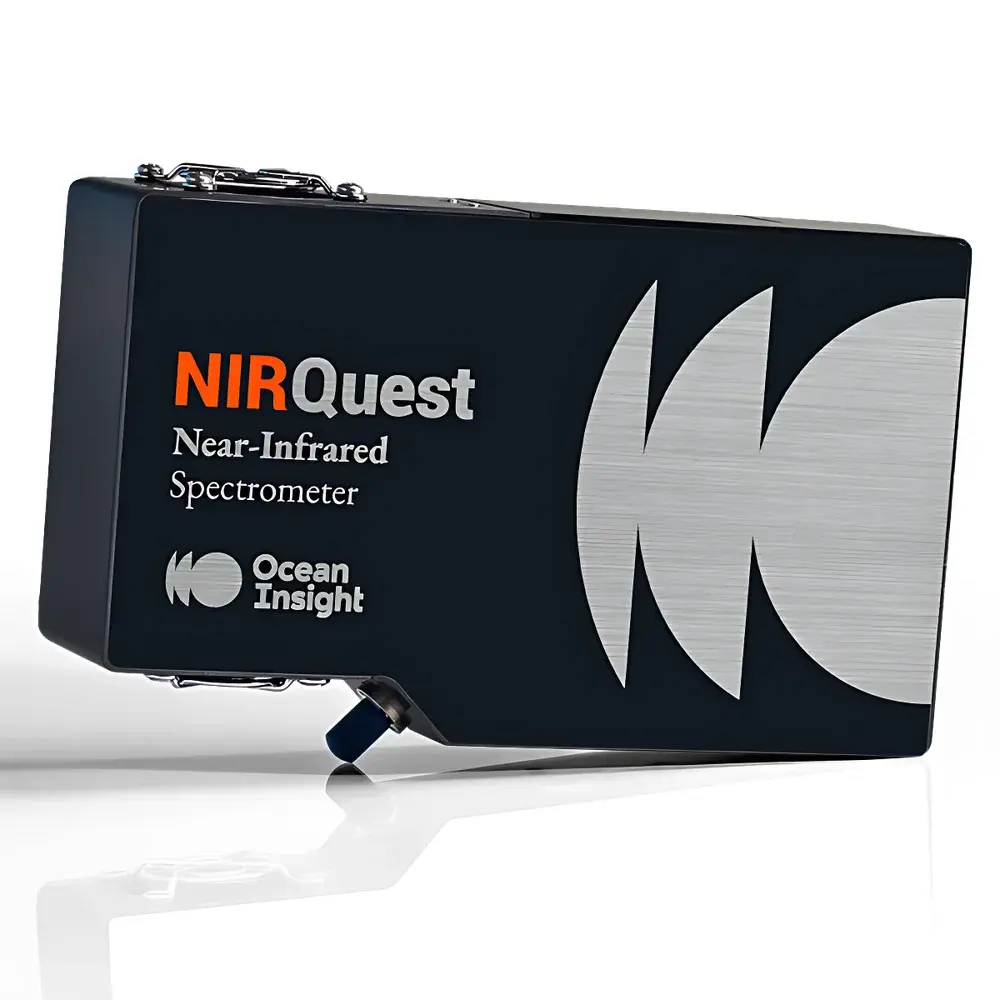
Ocean Optics NIRQuest Near Infrared Spectrometer
| Brand | Ocean Optics |
|---|---|
| Model | NIRQuest |
| Type | Laboratory-grade, Fiber-coupled, Thermoelectrically Cooled InGaAs Array Spectrometer |
| Wavelength Range | 900–1700 nm (standard), up to 2500 nm (optional configurations) |
| Optical Resolution | Configurable via slit width (10–200 µm) and grating selection |
| Detector | Hamamatsu InGaAs linear array (512 or 256 pixels) |
| Cooling | Thermoelectric (TEC), stabilized to ~30 °C below ambient |
| A/D Converter | 16-bit USB interface |
| Integration Time | As low as 1 ms |
| Measurement Modes | Diffuse reflectance, transmission |
| Software Compatibility | SpectraSuite (with spectral acquisition, real-time processing, and basic chemometric tools) |
| Compliance | CE, RoHS, FDA 21 CFR Part 11-ready via optional audit-trail configuration |
| Sample Interface | SMA905 fiber optic connector |
Overview
The Ocean Optics NIRQuest is a laboratory-optimized, fiber-coupled near-infrared (NIR) spectrometer engineered for high-fidelity spectral acquisition in the 900–2500 nm range. Based on the Czerny-Turner optical architecture, it employs thermoelectrically cooled InGaAs linear array detectors (Hamamatsu G9204-512, G9206-256, or G9208-256) to deliver stable, low-noise performance critical for quantitative NIR analysis. Unlike Fourier-transform infrared (FT-IR) systems, the NIRQuest utilizes fixed-grating dispersive optics — enabling rapid, real-time spectral capture with millisecond-level integration times and no moving parts. Its modular design supports seamless integration into benchtop analytical workflows, process monitoring setups, or portable field-deployable configurations. The instrument is optimized for applications requiring robust signal-to-noise ratio (SNR), thermal stability, and reproducible photometric response — particularly where moisture, protein, starch, or lipid content quantification is essential.
Key Features
- Thermoelectric cooling (TEC) stabilizes detector temperature up to 30 °C below ambient, minimizing dark current drift and enhancing long-term measurement repeatability.
- Configurable optical resolution via interchangeable slits (10, 25, 50, 100, or 200 µm) and application-specific gratings — including options covering 900–1700 nm, 900–2100 nm, or 900–2500 nm spectral windows.
- 16-bit USB 2.0 interface ensures high dynamic range and low-latency data transfer; compatible with Windows, macOS, and Linux environments via Ocean Insight’s SDK.
- Crossed-beam Czerny-Turner optical layout provides excellent stray light rejection and consistent linearity across the full spectral range.
- Real-time triggering support (hardware TTL, software, or external sync) enables synchronization with auxiliary devices such as pulsed light sources or automated sample handlers.
- Compact, rugged aluminum housing rated for continuous operation in controlled laboratory environments (20–30 °C, <70% RH non-condensing).
Sample Compatibility & Compliance
The NIRQuest interfaces exclusively via SMA905 fiber optic coupling, supporting standardized probe geometries for diffuse reflectance (e.g., bifurcated reflection probes), transmission (flow cells, cuvettes), and contact-based measurements (contact probes for granular solids or pastes). It is routinely deployed in grain quality assessment (moisture, protein, oil content per ISO 12099:2017), pharmaceutical raw material identification (per USP ), and environmental water analysis (e.g., dissolved organic carbon estimation). The system complies with CE and RoHS directives. When paired with SpectraSuite’s optional audit-trail module and user-access controls, it meets foundational requirements for GLP and GMP environments under FDA 21 CFR Part 11 for electronic records and signatures.
Software & Data Management
SpectraSuite — Ocean Insight’s native spectral acquisition and visualization platform — provides real-time spectrum display, baseline correction, peak integration, and export in CSV, TXT, or JCAMP-DX formats. While the base software does not include advanced chemometric modeling (e.g., PLS regression or PCA), it exports calibrated intensity data directly to third-party platforms such as MATLAB, Python (via NumPy/Pandas), Unscrambler X, or Pirouette for full multivariate calibration development. The SDK includes C++, C#, Python, and LabVIEW drivers, enabling custom automation for high-throughput screening or inline process control architectures.
Applications
- Food & Agriculture: Rapid quantification of moisture, protein, starch, and fat in cereals, legumes, and dairy powders using established PLS models trained on reference wet chemistry data.
- Pharmaceuticals: Identity verification of excipients and active pharmaceutical ingredients (APIs) in blend uniformity studies and tablet coating thickness estimation.
- Environmental Monitoring: Screening of dissolved organic matter (DOM), nitrate, and total petroleum hydrocarbons (TPH) in aqueous matrices using spectral fingerprinting techniques.
- Materials Science: Characterization of polymer composition, crystallinity, and degradation state in polyolefins and bioplastics.
- Research & Development: Method development for non-destructive, reagent-free analysis in academic and industrial labs seeking alternatives to FT-IR or benchtop NMR for routine screening.
FAQ
What wavelength ranges are available for the NIRQuest series?
The NIRQuest is offered in three primary configurations: NIRQuest512 (850–1700 nm), NIRQuest256-2.1 (900–2100 nm), and NIRQuest256-2.5 (900–2500 nm). Grating and slit selection further define effective resolution and throughput.
Is the NIRQuest suitable for regulated pharmaceutical QC environments?
Yes — when deployed with validated SpectraSuite configurations, electronic signature protocols, and full audit-trail logging enabled, it supports compliance with FDA 21 CFR Part 11 and EU Annex 11 requirements for analytical instrumentation.
Can I use my own chemometric models with the NIRQuest?
Absolutely. SpectraSuite exports radiometrically calibrated spectra in standard formats; these datasets are fully interoperable with commercial and open-source chemometrics software for model training, validation, and deployment.
Does the instrument require external cooling or power conditioning?
No. The integrated TEC and internal voltage regulation eliminate the need for external chillers or uninterruptible power supplies under standard lab conditions. Ambient temperature stability remains critical for optimal long-term calibration retention.
How is wavelength calibration maintained over time?
Each unit ships with factory-applied Hg/Ar lamp calibration and supports user-initiated recalibration using optional calibration sources. Drift is typically less than ±0.2 nm over 8 hours at constant ambient temperature.




